Category: Uncategorized

  • What Happens If Someone Survives an Execution Attempt?

    What Happens If Someone Survives an Execution Attempt?

    What Happens If Someone Survives an Execution Attempt?

    Someone is taken into an execution chamber. The procedure begins. Then something goes wrong, and the prisoner is still alive.

    The obvious question is also the hardest to imagine asking: What happens now?

    In the United States, surviving an execution attempt does not automatically erase the death sentence. The prisoner remains in custody, may need urgent medical treatment, and can face another execution attempt if the necessary legal authorization remains or is obtained. The Supreme Court has permitted a second attempt under particular circumstances. 

    But that does not mean officials have unlimited permission to keep trying. Court orders, state law, the prisoner’s condition, and decisions by the governor can change what happens next.

    There are two separate questions: what happens to the person immediately, and what happens to the sentence afterward.

    Does Surviving an Execution Mean You Go Free?

    No. There is no automatic rule that surviving an execution earns a prisoner their freedom.

    One of the clearest examples is Willie Francis. After Louisiana’s electric chair failed to kill him in 1946, he was removed from the chair and returned to prison. His death sentence remained in place, and the state sought to carry it out again. 

    That distinction is easy to miss. An execution attempt is the state’s effort to carry out a sentence. If the attempt fails, that does not, by itself, overturn the conviction or replace the sentence.

    I understand why people might assume otherwise. Enduring the procedure feels like something that should fundamentally change the situation.

    Legally, however, survival alone does not produce a new judgment.

    The same question came up during the reporting surrounding Christa Pike’s interrupted execution attempt. Understanding what happened during a particular procedure requires a separate account from understanding what the law may allow afterward.

    What Happens Immediately After the Attempt Stops?

    The immediate concern is the prisoner’s condition.

    Depending on what occurred, that may involve assessing injuries, providing treatment, or transferring the person for additional care. The exact response will depend on the medical situation and the orders governing the interrupted procedure.

    In Pike’s case, her attorneys filed an emergency motion asking for the execution to stop and lifesaving measures to begin. That was a request for intervention, not proof that the court had already granted it. 

    Medical treatment does not automatically cancel the sentence. And the existence of a death sentence does not answer what treatment someone needs after an interrupted attempt.

    This is why a developing report can contain several different events: an execution is stopped, lawyers seek emergency relief, medical care is requested, and the legal dispute continues.

    Those events are connected, but they are not interchangeable.

    Can the State Try to Execute the Person Again?

    Yes, a second execution attempt can be legally possible.

    The important qualification is that it must comply with the applicable law and court orders. A previous failure does not settle every legal challenge to another attempt.

    The Willie Francis Case

    In Louisiana ex rel. Francis v. Resweber, decided in 1947, the U.S. Supreme Court allowed Louisiana to proceed with another execution attempt after the electric-chair failure.

    Francis argued that another attempt would violate constitutional protections, including those involving double jeopardy and cruel and unusual punishment. The Court rejected those objections under the circumstances before it, treating the failed attempt as an accidental equipment failure rather than intentional mistreatment. 

    That ruling permitted another attempt in that case. It was not a declaration that every failed execution, however it happens, can lawfully be repeated.

    The reason for the failure and the risks of a proposed second attempt still matter.

    Kenneth Smith Faced a Second Attempt With a Different Method

    A much more recent example is Kenneth Eugene Smith.

    Alabama’s November 2022 attempt to execute Smith by lethal injection failed because officials could not establish the necessary intravenous access. That history appears in the court documents concerning his later execution. 

    Alabama subsequently executed him by nitrogen hypoxia on January 25, 2024, according to the state Department of Corrections. 

    His case shows that a failed attempt can be followed by another date and another method.

    It also highlights an important distinction: an attempt stopped before lethal drugs are administered is different from an attempt in which drugs are reportedly administered but do not produce the expected outcome.

    Both can be described as failed execution attempts. Their medical facts are different.

    Is a Second Attempt Double Jeopardy?

    A second execution attempt is not automatically barred as double jeopardy.

    In the Francis case, the Supreme Court rejected the argument that another attempt following an accidental failure violated the constitutional protection being asserted. 

    The practical distinction is between prosecuting someone again for an offense and attempting to complete an existing sentence.

    That does not make a second attempt free from constitutional scrutiny. It means the phrase “double jeopardy” does not, on its own, resolve the question.

    I think this is where the legal answer and the emotional response can feel especially far apart. Someone can find the idea of repeating the procedure deeply troubling while still recognizing that courts have allowed it.

    Do Officials Try Again That Night?

    There is no nationwide answer.

    An execution may be governed by a specific date or time window. Whether officials can continue depends on that authorization, any court intervention, the applicable procedure, and what has happened medically.

    For Smith’s January 2024 execution, Alabama announced a defined window beginning at midnight on January 25 and ending at 6 a.m. on January 26. That illustrates why the actual authorization matters. 

    An execution window is not a guarantee that an attempt will continue throughout it. It establishes a time limit within which other legal and practical requirements still apply.

    If the authorization expires, officials cannot simply assume it remains valid indefinitely. The process for securing a future date depends on the jurisdiction.

    Does Surviving Mean a Guaranteed Waiting Period?

    No universal waiting period follows every unsuccessful attempt.

    A useful Tennessee example involves Tony Von Carruthers. On May 21, 2026, Governor Bill Lee announced that he was granting Carruthers a one-year temporary reprieve. 

    The one-year delay was an executive decision in that case. It should not be treated as a general rule for everyone whose execution is interrupted.

    That matters when reading headlines. A report that one prisoner received a year-long reprieve does not establish that another prisoner will receive the same delay.

    Can the Sentence Be Changed to Life in Prison?

    A death sentence can be changed through an appropriate legal ruling or clemency decision. The unsuccessful attempt itself does not automatically make that change.

    Three terms help explain the possible developments.

    A Stay Pauses the Execution

    A stay blocks an execution while it remains in effect. It does not necessarily overturn the conviction or permanently eliminate the death sentence.

    A Reprieve Postpones It

    A reprieve delays the execution. Carruthers’ announced one-year reprieve is an example of a postponement rather than an announcement that his sentence had been reduced. 

    A Commutation Changes the Punishment

    A commutation reduces or replaces the sentence through the authorized clemency process. Its availability and requirements depend on the jurisdiction.

    A delay and a reduced sentence are different outcomes. Knowing which one occurred is more useful than a headline saying the prisoner was “spared.”

    Can Officials Switch to Another Execution Method?

    Sometimes, but a failed attempt does not create permission to choose any method.

    The replacement must be authorized under the relevant law and remain subject to legal challenges.

    Smith’s case provides a documented example: the failed lethal injection attempt was followed by proceedings concerning nitrogen hypoxia, and Alabama ultimately used that method. 

    That sequence should not be mistaken for a universal procedure. Another state may have different authorized methods, different selection rules, or a court order preventing a proposed approach.

    Why “They Survived” May Not Tell the Whole Story

    The phrase sounds final. In a developing story, it may describe only a moment.

    A prisoner might be reported alive when witnesses leave, while their later medical condition is still unknown. Alternatively, an attempt might be abandoned before the lethal substance is administered.

    Those situations should not be collapsed into the same account.

    When reading coverage such as the reports from Christa Pike’s execution attempt, I look for the point in time the statement describes. Was the person alive during the procedure? When it stopped? After treatment?

    A report of survival at one stage does not establish recovery, release, or the cancellation of a sentence.

    Questions About Surviving an Execution Attempt

    Has anyone faced another execution after a failed attempt?

    Yes. Kenneth Smith underwent an unsuccessful lethal injection attempt in November 2022 and was executed by nitrogen hypoxia in January 2024. 

    Does the first attempt count as serving the death sentence?

    Surviving an attempt does not automatically mean the sentence has been legally satisfied. The Supreme Court permitted another attempt in the Willie Francis case. 

    Do they have to hold another murder trial?

    Not simply because the execution failed. A proposed second attempt generally concerns carrying out the existing sentence. A new trial would require a separate legal basis.

    Can lawyers ask a court to stop another attempt?

    Yes. The Francis and Smith cases both involved legal challenges to a proposed execution after an earlier attempt failed. Whether a court grants relief depends on the claims and circumstances. 

    Does a hospital transfer mean the person will recover?

    No. A transfer indicates a change in where care is being provided. It does not, by itself, establish the person’s prognosis or eventual outcome.

    About this article: This is a factual explainer based on real court decisions and documented cases, not original fiction. Written by the Stories in the Static editorial team, with first-person interpretation separated from the legal and historical record.

  • What Happened During Christa Pike’s Execution Attempt?

    What Happened During Christa Pike’s Execution Attempt?

    Tennessee inmate gets two lethal injections and still alive

    The headline seemed almost impossible: a Tennessee death row prisoner had received two lethal injections, but her lawyers said she was still alive.

    On September 30, 2026, Christa Pike’s scheduled execution became an unfolding emergency. Instead of a straightforward announcement that her sentence had been carried out, reports described breathing sounds, closed curtains, emergency legal filings, and unanswered questions. 

    The central fact needs careful wording: Pike’s attorneys reported that she remained alive after the injections. That report did not establish her eventual medical outcome.

    What happened that night deserves more than a shocking headline. It also deserves a clear distinction between what people witnessed, what lawyers alleged, and what officials had explained.

    Reporting cutoff: September 30, 2026, at approximately 10:35 p.m. Central. This account reflects information available during a developing story.

    What Happened During Christa Pike’s Execution Attempt?

    Did Christa Pike Survive the Lethal Injections?

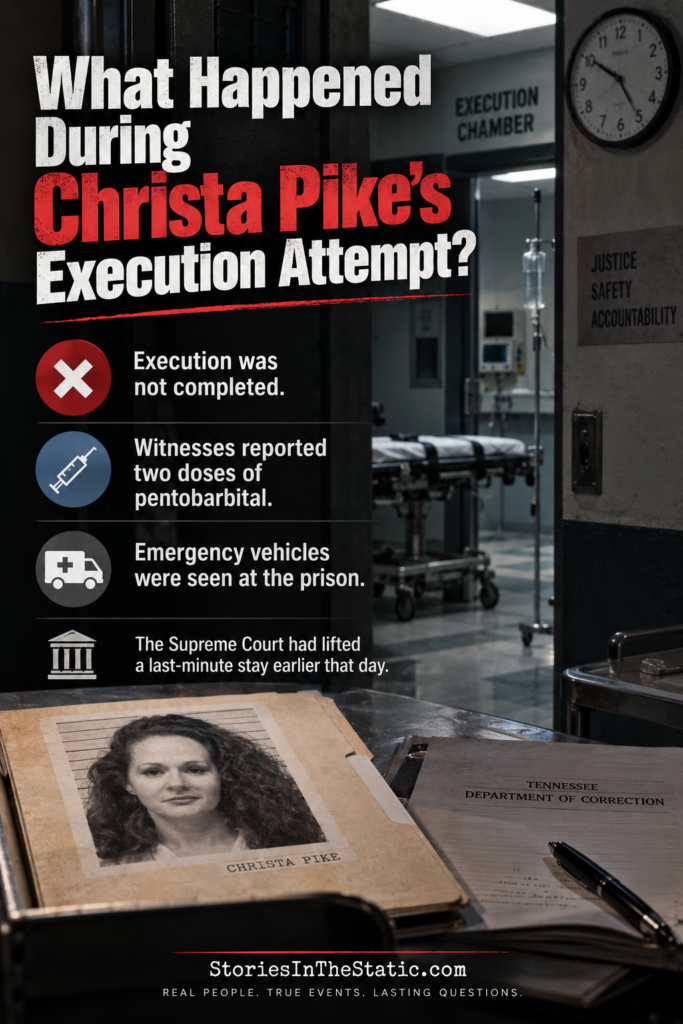
    According to her defense team, Pike remained alive after receiving two syringes of the lethal injection drug.

    WVLT reported that assistant federal defender Luke Ihnen confirmed the injections and said her attorneys had filed an emergency motion seeking to stop the execution. At this reporting cutoff, her longer-term condition remained unresolved in the reporting reviewed for this article.

    There is a meaningful difference between saying someone was reported alive during an execution attempt and saying that person survived it with a known medical outcome.

    The first describes an observation at a particular moment. The second requires information about what happened afterward.

    If you arrived here from a screenshot saying “still alive after two lethal injections,” that distinction is the first thing to understand.

    Pin

    What Witnesses Could See, and What They Couldn’t

    Perhaps the most unsettling part of the early accounts was the interrupted view.

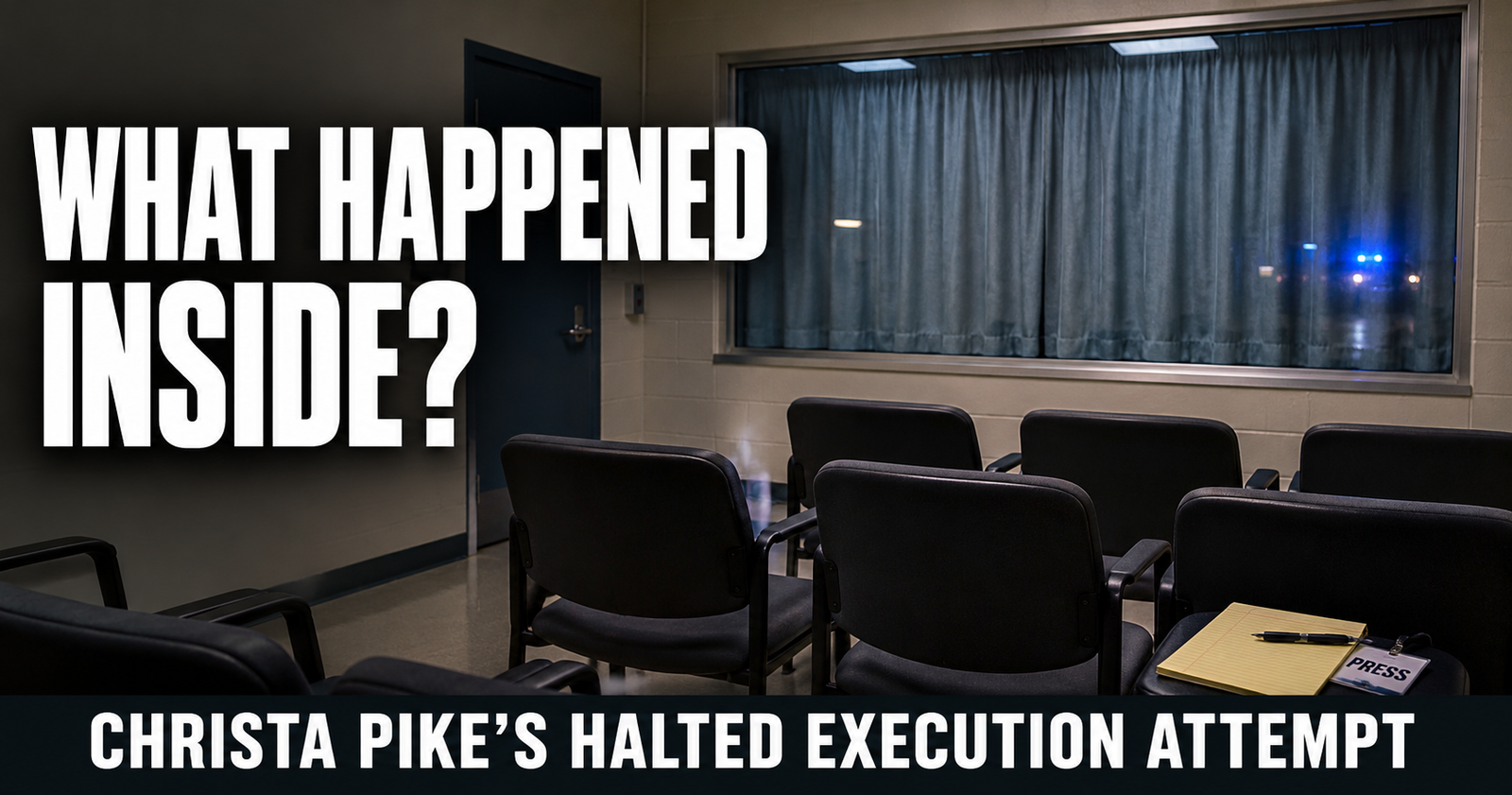
    WVLT published a witness timeline describing curtains opening and closing during the procedure. Witnesses were escorted out of the viewing room at 8:53 p.m. Central. Reporter Will Puckett described sounds resembling heavy snoring, while other accounts described Pike complaining about pain in her arm. 

    Those accounts matter. But a witness watching through a window cannot provide a complete medical explanation of what is happening inside an execution chamber.

    An observation about a sound is not a diagnosis. A closed curtain leaves a gap in the public account.

    That is the detail that stands out most to me. Readers can easily picture an execution as one continuous, witnessed procedure. The accounts emerging that night described something harder to reconstruct.

    When the view disappeared, so did the witnesses’ ability to explain what happened next.

    What Her Lawyers Said in the Emergency Motion

    WSMV reported that Pike’s attorneys filed an emergency motion alleging that both syringes of pentobarbital had been administered, but that she still had a heartbeat and had not lost consciousness.

    The filing described her as “still alive and snoring” and asked for the execution to stop and lifesaving measures to begin. Those were statements from her legal team, rather than independent medical findings published by the state. 

    The request changed the immediate question.

    Earlier, the dispute had been whether the execution should proceed. Now, her attorneys were asking a court to intervene in a procedure already underway.

    A motion asking for emergency relief is not itself a court order granting that relief. Keeping those two steps separate is essential when following a rapidly changing case.

    Were Ambulances Called to the Prison?

    WSMV reported observing ambulances arrive at the prison and leave afterward with police vehicles following. That observation alone did not establish who was transported or their condition. 

    Tennessee Lookout separately reported that a spokesperson for the U.S. Campaign to End the Death Penalty said Pike had been taken to a hospital. The group did not know her medical status. That hospital-transfer account was attributed to an advocacy organization, not presented as a medical update from the Tennessee Department of Correction.

    This is where breaking stories can become misleading without anyone inventing an entire event.

    An ambulance is observed. A transfer is reported. Someone online fills in the outcome.

    Those are separate pieces of information. They should stay separate until evidence connects them.

    Why Was Christa Pike on Death Row?

    Behind the execution headlines was the killing of Colleen Slemmer, a 19-year-old student at a job-training facility in Knoxville.

    Pike was 18 when Slemmer was killed in 1995. Pike and her boyfriend were convicted in the case, and Pike received a death sentence. By the scheduled execution in September 2026, she was 50. 

    Slemmer’s mother, May Martinez, told the Associated Press that she wanted the sentence carried out after decades of waiting. 

    I think a responsible account has to hold two things in view: the person whose life was taken and the questions surrounding the state’s attempt to carry out a sentence.

    Examining the execution does not require minimizing the murder. Remembering Colleen does not require guessing what happened inside the chamber.

    Why Did the Execution Proceed After a Court Had Stopped It?

    Earlier on September 30, a federal appeals court temporarily stayed Pike’s execution.

    The Sixth Circuit sought more time to consider issues involving her childhood abuse history and its treatment during sentencing. Tennessee appealed, and the U.S. Supreme Court lifted the stay that evening. Justices Sonia Sotomayor, Elena Kagan, and Ketanji Brown Jackson dissented. 

    That sequence explains why early headlines appeared to contradict one another.

    A headline saying the execution was halted could accurately describe the morning’s court action. A later headline saying it could proceed could accurately describe the Supreme Court’s decision.

    Neither headline, by itself, explained what happened during the subsequent execution attempt.

    The court dispute before the injections and the emergency filings afterward were different stages of the same night.

    Why Didn’t the Injections Produce the Expected Outcome?

    At this reporting cutoff, the available accounts did not establish a verified medical explanation.

    The Associated Press reported that authorities appeared to administer two doses of pentobarbital and that a corrections spokesperson could not immediately explain what had happened. 

    That leaves a question, not permission to choose the most dramatic answer.

    I would not treat reports of snoring, arm pain, or an extended procedure as proof of a particular cause. Explaining the outcome would require medical records, a documented account of the administration, and qualified review.

    The honest answer to “How could this happen?” was still incomplete.

    The Questions an Official Account Needs to Answer

    The most useful next update would be a documented sequence of events.

    That means explaining when the drugs were administered, what staff observed afterward, what happened while the curtains were closed, when the procedure was stopped, and what medical treatment followed.

    Pike’s condition is another essential part of that account.

    To me, these are the questions that make the story worth following. The headline captures attention, but the timeline determines what readers can actually understand.

    Until those details are established, the uncertainty should remain visible.

    What Happens If Someone Survives an Execution Attempt?

    Surviving an execution attempt does not automatically cancel a death sentence or mean the prisoner goes free. It can lead to emergency medical treatment, additional court proceedings, a delay, and potentially another attempt.

    What happens next depends on the prisoner’s condition, the execution authorization, court orders, and any action by the governor.

    The Immediate Question Is Medical Care

    When an execution is interrupted and the prisoner remains alive, their medical condition becomes an urgent concern.

    In Pike’s case, her attorneys asked the courts to stop the procedure and require lifesaving measures. That was a request for emergency intervention, not proof that a judge had already granted it. WSMV also reported seeing ambulances arrive and depart. 

    Stopping the execution and treating the prisoner are separate decisions from what happens to the death sentence afterward.

    Can the State Try to Execute the Person Again?

    A second attempt can be legally possible. There is no automatic “you survived, so you’re free” rule.

    In the 1947 case Louisiana ex rel. Francis v. Resweber, the U.S. Supreme Court allowed Louisiana to attempt another execution after an electric-chair malfunction failed to kill Willie Francis. The Court treated the first attempt as an accidental failure and rejected the constitutional objections to another attempt under those circumstances. 

    That decision does not establish that every second attempt is lawful regardless of what happened. The circumstances, alleged suffering, execution method, and applicable court orders still matter.

    For Pike, the possibility of another attempt should not be confused with an announced decision to make one.

    Would They Try Again Immediately or Set Another Date?

    There is no single timetable that applies to every failed execution.

    Tennessee’s Supreme Court rules provide a process for the state attorney general to request an execution date when no date is in effect. A future attempt would have to comply with the applicable authorization and any intervening court orders or reprieve. An unfinished execution does not create open-ended permission to continue whenever officials choose.

    A delay can also come from the governor. After Tennessee’s unsuccessful attempt to execute Tony Von Carruthers in May 2026, Governor Bill Lee announced a one-year temporary reprieve. That was a specific decision in Carruthers’ case, not a guaranteed waiting period for every prisoner who survives an attempt. 

    Could the Death Sentence Be Changed to Life in Prison?

    That is a possible outcome through a separate legal ruling or executive clemency decision. It does not happen automatically because an execution failed.

    A reprieve postpones an execution. A commutation reduces or changes the sentence. A court-ordered stay temporarily blocks the execution while legal issues are addressed.

    Those terms can sound interchangeable in breaking headlines, but they describe different outcomes.

    What Does That Mean for Christa Pike?

    At this article’s reporting cutoff, the accounts reviewed did not establish Pike’s final medical outcome or an announced schedule for another execution attempt.

    The next developments to watch are her condition, official confirmation of whether the procedure was terminated, rulings on the emergency filings, and any new execution order or action by the governor.

    My biggest takeaway is that surviving the procedure and having the sentence lifted are two very different things.The first would leave urgent medical and legal questions. The second would require a separate decision.

    Questions About Christa Pike’s Execution Attempt

    Was Christa Pike still alive after two lethal injections?

    Her defense team reported that she was. That statement described her condition during the attempted execution and did not establish her eventual outcome. 

    What drug was reportedly used?

    Her attorneys’ emergency filing identified pentobarbital and alleged that both syringes had been administered. 

    Did surviving the attempt mean she was released?

    The reporting reviewed for this article did not announce her release or the cancellation of her conviction. An interrupted execution and a change to a criminal judgment are separate matters.

    Was she taken to a hospital?

    Tennessee Lookout attributed a hospital transfer to a spokesperson for an anti-death-penalty organization. The spokesperson did not know her medical status, so that report should not be read as confirmation of recovery. 

    Is this a true story?

    Yes. This article covers a real criminal case and reported events surrounding the September 30, 2026, execution attempt. The developing medical outcome and the explanation for what happened remained unresolved at the stated reporting cutoff.

    About this story: This is a real, documented case, not original fiction. Written by the Stories in the Static editorial team using attributed news reports, with first-person commentary clearly separated from reported facts.

  • Why Does UVB-76 Keep Buzzing? The Russian Radio Mystery

    Why Does UVB-76 Keep Buzzing? The Russian Radio Mystery

    Why Does UVB-76 Keep Buzzing? The Russian Radio Mystery

    A repeating buzz is not much of a radio program.

    There is no host welcoming listeners. No playlist. No explanation of what comes next.

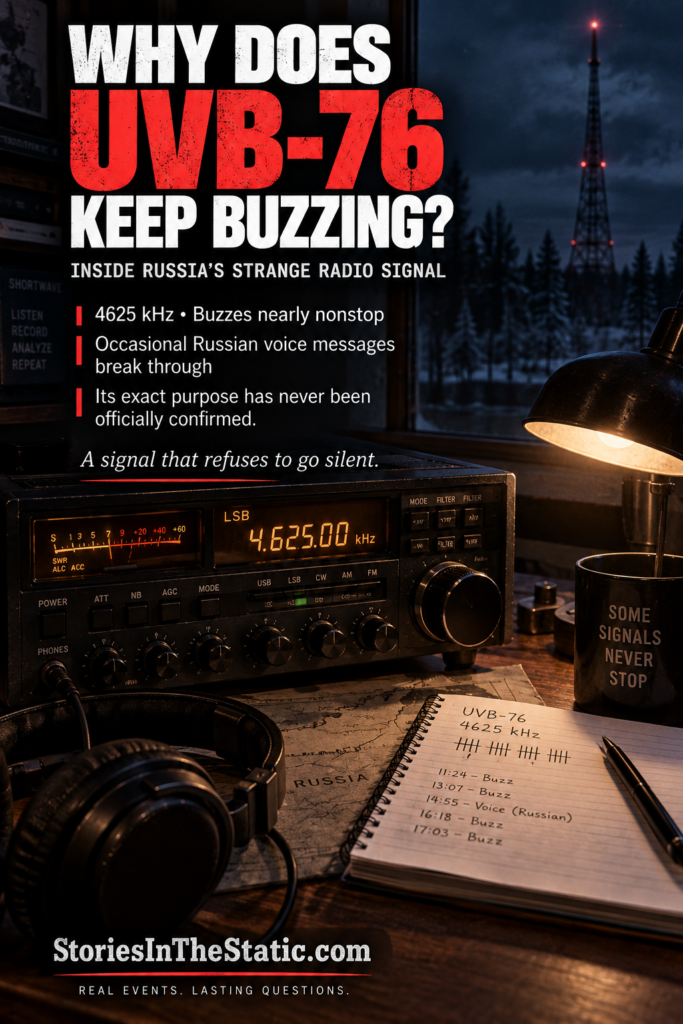
    Yet a Russian shortwave signal known as UVB-76, or “The Buzzer,” has attracted listeners for decades. Usually, it broadcasts its familiar repeating sound. Sometimes, a voice interrupts with Russian words and numbers. The station is monitored on 4625 kHz. 

    That change is the hook: a sound you could ignore for hours suddenly becomes a message you cannot understand.

    The best-supported public explanation is a Russian military communications network using the buzz as a channel marker. The much more dramatic claim that silence would automatically trigger nuclear war is not supported by the specialist monitoring sources examined here. 

    I think the real story is interesting enough without turning every pause into a countdown.

    Pin

    The Buzz Is the Part Everyone Notices

    “The Buzzer” is an unusually honest nickname.

    Its signature sound repeats while the frequency is not carrying other traffic. Radio-monitoring group Priyom identifies that sound as a channel marker, rather than an unexplained message in itself. 

    That changes how I read the station.

    The buzz may seem pointless to somebody expecting entertainment. For a communications network, a recognizable marker can have a practical purpose.

    Think of it as a frequency announcing that it is occupied and active. That is an analogy, not a translation of the sound.

    The buzz is not necessarily the message. It marks the place where messages can appear.

    Then Someone Starts Speaking

    The station also carries live voice transmissions.

    Specialist researchers describe messages containing recipient callsigns, codewords, and groups of numbers. They connect this traffic with Russian military message formats, including those known as “Monolith” messages. 

    The listener can hear the delivery without knowing the instruction behind it.

    That is the distinction I find most compelling. The transmission is publicly audible, but its meaning is intended for particular recipients.

    A strange word might be understandable as a Russian word and still tell an outside listener almost nothing about the order.

    Recognizing the vocabulary is not the same as possessing the information needed to interpret it.

    Why Keep a Frequency Occupied With Noise?

    Numbers Stations Research identifies the buzz as a marker used to keep the channel occupied. Its account also discusses possible use in propagation measurements, which concern how radio signals travel. 

    To an outside listener, repetition creates suspense.

    To an operator, repetition may simply be normal operation.

    That difference explains a lot of the station’s reputation. We hear a sound without seeing the work around it, then supply a story that makes the sound feel meaningful.

    My strongest interpretation is that the buzz serves a routine communications function. The interesting unknown is what particular messages mean, rather than whether the noise itself contains a supernatural secret.

    Even “UVB-76” Has a Twist

    The name most people search for appears to have started with a transcription mistake.

    Priyom identifies UVB-76 as a mistaken rendering of UZB76. Its historical records also list several later collective callsigns used in the network’s messages. 

    I like that detail because it punctures the image of a station frozen in time.

    The familiar internet label stayed popular. The network did not necessarily keep using that same identifier.

    A name can become a brand for a mystery even after it stops accurately describing the traffic.

    Is It a Numbers Station?

    UVB-76 is frequently grouped with numbers stations because its voice messages include numbers and other coded elements.

    But specialist researchers distinguish it from stations used to send intelligence traffic to agents. Numbers Stations Research classifies The Buzzer as a military station, not an espionage numbers station. 

    That distinction matters.

    “Someone is reading numbers” tells us what a listener hears. It does not, by itself, establish who receives the message or what job the network performs.

    I would describe it as a military radio network with coded voice traffic, while acknowledging that much of the public knows it through the broader numbers-station category.

    The Theory That Made It Famous Is Also the Weakest Shortcut

    The doomsday version goes roughly like this:

    The buzz is a signal that Russia remains operational. If it stops, an automatic system launches nuclear weapons.

    That is a terrifying story. It is also a claim requiring evidence.

    Priyom explicitly rejects the idea that The Buzzer functions as that kind of “dead hand” switch. Its explanation instead identifies an operational military communications network. 

    I would not use an online recording of this station to judge whether nuclear war is beginning.

    The public evidence does not establish that relationship.

    A military connection can make a signal important without making every interruption an automatic launch command.

    What Does a Pause Actually Tell Us?

    A pause tells a listener that the usual sound was not received during that period.

    It does not automatically identify the reason.

    Possible explanations to investigate include changes in transmission, equipment problems, interference, or reception conditions. Those are possibilities, not a diagnosis of any specific recording.

    Priyom’s station profile describes a network using multiple transmitter sites and notes equipment and channel-separation problems. 

    That is a more grounded starting point than treating silence as proof of catastrophe.

    I would also distinguish between a station going off air and somebody’s online listening feed failing. A stream adds another system between the transmitter and the audience.

    A silent browser tab is not a complete report on a military network.

    Not Everything on the Frequency Comes From The Buzzer

    This is another detail that can turn an ordinary recording into a misleading headline.

    Other transmissions can interfere with the frequency. Numbers Stations Research documents instances involving music and other unauthorized signals over the channel. 

    Hearing something unusual near The Buzzer does not automatically mean its operators chose to transmit it.

    Before assigning a meaning, I would ask:

    Who recorded it? Is there an identifiable receiver and date?

    Was it the station or interference? Are experienced monitors treating it as genuine network traffic?

    What can actually be established? A recording may demonstrate a sound without proving its source.

    Those questions make a less dramatic headline. They make a more useful investigation.

    My Three Explanations, Ranked by the Evidence

    Military Communications With a Channel Marker

    This is the explanation I find strongest.

    It fits the specialist classification, recognizable message formats, and long-term monitoring records.

    It also explains why the station can be audible without providing public instructions about how to understand it.

    My assessment: well supported by the monitoring sources, although those sources are not an official disclosure of every network function.

    A Role in Readiness, Training, or Testing

    Specialist accounts describe military messages that may relate to readiness and training. 

    That offers a possible explanation for activity that outside listeners cannot connect with a visible event.

    But I would not hear a particular message and confidently declare it a drill. Without the relevant instructions, that would be another guess.

    My assessment: consistent with the military-network explanation; individual transmissions remain difficult to interpret publicly.

    A Publicly Audible Nuclear Trigger

    This is the explanation I find least convincing.

    It relies heavily on the station sounding ominous and being associated with military communications. Neither fact establishes an automatic-launch function.

    My assessment: not supported by the evidence reviewed here.

    What Makes This Different From a Hijacked Broadcast?

    In a television intrusion, an unauthorized person borrows an audience.

    The Buzzer has a different appeal. People voluntarily seek out a communications signal that was never designed as public entertainment.

    The contrast is clear in the real 1977 television interruption attributed to “Vrillon”. That voice claimed to address humanity. The Buzzer’s traffic appears directed toward particular recipients.

    One asks the public to believe a message. The other lets the public hear a message without understanding it.

    To me, the second situation can be just as absorbing.

    Why People Keep Listening

    My interpretation is that the repetition creates an expectation.

    Once you understand the normal pattern, every departure feels significant. A voice appears, the buzz changes, or reception drops, and suddenly you have something to examine.

    The same attention to recordings drives interest in the unresolved Max Headroom television hijacking. A recording gives people something concrete to replay, compare, and argue about.

    But a recording has limits.

    It can preserve an event perfectly well while leaving its meaning unresolved.

    Can You Listen to UVB-76 Yourself?

    Yes. The frequency is publicly receivable with suitable equipment and reception conditions.

    Priyom provides station information and an audio sample. Its FAQ also describes listening through remotely accessible receivers or a shortwave radio tuned to 4625 kHz. 

    If I were starting, I would use a specialist monitoring source before choosing a video labeled “terrifying secret Russian signal.”

    The source matters because an entertaining edit can remove the ordinary stretches, combine unrelated recordings, or present interference as an official transmission.

    A sample demonstrates the sound. A monitoring record supplies context.

    Is UVB-76 real?

    Yes. The Buzzer is a real radio signal documented by specialist listeners, with recordings and activity logs. 

    What frequency does The Buzzer use?

    Its well-known frequency is 4625 kHz, equivalent to 4.625 MHz. 

    Do people know what the messages mean?

    Researchers recognize message structures, but that does not mean the public can translate a particular codeword into the intended military instruction. Priyom’s explanation distinguishes hearing the message from knowing its operational meaning. 

    Does the buzz stopping mean nuclear weapons will launch?

    The specialist sources reviewed here do not support that claim. A pause or lost reception should not be treated as evidence of an impending launch. 

    About this story: UVB-76 is a real, documented radio station, not original fiction. Military-network descriptions are attributed to specialist monitoring sources; the doomsday claim is an unsupported theory. Written by the Stories in the Static editorial team, with first-person analysis distinguished from reported evidence.

  • Was the Vrillon Broadcast Real? The 1977 TV Mystery

    Was the Vrillon Broadcast Real? The 1977 TV Mystery

    Was the Vrillon Broadcast Real? The 1977 TV Mystery

    The television picture kept going. The voice no longer belonged to the program.

    On November 26, 1977, viewers in parts of southern England heard an unfamiliar speaker interrupt their evening television. The voice claimed to represent an extraterrestrial organization and delivered a warning to humanity.

    The interruption became known as the Vrillon broadcast, or the Southern Television broadcast interruption. It was a real intrusion into television audio. That does not establish that the speaker was an alien. 

    That distinction is where I think this story gets interesting.

    Someone apparently made an extraordinary claim through an ordinary television system. Decades later, people still argue about the claim, while some surprisingly basic details of the event remain inconsistent.

    Pin

    A Voice With a Message for Humanity

    The interruption happened shortly after 5 p.m. on a Saturday, during Southern Television’s early-evening programming.

    Accounts describe a distorted voice identifying itself as Vrillon, a representative of the Ashtar Galactic Command. Its message urged humanity to abandon weapons and live peacefully. 

    There was no spacecraft on the screen. No visitor standing beside the newsreader. No demonstration that the speaker possessed knowledge beyond human reach.

    The claim of an alien identity came from the voice itself.

    I would keep that in mind before interpreting anything else. A stranger saying they speak for another civilization is a statement we can investigate, not evidence that the civilization sent them.

    Still, choosing television gave the statement an audience that had not volunteered to hear it.

    The Picture Stayed Familiar. The Sound Did Not.

    The intrusion mainly affected the audio.

    Viewers could continue seeing ordinary programming while hearing the unauthorized message. It was not a complete replacement of the screen with an alien announcement. 

    To me, that mismatch is the most unsettling feature of the incident.

    An obviously separate video might look like an inserted sketch. A voice speaking over a familiar program creates a different question: is this coming from the station, the television, or somewhere else?

    I cannot tell you exactly how every viewer reacted. But I can understand why the combination would be confusing. The picture suggested normal service. The sound suggested somebody else had control.

    How Could a Human Voice Get Into the Broadcast?

    The technical explanation centers on the Hannington transmitter.

    Historical accounts describe Hannington receiving Southern Television’s programming over the air from the Rowridge transmitter, then rebroadcasting it. An unauthorized nearby transmission could interfere with that incoming signal. 

    That is the essential distinction: the audience heard the message through a broadcasting system with a potential point of interference.

    We do not need an extraterrestrial explanation to account for how an outside voice could reach television viewers.

    However, explaining a possible method does not identify the person responsible.

    Those are separate questions. A case can have a plausible technical explanation and still lack a confirmed perpetrator.

    Even the Famous Name Is Less Certain Than It Looks

    “Vrillon” is the name most commonly associated with the event today.

    But historical accounts also record versions such as Asteron and Gillon. The differences appear in reporting and later descriptions of what people heard. 

    I find that detail useful because it pushes back against the polished version of this mystery.

    Online, the story often comes packaged with a definite name, a precise time, a complete transcript, and a confident explanation. The surviving accounts are messier.

    A distorted voice is not an ideal source for spelling an unfamiliar name.

    That does not make the intrusion imaginary. It means the record should retain the uncertainty instead of quietly smoothing it away.

    How Long Did the Vrillon Broadcast Last?

    You will often see the interruption described as lasting six minutes.

    But the published accounts do not all agree.

    An archive-based review identifies a contemporary report describing about three minutes, another describing more than six, and a later broadcasting-history account giving five and a half minutes. 

    I would describe it as lasting several minutes rather than pretend we have an uncontested stopwatch reading.

    It is possible that different accounts measured different things, such as the spoken message versus the entire audio disturbance. That is a possible explanation for the discrepancy, not something I can establish from the sources.

    The disagreement matters because it shows how repetition can turn an estimate into an apparently exact fact.

    My Leading Explanation Is a Deliberate Human Intrusion

    My strongest interpretation is that someone with relevant technical knowledge deliberately placed the message into the broadcast.

    That judgment fits the reported signal arrangement and the carefully constructed speech.

    It does not require us to assume who the person was, whether they worked in broadcasting, or whether they sincerely believed the message.

    There are several possible motives. I would weigh them differently.

    A Technical Prank

    Someone may have wanted to prove that they could interrupt television.

    The alien identity supplied a dramatic disguise. A message to humanity ensured that the stunt would sound larger than a local interference incident.

    Why I find it plausible: the performance depended on claiming an identity, not proving it.

    What remains missing: a verified confession or evidence connecting a particular prankster to the transmission.

    A Sincere Message Delivered Under an Invented Identity

    Another possibility is that the person wanted to promote peace or spiritual beliefs and chose an extraterrestrial speaker to give the message authority.

    The name Ashtar already existed in UFO-contact belief traditions before this broadcast. It was not a concept that first appeared on television that evening. 

    Why I consider this possibility: the speech sounds like an appeal, not simply a random burst of noise.

    Why I would not name a group: resemblance to a belief tradition does not prove that any particular organization carried out the intrusion.

    An Actual Extraterrestrial Communication

    This is the possibility that gives the story its headline.

    It is also the one I find least supported.

    The speaker claimed an alien identity, but the claim supplied no independently verifiable proof of an extraterrestrial source.

    An unidentified human speaker is still a sufficient explanation. Failing to identify that speaker does not turn the broadcast into evidence of alien contact.

    “They Never Found the Person” Is Not Proof of Aliens

    This is the reasoning jump I would avoid most carefully.

    A mystery can remain unresolved because evidence was incomplete, a lead failed, records became difficult to find, or the responsible person stayed quiet.

    None of those possibilities requires an extraordinary source.

    When a stranger calls from an unknown number, not recognizing the voice does not tell us where in the universe the caller lives.

    The same principle applies here. The unanswered identity question is real. The alien interpretation remains unsupported.

    The Most Useful Recent Detail Is About the Archive

    In May 2026, Ofcom responded to a request for a recording and archival material concerning the interruption.

    The regulator said it did not hold the requested information. It explained that material it had held from the earlier broadcasting authorities had been transferred to Bournemouth University and suggested directing the inquiry there. 

    That is a small administrative detail, but I think it is more valuable than another dramatic theory.

    It provides a possible direction for research.

    It also prevents a misleading conclusion. Ofcom saying it does not hold a tape is not the same as saying no tape exists anywhere. It is certainly not proof that somebody destroyed evidence.

    The response identifies an archive location to investigate, without promising what that archive contains.

    Was the Person Behind Vrillon Ever Identified?

    I did not find a publicly verified identification supported by an official case outcome or independently corroborated evidence.

    A 2023 interview about the investigative podcast The Interruption described the continuing search for the person responsible. Its host discussed archival research, leads, and the influence of his own beliefs on the investigation. 

    I appreciate that last point.

    Investigating a strange event means deciding where to look. If you begin convinced it was an alien message, you may spend your time examining UFO beliefs. If you begin convinced it was a broadcasting prank, you may search technical communities.

    Neither starting point guarantees that you will find the right person.

    A good theory should guide a search while remaining open to being wrong.

    Why This Story Belongs Beside Max Headroom

    Ten years after the Southern Television incident, a masked figure interrupted two Chicago stations.

    The details were different, but the central experience was similar: ordinary television suddenly carried something its audience was not supposed to see or hear.

    Our account of the unidentified people behind the Max Headroom hijacking examines the recordings, technical explanations, and limits of the available evidence.

    What connects the stories for me is the use of a disguise. One intrusion offered a mask. The other offered a claimed identity.

    Both encouraged viewers to concentrate on the character while the actual operator stayed out of sight.

    Captain Midnight Offers a Useful Comparison

    The earlier HBO intrusion known as Captain Midnight gives us a different outcome.

    Investigators connected that broadcast to John MacDougall, and the case ended with a guilty plea.

    In the evidence trail that exposed HBO’s Captain Midnight, the equipment and circumstances helped turn an anonymous message into an identifiable act.

    That comparison keeps me grounded when reading about Vrillon.

    Broadcast intrusions can be human acts with discoverable perpetrators. When one remains unresolved, I would investigate what evidence is missing before reaching for a more extraordinary explanation.

    Was the Vrillon broadcast a real event?

    Yes. The Southern Television audio interruption was a real, reported event. Calling it real does not validate the voice’s claim to represent aliens. 

    Did it interrupt every television in Britain?

    No. Accounts place the affected broadcast in parts of southern England served by the relevant transmission system. It was not a nationwide takeover of every television channel. 

    Was the message definitely six minutes long?

    Six minutes is widely reported, but accounts differ. Several minutes is a more cautious description when discussing the conflicting record. 

    What do I think happened?

    I think a technically capable person or group used an alien identity to deliver a deliberate message through a vulnerable broadcast system. Whether the motive was humor, belief, publicity, or something else remains uncertain. That is my interpretation, not a solved finding.

    About this story: This is a real, documented broadcast interruption, not original fiction. The alien identity was the speaker’s claim, not an established fact. Written by the Stories in the Static editorial team, with first-person interpretations clearly distinguished from documented evidence.

  • Was the Max Headroom Hijacker Ever Caught? The Real Story

    Was the Max Headroom Hijacker Ever Caught? The Real Story

    Was the Max Headroom Hijacker Ever Caught? The Real Story

    Someone interrupted the evening news wearing a rubber mask. The station stopped the intrusion, restored its programming, and continued the broadcast.

    About two hours later, the masked figure appeared on another channel.

    This time, the interruption lasted longer. There was distorted speech, a moving metal backdrop, and a performance that became increasingly bizarre. Then the picture disappeared, and the scheduled program returned.

    That happened in Chicago on November 22, 1987. Two television stations had been hijacked in one night. The people behind the Max Headroom incident have never been publicly identified through a confirmed investigation. The available record still describes an unresolved case. 

    What makes this story unsettling is that the footage survives. We can see what viewers saw. We can hear much of what they heard.

    But seeing someone perform a crime is different from knowing who they are.

    Pin

    The First Interruption Was Over Almost Immediately

    The first target was WGN-TV.

    At approximately 9:14 p.m., during the station’s evening sports coverage, an unauthorized image replaced the broadcast. A person wearing a Max Headroom mask swayed in front of a corrugated metal background. There was no intelligible speech.

    The intrusion lasted less than half a minute. A WGN engineer changed the frequency of the link carrying programming from the studio to its transmitter, breaking the interfering signal’s hold. Contemporary reporting described the interruption as 28 seconds. 

    That first appearance could have remained a strange local television incident: a brief interruption, an apology, and a return to the sports report.

    Instead, the person or group responsible tried another station.

    Then the Figure Appeared During Doctor Who

    Later that evening, WTTW viewers were watching Doctor Who when their program disappeared.

    The masked figure returned in a longer intrusion, this time with audible but distorted speech. The segment lasted approximately 90 seconds.

    In WTTW’s retrospective, air director Paul Rizzo recalled the staff’s growing stress as the station remained unable to remove the unwanted broadcast. The pirate signal eventually disappeared on its own, and Doctor Who resumed. 

    That difference between the two intrusions matters.

    WGN interrupted the intruder. At WTTW, the staff could not immediately regain control.

    For viewers, both appeared on the same familiar device in their living rooms. Behind the scenes, the stations faced different circumstances when trying to restore their programming.

    What Was Actually in the Broadcast?

    The recording is strange, but it is not completely random.

    The figure wore a mask and sunglasses, moving in front of a metal panel that imitated the real Max Headroom character’s shifting background. The distorted speech included a reference to WGN personality Chuck Swirsky.

    The performer also held up a Pepsi can and used the advertising phrase “Catch the wave,” a joke involving a character associated with Coca-Cola commercials. Contemporary reporting documented those details. 

    The segment ended with a crude prank involving another participant before normal programming returned.

    There is no need to reproduce the explicit portion to understand the case. The important point is that the intrusion was a prepared performance, rather than an unexplained picture accidentally appearing on a television.

    Someone wanted an audience.

    The unresolved question is what they wanted that audience to understand.

    Why Use Max Headroom?

    Max Headroom was an established television character, not an identity invented for the hijacking.

    The character’s artificial-looking presentation, irregular speech, and association with television made the disguise recognizable. His fictional world also involved the power of broadcasting and unauthorized transmissions. 

    That made the choice particularly fitting for a real intrusion into television programming.

    Still, the choice of character does not establish a motive. It could support several interpretations: a parody, a technical stunt, a complaint about broadcasting, or an attempt to create something people would remember.

    A fitting costume is evidence of a deliberate choice. It is not proof of the reason behind that choice.

    That distinction is easy to lose when a mystery has been retold for decades.

    How Could Someone Hijack a Television Station?

    The leading technical explanation involves the links carrying programming from the stations’ studios to their transmission sites.

    An interfering microwave signal could overwhelm the legitimate signal being received at the broadcast facility. Contemporary engineers discussed that possibility immediately after the incident. 

    This was not the same as breaking into a modern streaming account. It involved broadcast equipment and knowledge of the transmission system.

    WTTW engineer Al Skierkiewicz later described the necessary expertise as a combination of broadcast, satellite, or amateur-radio knowledge. 

    The technical explanation helps make the event understandable. It also supplies a useful boundary: this was not something an ordinary viewer could accomplish simply by owning a television.

    But knowing what skills an intruder probably needed does not identify the intruder.

    What Investigators Had to Work With

    The Federal Communications Commission investigated.

    People who had seen the interruptions offered recordings, giving investigators material to examine rather than relying entirely on witnesses’ memories. That cooperation was reported shortly after the hijacking. 

    The footage provided the mask, background, speech, references, and visible performance.

    Each detail might narrow a search. None necessarily points to a unique person.

    A reference to a local broadcaster could come from an employee, a former employee, or a viewer. Technical ability could belong to someone working in broadcasting or someone with relevant experience elsewhere.

    The temptation is to turn those possibilities into a profile so precise that it feels like an identification. The evidence does not justify that step.

    Was It an Inside Job?

    An inside job is one of the familiar theories.

    The intruder’s technical knowledge and references to WGN make the idea understandable. Someone familiar with broadcasting might know where a system could be interrupted.

    However, there is no confirmed public finding that a station employee carried out the hijacking.

    Historical accounts also discuss people from the amateur-radio or hacker communities as possible participants. Those remain possibilities rather than established identities. 

    My concern with the inside-job theory is how quickly a reasonable question becomes a confident claim.

    “Could an employee have done this?” is fair.

    “An employee must have done this” requires evidence we do not have.

    Did the Equipment Have to Cost a Fortune?

    Early reporting included very high estimates for equipment powerful enough to cause the interference.

    Later reporting presented a different assessment. WIRED described the lead FCC investigator’s view that surplus amateur-radio equipment could have been sufficient, provided the operators had substantial technical knowledge. 

    That disagreement is worth preserving.

    We cannot inspect the actual equipment used, because the perpetrators have not been conclusively identified. Estimates depend on assumptions about how they operated and what equipment they obtained.

    An expensive setup is possible. A less expensive arrangement using surplus equipment is also part of the published discussion.

    Neither estimate supplies a name.

    Captain Midnight Shows What a Solved Case Looks Like

    The Chicago hijacking was not the first widely reported television signal intrusion.

    In April 1986, a man calling himself Captain Midnight interrupted HBO with a message protesting subscription charges. Investigators identified John MacDougall, and the case produced a guilty plea.

    Our account of how investigators caught Captain Midnight after the HBO hijacking follows the transmission requirements, equipment clues, and reported tip that helped narrow that investigation.

    The comparison is useful because both stories involve an unauthorized broadcast, but their outcomes differ.

    Captain Midnight has an identified perpetrator and a documented court outcome. The Max Headroom case has a surviving performance and an unresolved identity.

    A similar crime does not guarantee a similar trail of evidence.

    What Later Retellings Often Make Too Certain

    Some versions of this story turn the unknowns into settled details.

    They describe the intruders as employees, assign them a precise budget, or state that they operated from a particular rooftop. They may also assume that the longer WTTW performance proves WGN was the original target.

    Those ideas can be discussed, but they should be identified as interpretations.

    The broadcast’s references to WGN support interest in that station. They do not reveal every decision made before the intrusion.

    Likewise, a technically plausible location is not a confirmed location.

    An explanation can sound convincing while still depending on facts nobody has established.

    The Recording Answers One Question and Leaves Another Open

    The surviving footage makes it difficult to dismiss the event as an invented internet story. Contemporary reporting and the stations’ own accounts establish that the interruptions happened.

    WTTW later revisited the experience with people who were there, including a viewer and station staff. 

    What the recording cannot do by itself is remove the disguise.

    I think that is why this particular mystery holds attention. Usually, seeing the person responsible feels like a major step toward solving a case.

    Here, the public can watch the performer repeatedly and remain no closer to a confirmed identity.

    Was the Max Headroom hijacker ever caught?

    The available public record does not establish that the perpetrators were caught or conclusively identified. The FCC investigation failed to identify the people responsible. 

    Did the hijacking happen in 1987 or 1989?

    It happened on November 22, 1987. Contemporary newspaper coverage and WTTW’s retrospective support that date. Some later accounts contain an incorrect year. 

    Were both interruptions on the same station?

    No. The first interrupted WGN-TV’s evening news. The second interrupted Doctor Who on WTTW later that night. 

    Was Captain Midnight the person wearing the Max Headroom mask?

    There is no confirmed evidence connecting John MacDougall to the Chicago intrusion. Captain Midnight was a separate, identified perpetrator in the earlier HBO case. The Max Headroom perpetrators remain unidentified in the public record. 

    About this story: This is a real, documented event, not original fiction. Written by the Stories in the Static editorial team using contemporary reporting and broadcaster accounts, with theories clearly separated from established facts.

  • How Was Captain Midnight Caught After Hijacking HBO?

    How Was Captain Midnight Caught After Hijacking HBO?

    How Was Captain Midnight Caught After Hijacking HBO?

    Shortly after midnight on April 27, 1986, someone interrupted HBO with a complaint about the bill.

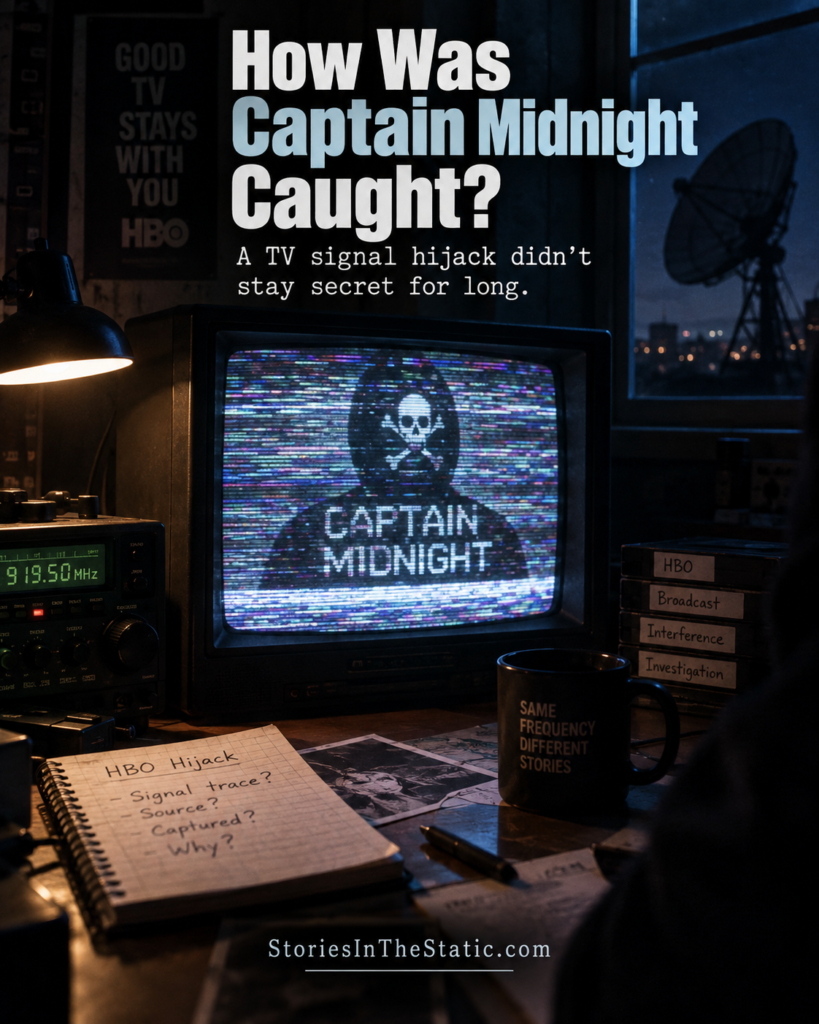
    Viewers watching The Falcon and the Snowman suddenly saw a color test pattern and a message signed “Captain Midnight.” The intruder objected to a $12.95 monthly charge and warned two other movie channels that they could be next. The interruption lasted about four minutes. 

    A nickname hid the person responsible. It did not hide the equipment he had used.

    Captain Midnight was John R. MacDougall, a satellite dish dealer and part-time uplink operator in Ocala, Florida. Investigators narrowed the search using the transmission’s technical requirements, the equipment that produced the lettering, and a tip reported at the time. MacDougall pleaded guilty in July 1986.

    The interesting part is how an anonymous message on a television screen became a trail investigators could follow.

    Pin

    The Man Behind the Message Had Something to Lose

    MacDougall was 25 when authorities identified him. He sold satellite television equipment and also worked at Central Florida Teleport, a facility that transmitted programming to satellites.

    That second job mattered. He had access to equipment capable of sending a signal upward, rather than simply receiving television at home.

    His business supplied the motive. HBO had begun scrambling its satellite programming in January 1986, preventing dish owners from watching without the required decoding equipment and subscription. MacDougall told authorities that the change was hurting his livelihood. 

    From a customer’s perspective, this was a dispute over paying for television. From a dealer’s perspective, the change affected the appeal of an expensive piece of equipment he was trying to sell.

    MacDougall’s response turned that business frustration into a federal case.

    Why Was He Angry About $12.95?

    The number in the message was not random. It referred to HBO’s monthly subscription charge for home satellite viewers.

    HBO began scrambling its signal full time on January 15, 1986. Other premium channels followed that spring. Contemporary reporting described the changes as a blow to home satellite dish sales. 

    The price gives the incident its strange, almost ordinary center. A man with specialized communications access used it to broadcast a complaint that could have appeared in a customer-service letter.

    That contrast makes the case memorable: a familiar grievance delivered through an extraordinary intrusion.

    What Did Captain Midnight Put on the Screen?

    His message identified HBO, signed off with the Captain Midnight name, rejected the monthly price, and warned Showtime and The Movie Channel.

    There was no explanation of who he was. No business address. No face for investigators to identify. Just lettering over a television test pattern. The recorded interruption preserves that simple presentation. 

    I find that restraint more striking than a complicated performance. He did not need an elaborate speech to demonstrate that someone outside HBO could replace its programming.

    The message made two statements at once. One was about subscription prices. The other was about control of the broadcast.

    How Did He Interrupt HBO?

    MacDougall interfered with HBO’s satellite transmission using an uplink facility. His transmission overrode the programming HBO was sending from Long Island, New York. 

    The important distinction is between receiving a signal and transmitting one.

    A household dish owner watching television was receiving programming. MacDougall’s workplace gave him access to the other side of that process.

    Calling the incident a “hack” is understandable, but it can create the wrong picture. This was a broadcast signal intrusion, not a stolen streaming password or a break-in to a modern website.

    The equipment that made the interruption possible also limited the number of plausible suspects.

    How Was Captain Midnight Caught?

    The investigation worked by narrowing possibilities. Authorities did not have to identify every person angry with HBO. They needed to identify a person with the means to transmit that particular interruption.

    The Transmission Required Powerful Equipment

    UPI’s contemporary account reported that investigators reduced a field of roughly 2,000 facilities to fewer than a dozen with the necessary power to disrupt the transmission. 

    That was a major change in the investigation. A television audience could include countless unhappy customers. The list of technically suitable transmission facilities was far smaller.

    The Lettering Was Another Clue

    Investigators also examined how the on-screen text had been generated.

    An industry tribute to broadcaster Kurt Elfers describes the investigation’s analysis of the lettering and its connection to a particular model of character generator, the equipment used to create television text. 

    The distinction matters. A font was a clue to equipment, not a name attached to a person. Its value came from combining it with the other requirements of the intrusion.

    A Reported Tip Helped Narrow the Search

    The July 22 UPI report also described a Wisconsin tourist who overheard a compromising telephone conversation in Florida and supplied a tip. 

    This is why I would be cautious with the neat version that Captain Midnight was caught “because of a font.”

    The contemporary record describes more than one lead. Technical capability, the displayed text, access to a suitable facility, and a reported tip all belong in the account.

    A catchy explanation is not always a complete explanation.

    What Happened When Authorities Identified Him?

    By July 1986, the Captain Midnight nickname had been connected to John MacDougall.

    He pleaded guilty to unlawfully transmitting the interfering signal. A contemporary account described the process as an extensive elimination of possible sources that ultimately led to the Florida operator. 

    The outcome removes one of the ambiguities that surrounds many broadcast-intrusion stories. In this case, there was an identified perpetrator and a guilty plea.

    That gives the mystery a firm ending, even if later retellings disagree about which investigative detail deserves the most credit.

    Did Captain Midnight Go to Prison?

    MacDougall received a $5,000 fine and one year of probation. His sentence was approved in August 1986. He did not receive a prison sentence in that disposition. 

    The interruption itself had been brief. The concern extended beyond one disrupted movie.

    Contemporary reporting noted the implications for other organizations using satellite communications. Authorities had reason to investigate how the intrusion happened, not simply restore HBO’s programming and forget it. 

    What Captain Midnight Later Said About His Motive

    In a 1996 interview published in Satellite Times, MacDougall discussed the incident from his own perspective, including his objections to the treatment of home satellite customers. 

    Years later, he continued to frame the interruption as a protest over pricing and business practices. A 2011 interview, cited in historical accounts, also described his regret that his motivations had not been understood as he intended. 

    His explanation helps establish how he viewed his actions. It does not turn that viewpoint into an excuse, or change the fact that he pleaded guilty.

    Both parts belong in a fair account.

    The Detail That Changes How I Read This Story

    Captain Midnight tried to speak anonymously through equipment that was anything but ordinary.

    The nickname concealed his identity from viewers. The transmission exposed requirements investigators could examine.

    That is the tension at the heart of the case. The screen offered almost no personal information, yet the act of putting the message there supplied useful evidence.

    The most memorable question is not simply how a man interrupted HBO. It is how much he revealed while doing it.

    Was Captain Midnight ever identified?

    Yes. Authorities identified him as John R. MacDougall, and he pleaded guilty in July 1986. 

    How long did the HBO interruption last?

    Contemporary UPI reporting described it as approximately four minutes. 

    Did investigators catch him using the font?

    Analysis of the lettering was part of the investigation. Accounts also describe the transmission requirements and a reported tip, so the font should not be presented as the only lead. 

    Written by the Stories in the Static editorial team, sharing documented mysteries and strange true stories with a clear distinction between evidence and speculation.

  • Hello world!

    Welcome to WordPress. This is your first post. Edit or delete it, then start writing!