A repeating buzz is not much of a radio program.
There is no host welcoming listeners. No playlist. No explanation of what comes next.
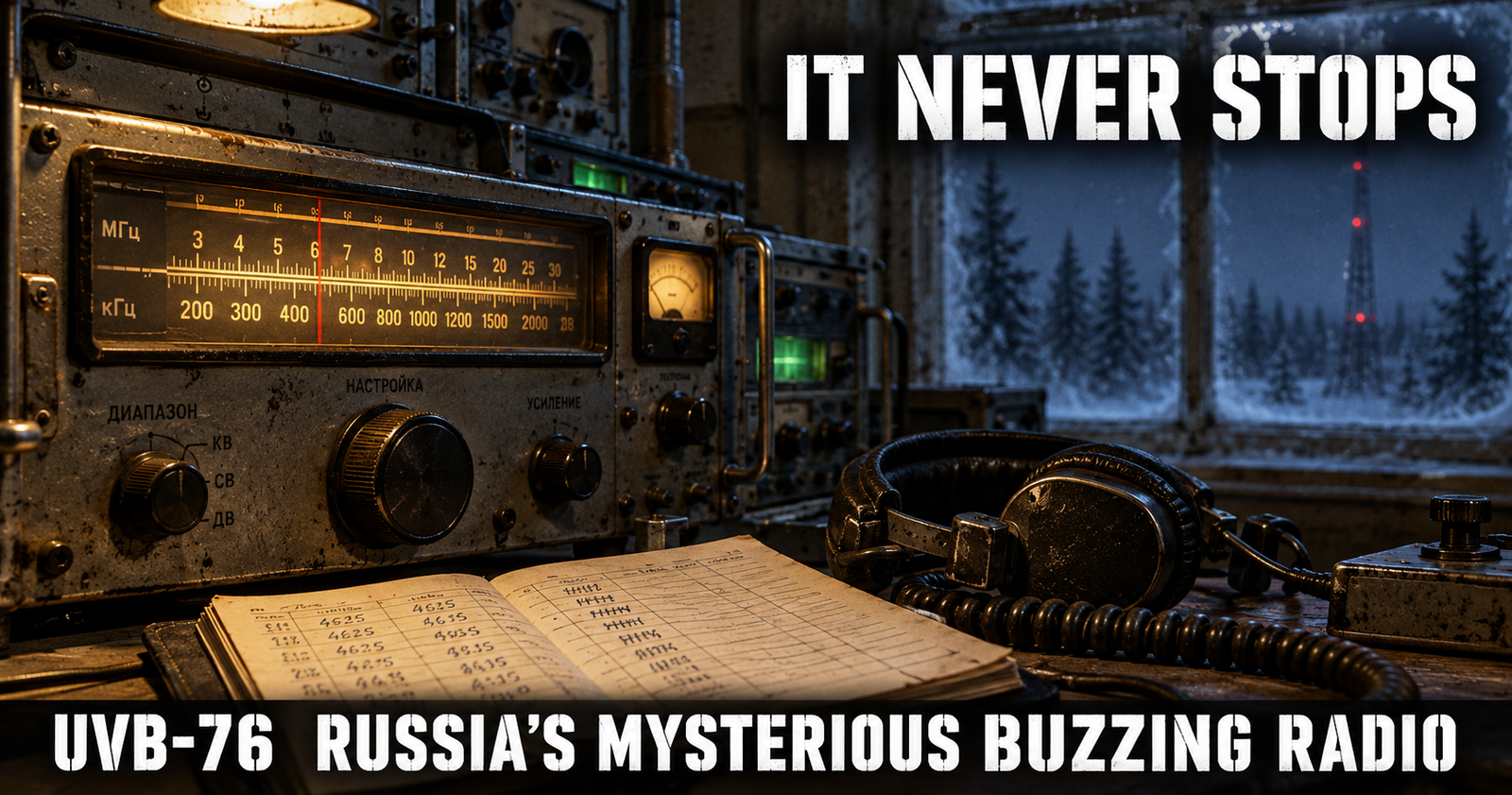
Yet a Russian shortwave signal known as UVB-76, or “The Buzzer,” has attracted listeners for decades. Usually, it broadcasts its familiar repeating sound. Sometimes, a voice interrupts with Russian words and numbers. The station is monitored on 4625 kHz.
That change is the hook: a sound you could ignore for hours suddenly becomes a message you cannot understand.
The best-supported public explanation is a Russian military communications network using the buzz as a channel marker. The much more dramatic claim that silence would automatically trigger nuclear war is not supported by the specialist monitoring sources examined here.
I think the real story is interesting enough without turning every pause into a countdown.
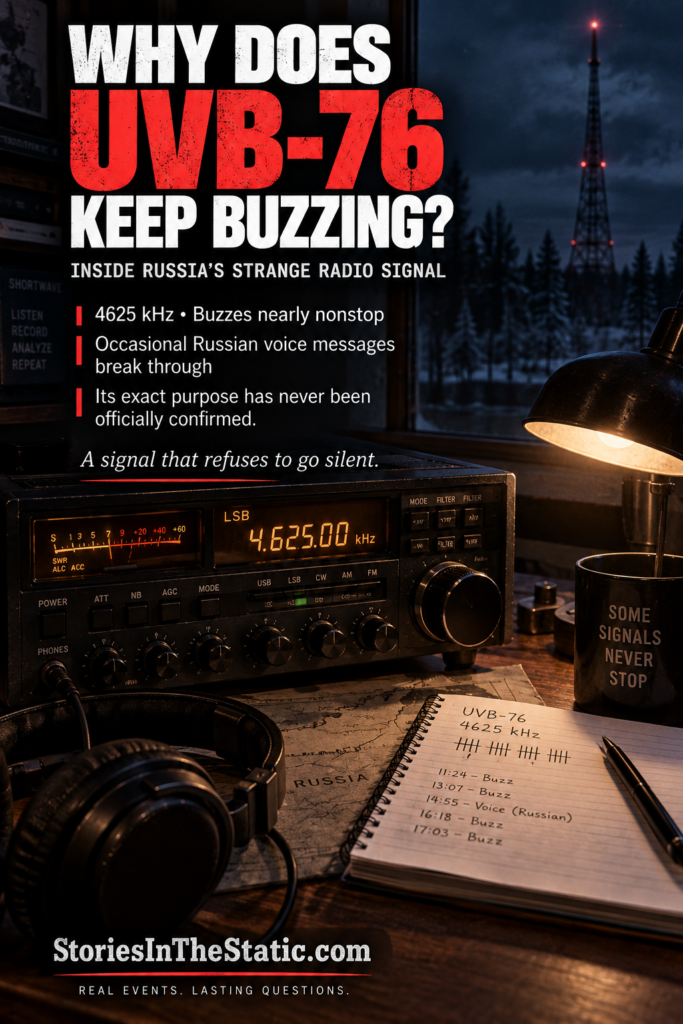
The Buzz Is the Part Everyone Notices
“The Buzzer” is an unusually honest nickname.
Its signature sound repeats while the frequency is not carrying other traffic. Radio-monitoring group Priyom identifies that sound as a channel marker, rather than an unexplained message in itself.
That changes how I read the station.
The buzz may seem pointless to somebody expecting entertainment. For a communications network, a recognizable marker can have a practical purpose.
Think of it as a frequency announcing that it is occupied and active. That is an analogy, not a translation of the sound.
The buzz is not necessarily the message. It marks the place where messages can appear.
Then Someone Starts Speaking
The station also carries live voice transmissions.
Specialist researchers describe messages containing recipient callsigns, codewords, and groups of numbers. They connect this traffic with Russian military message formats, including those known as “Monolith” messages.
The listener can hear the delivery without knowing the instruction behind it.
That is the distinction I find most compelling. The transmission is publicly audible, but its meaning is intended for particular recipients.
A strange word might be understandable as a Russian word and still tell an outside listener almost nothing about the order.
Recognizing the vocabulary is not the same as possessing the information needed to interpret it.
Why Keep a Frequency Occupied With Noise?
Numbers Stations Research identifies the buzz as a marker used to keep the channel occupied. Its account also discusses possible use in propagation measurements, which concern how radio signals travel.
To an outside listener, repetition creates suspense.
To an operator, repetition may simply be normal operation.
That difference explains a lot of the station’s reputation. We hear a sound without seeing the work around it, then supply a story that makes the sound feel meaningful.
My strongest interpretation is that the buzz serves a routine communications function. The interesting unknown is what particular messages mean, rather than whether the noise itself contains a supernatural secret.
Even “UVB-76” Has a Twist
The name most people search for appears to have started with a transcription mistake.
Priyom identifies UVB-76 as a mistaken rendering of UZB76. Its historical records also list several later collective callsigns used in the network’s messages.
I like that detail because it punctures the image of a station frozen in time.
The familiar internet label stayed popular. The network did not necessarily keep using that same identifier.
A name can become a brand for a mystery even after it stops accurately describing the traffic.
Is It a Numbers Station?
UVB-76 is frequently grouped with numbers stations because its voice messages include numbers and other coded elements.
But specialist researchers distinguish it from stations used to send intelligence traffic to agents. Numbers Stations Research classifies The Buzzer as a military station, not an espionage numbers station.
That distinction matters.
“Someone is reading numbers” tells us what a listener hears. It does not, by itself, establish who receives the message or what job the network performs.
I would describe it as a military radio network with coded voice traffic, while acknowledging that much of the public knows it through the broader numbers-station category.
The Theory That Made It Famous Is Also the Weakest Shortcut
The doomsday version goes roughly like this:
The buzz is a signal that Russia remains operational. If it stops, an automatic system launches nuclear weapons.
That is a terrifying story. It is also a claim requiring evidence.
Priyom explicitly rejects the idea that The Buzzer functions as that kind of “dead hand” switch. Its explanation instead identifies an operational military communications network.
I would not use an online recording of this station to judge whether nuclear war is beginning.
The public evidence does not establish that relationship.
A military connection can make a signal important without making every interruption an automatic launch command.
What Does a Pause Actually Tell Us?
A pause tells a listener that the usual sound was not received during that period.
It does not automatically identify the reason.
Possible explanations to investigate include changes in transmission, equipment problems, interference, or reception conditions. Those are possibilities, not a diagnosis of any specific recording.
Priyom’s station profile describes a network using multiple transmitter sites and notes equipment and channel-separation problems.
That is a more grounded starting point than treating silence as proof of catastrophe.
I would also distinguish between a station going off air and somebody’s online listening feed failing. A stream adds another system between the transmitter and the audience.
A silent browser tab is not a complete report on a military network.
Not Everything on the Frequency Comes From The Buzzer
This is another detail that can turn an ordinary recording into a misleading headline.
Other transmissions can interfere with the frequency. Numbers Stations Research documents instances involving music and other unauthorized signals over the channel.
Hearing something unusual near The Buzzer does not automatically mean its operators chose to transmit it.
Before assigning a meaning, I would ask:
Who recorded it? Is there an identifiable receiver and date?
Was it the station or interference? Are experienced monitors treating it as genuine network traffic?
What can actually be established? A recording may demonstrate a sound without proving its source.
Those questions make a less dramatic headline. They make a more useful investigation.
My Three Explanations, Ranked by the Evidence
Military Communications With a Channel Marker
This is the explanation I find strongest.
It fits the specialist classification, recognizable message formats, and long-term monitoring records.
It also explains why the station can be audible without providing public instructions about how to understand it.
My assessment: well supported by the monitoring sources, although those sources are not an official disclosure of every network function.
A Role in Readiness, Training, or Testing
Specialist accounts describe military messages that may relate to readiness and training.
That offers a possible explanation for activity that outside listeners cannot connect with a visible event.
But I would not hear a particular message and confidently declare it a drill. Without the relevant instructions, that would be another guess.
My assessment: consistent with the military-network explanation; individual transmissions remain difficult to interpret publicly.
A Publicly Audible Nuclear Trigger
This is the explanation I find least convincing.
It relies heavily on the station sounding ominous and being associated with military communications. Neither fact establishes an automatic-launch function.
My assessment: not supported by the evidence reviewed here.
What Makes This Different From a Hijacked Broadcast?
In a television intrusion, an unauthorized person borrows an audience.
The Buzzer has a different appeal. People voluntarily seek out a communications signal that was never designed as public entertainment.
The contrast is clear in the real 1977 television interruption attributed to “Vrillon”. That voice claimed to address humanity. The Buzzer’s traffic appears directed toward particular recipients.
One asks the public to believe a message. The other lets the public hear a message without understanding it.
To me, the second situation can be just as absorbing.
Why People Keep Listening
My interpretation is that the repetition creates an expectation.
Once you understand the normal pattern, every departure feels significant. A voice appears, the buzz changes, or reception drops, and suddenly you have something to examine.
The same attention to recordings drives interest in the unresolved Max Headroom television hijacking. A recording gives people something concrete to replay, compare, and argue about.
But a recording has limits.
It can preserve an event perfectly well while leaving its meaning unresolved.
Can You Listen to UVB-76 Yourself?
Yes. The frequency is publicly receivable with suitable equipment and reception conditions.
Priyom provides station information and an audio sample. Its FAQ also describes listening through remotely accessible receivers or a shortwave radio tuned to 4625 kHz.
If I were starting, I would use a specialist monitoring source before choosing a video labeled “terrifying secret Russian signal.”
The source matters because an entertaining edit can remove the ordinary stretches, combine unrelated recordings, or present interference as an official transmission.
A sample demonstrates the sound. A monitoring record supplies context.
Is UVB-76 real?
Yes. The Buzzer is a real radio signal documented by specialist listeners, with recordings and activity logs.
What frequency does The Buzzer use?
Its well-known frequency is 4625 kHz, equivalent to 4.625 MHz.
Do people know what the messages mean?
Researchers recognize message structures, but that does not mean the public can translate a particular codeword into the intended military instruction. Priyom’s explanation distinguishes hearing the message from knowing its operational meaning.
Does the buzz stopping mean nuclear weapons will launch?
The specialist sources reviewed here do not support that claim. A pause or lost reception should not be treated as evidence of an impending launch.
About this story: UVB-76 is a real, documented radio station, not original fiction. Military-network descriptions are attributed to specialist monitoring sources; the doomsday claim is an unsupported theory. Written by the Stories in the Static editorial team, with first-person analysis distinguished from reported evidence.