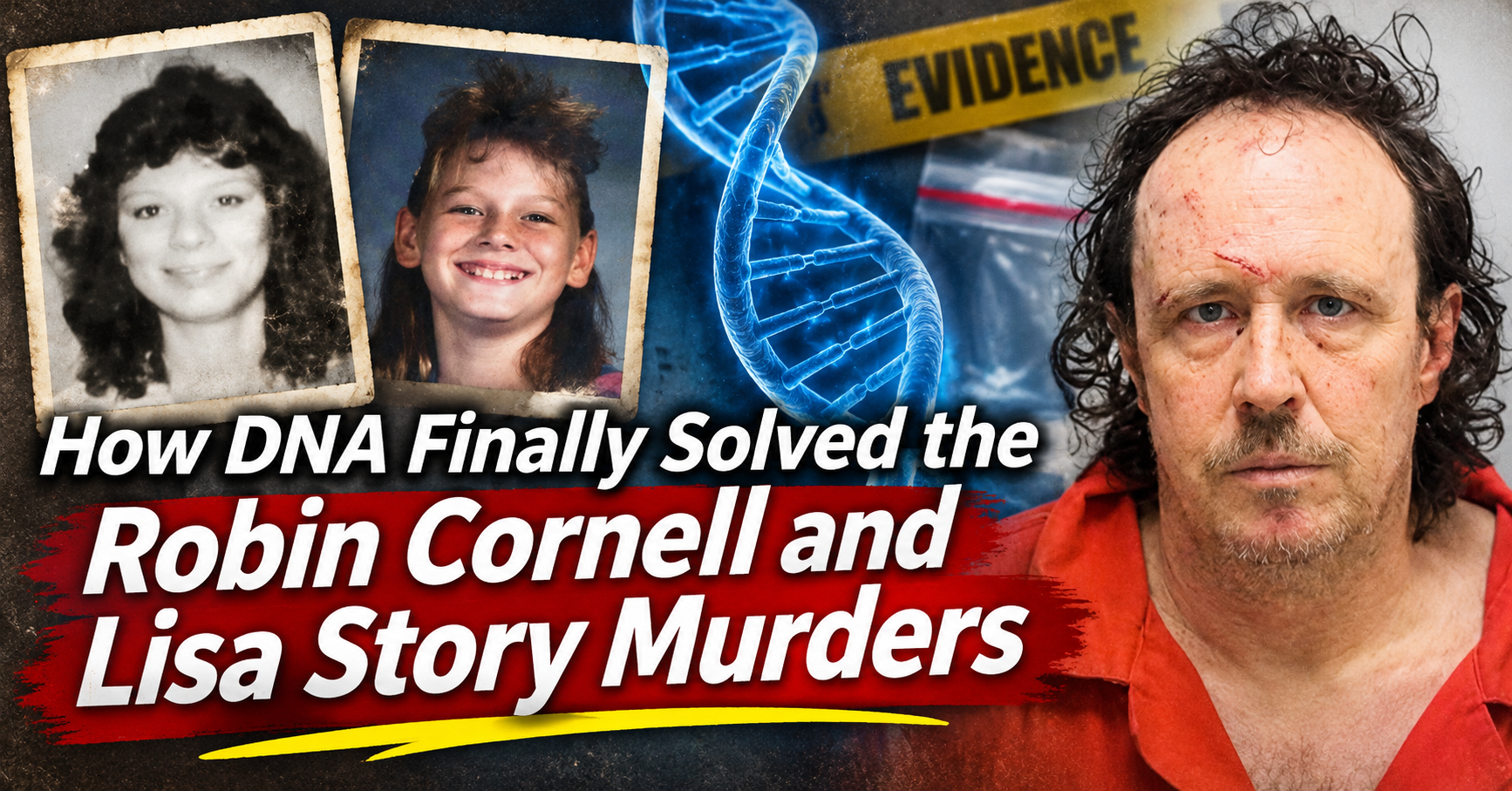
On May 10, 2016, a Cape Coral detective told the local paper she still believed the murders of Robin Cornell and Lisa Story could be solved. It had been 26 years to the day since Robin’s mother found them.
By then, investigators had a full DNA profile from a bedsheet in Robin’s room. It had been in a law enforcement database for years. That spring, it still hadn’t given them a name.
I like reading the old newspaper story before the court opinion. In the court opinion, Joseph Zieler’s name is right there at the top. In the newspaper, nobody knows yet. The detective is still talking about the information it might take to break the case. Four months later, police would announce an arrest. The clue that finally came in was a DNA sample taken in a different case.
If you came here because you saw Zieler elbow his lawyer, that video is real. It’s from June 26, 2023, and it happened hours before he was sentenced to death. To understand why he was standing in that courtroom at all, go back to a front door Jan Cornell couldn’t open on a Thursday morning in 1990.

The morning Jan Cornell came home
Lisa Story was 32. She worked with Jan Cornell, was her friend, and had recently moved into the spare bedroom of Jan’s Cape Coral condo to share expenses. Robin was Jan’s 11-year-old daughter. On May 9, Lisa agreed to watch Robin while Jan went to her boyfriend’s place to watch a basketball game.
Jan meant to come home after the game. Instead, she fell asleep. She woke around four the next morning and hurried back to get ready for work.
The front door had a broken handle. Jan could get in if only the deadbolt was locked, but she couldn’t open the door from outside if the handle was locked too. When she found it locked that morning, she thought Lisa might simply have forgotten about the handle. She walked around to the patio.
The sliding door was open. The vertical blinds were blowing out through it.
That’s the detail I keep coming back to in the Florida Supreme Court’s account of that morning. The lock still had an ordinary explanation. Then Jan rounded the corner and saw the door standing open. Inside, things were out of place. Upstairs, she found Lisa in one bedroom and Robin in the other.
Investigators collected evidence from the condo, including bedding from Robin’s room. A piece of that bedsheet would eventually supply the clearest DNA profile in the case. But it would take ten years to get that profile and another sixteen to find out whose it was.
The bedsheet had an answer years before the database did
The shorthand version of this story is that new DNA technology solved an old murder. That’s partly true. What gets lost is that the lab made progress more than once, and for years that progress still didn’t give police a suspect.
1990: The first tests gave police something to compare
Early testing produced consistent DNA results from more than one piece of evidence. DNA analysis also helped investigators rule out people they’d looked at. That was useful work: every exclusion closed off a possibility. The first results used an older testing method, though, and weren’t the type of profile investigators could upload to CODIS.
2000: A cutting from the sheet yielded a full profile
A new round of testing produced a complete profile from the bedsheet and partial profiles from other evidence in Robin’s room. The results were consistent with one another. The bedsheet profile went into CODIS, the Combined DNA Index System.
That changed what the police could do with the evidence. They now had a profile the system could compare against eligible DNA records. But a searchable profile doesn’t come with a name attached. As the FBI’s explanation of how CODIS works makes clear, the system can point to a potential suspect when there’s a matching record to compare it with. It can’t return a record it doesn’t have.
2012: The lab tested the sheet again
Another test of the bedsheet produced a full profile consistent with the one from 2000. By the time the detective spoke to the newspaper in 2016, the lab had already done the work that made a database match possible. Nobody needed to find a lost piece of evidence in a storage room. The evidence they needed had been in the case all along.

The article written before police had a name
In the Cape Coral Breeze’s May 2016 anniversary story, Detective Christy Jo Ellis said she believed the murders could be solved. She’d been working the case for years. The story went to print without the name that would dominate the headlines that September.
In 2016, authorities collected Zieler’s DNA in an unrelated case. That sample triggered a CODIS alert. Cape Coral detectives interviewed him and took a follow-up sample. The Florida Department of Law Enforcement confirmed the matches within days, according to the local report on the September arrest announcement.
There’s a photograph in that September story of Jan Cornell speaking at the press conference. I’d put it next to the May article. In May, there’s a detective explaining why she hasn’t given up. In September, there’s Robin’s mother standing at a microphone while police announce who they’ve arrested. At that point, she still had nearly seven more years to wait for a verdict.
What the match told police and what the jury still had to decide
A DNA match can address whose biological material was found. It can’t, by itself, explain when it got there or what happened in the room. That distinction mattered at Zieler’s trial because he offered an explanation for how his DNA might have gotten into the condo.
Zieler denied committing the murders. He claimed he was in Maryland at the time. He also suggested his DNA could have been left during an earlier encounter with Jan Cornell or one of her friends. Jan testified that she had never met him or had any contact with him.
The jury also had evidence from more than one place. There was the full profile from Robin’s bedsheet and other DNA evidence from her room. Testing of hairs recovered from Lisa yielded partial profiles consistent with Zieler’s. Those pieces didn’t all have the same strength. The value of hearing them together was that jurors could consider where each came from and weigh those locations against the explanation Zieler gave.
On May 18, 2023, the jury found Zieler guilty of two counts of first-degree murder. That was 33 years after Jan found Robin and Lisa.

What the video of Joseph Zieler and his lawyer actually shows
On the morning of June 26, Zieler motioned for his defense lawyer, Kevin Shirley, to come closer. Shirley leaned in, and Zieler struck him in the face with his elbow. Deputies intervened immediately.
In Court TV’s report published that morning, Shirley explained that he initially thought Zieler wanted to talk where the microphones couldn’t pick them up. The court was dealing with a request for a new trial that morning. The judge denied it. The sentencing came later that day.
So the clip shows what happened on sentencing day. It doesn’t show Zieler reacting to the sentence being announced. Those sound like almost the same thing in a caption. In the courtroom, they were hours apart.
Later that day, Judge Robert Banning imposed two death sentences. As the state attorney’s sentencing announcementmakes clear, there was one sentence for Robin’s murder and one for Lisa’s.
Why a jury vote from 2023 is still at issue
The jury recommended death by a vote of 10 to 2 for each murder. That was a vote about punishment. The jury had already found Zieler guilty by then.
The distinction matters because Florida changed its sentencing law before Zieler’s trial went forward in May 2023. Under the new law, at least eight of twelve jurors could recommend death, where previously the recommendation required unanimity. The judge made the final sentencing decision.
Florida’s Supreme Court upheld both convictions and death sentences on April 16, 2026. In Zieler’s petition asking the U.S. Supreme Court to review the case, his lawyers ask whether Florida’s nonunanimous sentencing provision violates the Sixth or Eighth Amendment. The question they put before the Court concerns the sentencing vote.

As of November 17, 2026, the U.S. Supreme Court docket for Zieler’s case records that consideration of the petition was rescheduled on November 16. It lists no decision on whether the Court will take the case. If you’re wondering how someone can be sentenced to death one year and still have a case before another court years later, what happens in the years after a death sentence explains where direct appeals and later challenges fit.
Was this genetic genealogy or a direct DNA match?
It was a direct lead through CODIS. The profile from the bedsheet was already in the system when Zieler’s sample from an unrelated case was entered. Investigators didn’t have to build a family tree to figure out who might have left the DNA. After the alert, they obtained another sample to confirm the match.
Why do some accounts say 26 years and others say 33?
Both numbers describe a different wait. In 2016, 26 years after the murders, the DNA alert led police to Zieler. In 2023, 33 years after the murders, a jury convicted him. The May 2016 newspaper story sits just before the first of those milestones, when investigators already had a profile from Robin’s room and still couldn’t tell her mother whose it was.