
The band played a funeral tune while the waiters brought out lager. Below the crowd, in a coffin trimmed with silver, lay the man they had paid fifty cents to watch get buried.
Franz Vester was alive when they lowered him into the ground. That was the whole idea. He had invented a coffin you could climb out of, and he wanted people to see him do it.
The demonstration took place in Newark, New Jersey, in 1868. Vester was supposed to stay buried for two hours. After an hour and fifteen minutes, some of the spectators wanted to leave. Someone gave the signal, and about a minute later, according to the newspaper account, Vester came up by himself.
There was a bell in Vester’s design for someone who woke up underground and couldn’t climb. That’s the part of the story I wanted to chase down. Did a safety coffin ever save someone who had been buried by mistake? I could verify that people built and tested these devices. I couldn’t verify a rescue in which one brought an unsuspecting person out of a grave alive. What I did find was a French television report, an alarm that was supposed to pick up a breath, and a real case in which people noticed signs of life and still sent a living woman to a funeral home.
What the newspaper actually says happened in Newark
In the October 1868 newspaper account of Vester’s burial, about 600 people turned up at Baire’s Brewery Garden. Spectators took to trees and other high spots for a better view. Workers lowered the coffin, fitted the shaft, and shoveled dirt around it. The top of the shaft stayed above ground.
That last bit changes how you picture the stunt. Vester had several feet of earth above him, but there was a way up through it. He knew where it was. He knew the people above had seen him go in alive. And if something went wrong, they knew exactly where to start looking.
I found an earlier printing of the same burial story in the Public Ledger. It has the same crowd estimate, the same coffin with silver trim, and the same account of spectators gathering around the grave. The wording is close enough that I’d treat it as another printing of the same report. Two old newspapers can look like two witnesses when all you’re actually seeing is one story traveling.
There’s one distinction both the setup and the ending make clear: Vester was a volunteer. When he climbed out, he showed a crowd that a person who knew the way could get through the shaft. What nobody got to see was a cemetery worker hearing an unexpected bell and discovering that someone had been buried alive.
How the bell in a safety coffin was supposed to work
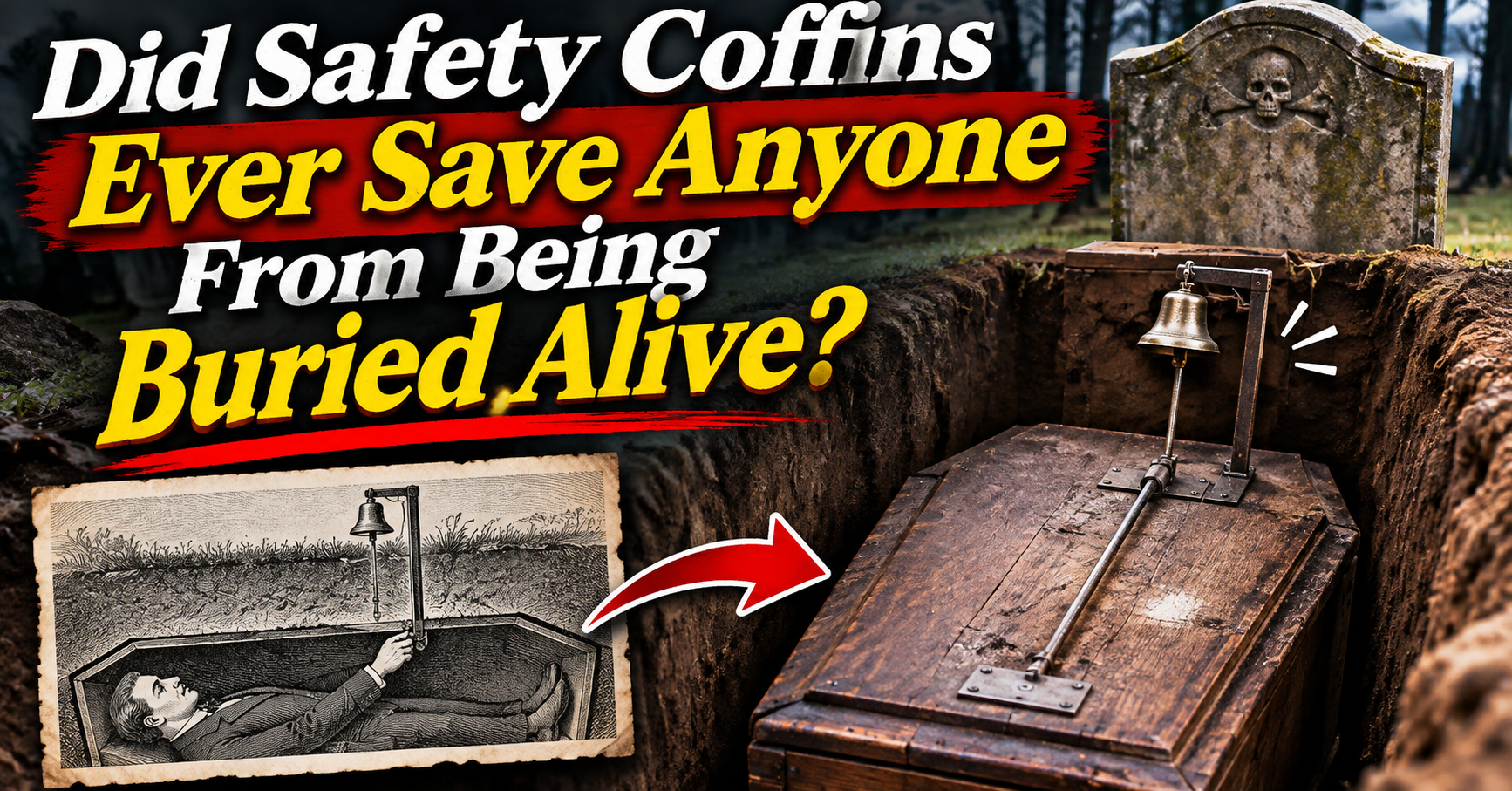
Open Vester’s original 1868 patent drawing and look where he put the shaft. It’s directly above the occupant’s face. In the drawing, the ladder is inside that shaft, the bell sits near the top, and a cord runs down to the hand of the person presumed dead.
The ladder and the bell were there for two different people, in a sense. One wakes up strong enough to climb. The other can barely move but still has enough strength to pull a cord. The same coffin was meant to give both of them a chance.
Vester also gave the shaft air openings and a glass panel so someone above could look down. If the occupant was confirmed dead, the shaft could be pulled out and used on another grave. A sliding door would close the opening in the coffin.
That removable shaft is the part of the patent I didn’t expect. It makes the invention feel less like a one-off stunt and more like something Vester imagined a cemetery using in the course of an ordinary week. It also raises a question the patent doesn’t answer for any particular burial: How long would the equipment stay in place, and who would be there to check it?
At the brewery garden, the signal to come out went down to a man everyone knew was alive. In an emergency, it would have to come up from a person everyone believed was dead.



The inventors who tried to get rid of the bell cord
A cord makes sense if you picture somebody waking up alert enough to realize where they are and what they’re holding. What if they never got that far?
In 1882, an Ohio inventor put a dial above the grave
John G. Krichbaum’s patent for a grave indicator shows a pipe with a crosspiece positioned near the occupant’s hands. Moving the crosspiece would turn a pointer on a scale above ground. A stronger movement could push the cover up and leave it raised.
The raised cover could still be there when someone walked by later. That’s a meaningful change from a bell, which can ring when nobody is around. But a dial still needs a person to look at it, understand what it means, and act. Krichbaum had changed how long the message could last. He hadn’t found a way to make sure it reached anybody.
By 1900, a breath was supposed to be enough
In a 1900 patent for an electric coffin alarm, the inventor proposed putting a wire close to the person’s chest. If their chest rose enough to move it, that movement could close a circuit and activate an alarm and a visible signal.
Read those three patents in order and you can see the inventors asking less and less of the person in the coffin. Vester wanted a pull on a cord. Krichbaum wanted a movement of the hands or body. The electric alarm was designed to pick up a breath. Each invention tries to solve a problem the one before it leaves behind.
But as you make an alarm easier to set off, another question gets harder: What else might set it off?
What if the bell rang and nobody was alive?
In Larry Dossey’s historical review of premature burial and safety coffins, he describes reports of graves being reopened after bells rang. He attributes those alarms to shifts in the body during decomposition that pulled on cords attached to the limbs. His review does not identify a documented case of someone actually buried alive in a safety coffin.
I wouldn’t put those reported false alarms on the same footing as Vester’s patent or a newspaper account with a named inventor and a venue. But they expose a problem that shows up in the drawings themselves. The devices register movement. People above ground have to decide what that movement means.
Think about what it would take to verify even one rescue. You’d want a name, a place, and a record of the burial. You’d want to know which device was fitted to the coffin, who heard or saw it go off, and who was there when the coffin opened. Leave out the alarm and you might have a case of premature burial, but you haven’t shown that a safety coffin saved anyone. Leave out the mistaken burial and you may have another demonstration.
That’s exactly where one of the best-known stories gets interesting.


The French inventor whose story sounds like the missing rescue
The story often goes like this: A young Frenchman called Angelo Hays crashed his motorcycle in 1937. He was taken for dead, buried, and dug up two days later because of an insurance inquiry. Then he invented a coffin that could keep a person alive underground.
You can find that version in a funeral industry publication’s account of the Hays story. What I couldn’t find was a contemporary burial or exhumation record that establishes the 1937 account. Even if it happened exactly as retold, the story credits an insurance inquiry with getting the coffin opened. The invention comes afterward.
What I could verify was stranger in its own way. French television’s 1974 report from the fair at Saint-Aulayeintroduces Angel Hays and his planned 30-hour burial in a coffin of his own design. More than a century after Vester climbed out of the ground in Newark, another inventor was willing to get in a coffin in front of an audience to show people what it could do.
The footage makes the legend feel more convincing because there really is a man, there really is a coffin, and there really is a burial stunt. But it documents the fair in 1974. It doesn’t document what happened after a motorcycle crash in 1937. If you’re trying to find the rescue behind the story, that gap is everything.
What a documented case of mistaken death looks like
In Michigan in 2020, Timesha Beauchamp was taken to a funeral home after being declared dead. When an embalmer unzipped the body bag, she was alive. She was taken to a hospital and died about six weeks later.
The detail I keep coming back to is what happened before the bag was opened. A federal appeals court’s account of the allegations in Beauchamp’s case says people had already noticed signs of life. Her family reported that she had gasped. A funeral home worker reportedly asked about movement in her chest. The movements had been explained away as an effect of medication.
Beauchamp wasn’t buried. There was no coffin alarm. What her case gives us is a record with a name, a sequence of events, and people who were there to see what happened. It also shows why the old inventions leave me uneasy. The person you’re trying to help might already be giving you a signal. The question is whether anybody recognizes it.

We’ve covered an older version of that moment in the story of Anne Greene, whose coffin was opened before a planned dissection. Both cases belong in the history of people being taken for dead. Neither is a case of a grave bell saving someone. You can take the fear seriously without giving the invention credit it hasn’t earned.
Why the grave-bell story is so easy to believe
One reason is that people really did patent these things. Another is that the language practically writes the story for you. Someone hears a bell. Someone digs. A person is saved by the bell. It fits so neatly that you can almost forget to ask where the expression first turns up.
An 1893 boxing report traced by HistoryExtra uses the expression for a fighter spared when the round ended. The old grave bells and the boxing expression both have a paper trail. The claim that one gave us the other doesn’t.

I ran into the same problem with the story of Octavia Hatcher’s coffin in Kentucky. A real grave and a real name give a story somewhere to stand. They don’t put a witness inside the room when the coffin was supposedly opened. The closer you get to the detail everybody remembers, the more carefully you have to ask who saw it and when they wrote it down.
Did cemeteries really put bells on graves?
Some patented designs called for bells at the surface, and Vester’s device was demonstrated in public. That establishes that grave bells were more than a legend. It doesn’t establish that most cemeteries installed them or that ordinary graves routinely had them. A drawing with a patent number tells you what someone meant to build. It doesn’t tell you how many families used it.
Were safety coffins still being invented in the 20th century?
Yes. In 1983, the U.S. issued a coffin alarm patent to Fernand Gauchard. That’s more than a century after Vester’s demonstration. It shows the idea survived well beyond the Victorian era. Like the earlier patents, it documents an invention. It doesn’t document a rescue.
Did anyone ever ring a coffin bell and get rescued?
I couldn’t verify a case in which a person was buried by mistake, set off a coffin alarm, and was brought out alive because somebody responded. Vester climbed out, but he’d gone down on purpose. Hays went on television, but that was a planned demonstration. The best-documented case of mistaken death I found in this search ended at a funeral home, before burial. After all those drawings and newspaper stories, the one record I was looking for was still missing: somebody above ground saying they heard a bell they weren’t expecting.