
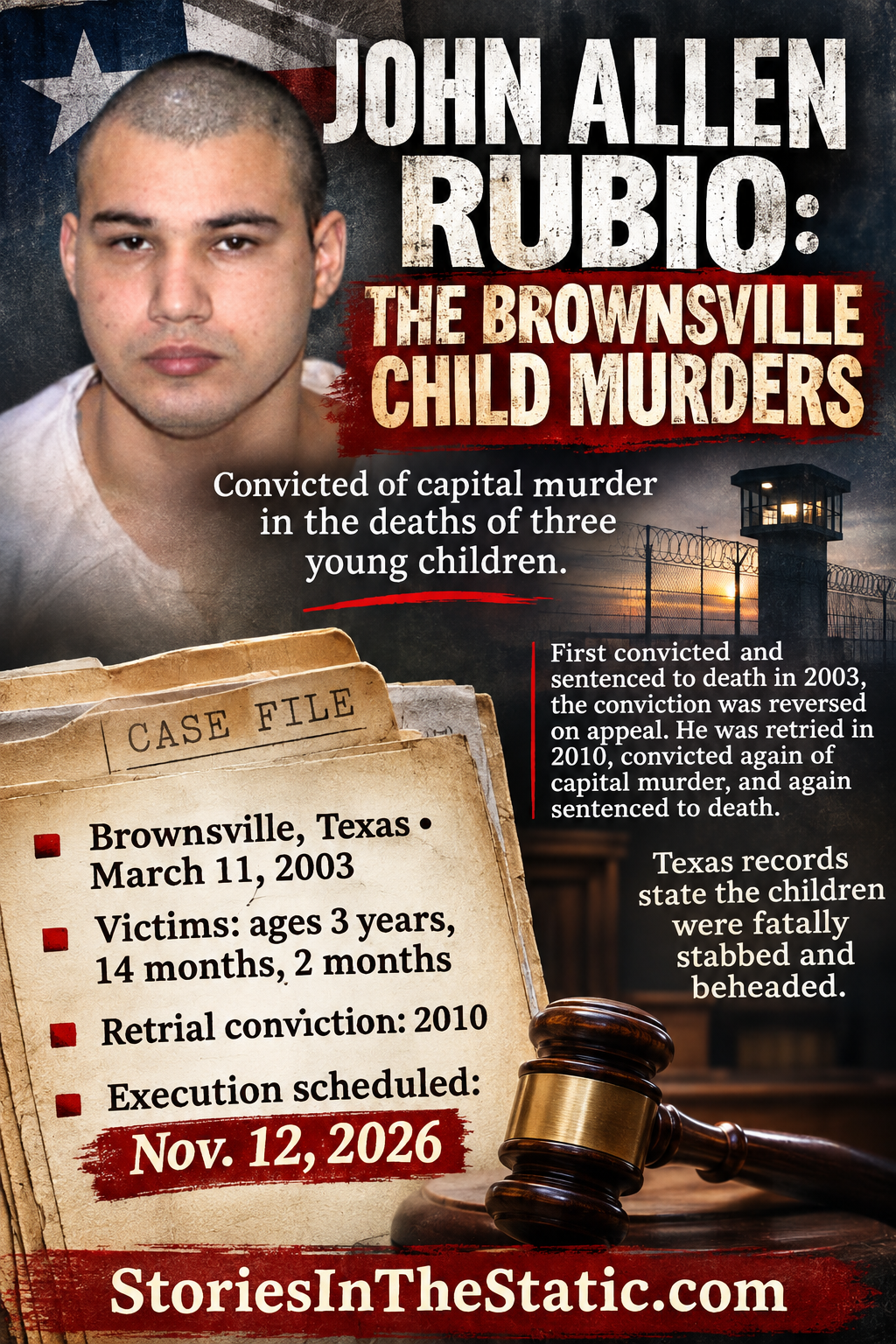
At John Allen Rubio’s first murder trial, the jury heard what Angela Camacho had told police. The defense never got to ask her a single question about it.
Four years after that jury convicted Rubio, a Texas appeals court threw out the verdict. The judges considered the evidence that he took part in the killings overwhelming. What troubled them was how the state had tried to prove what Rubio understood when he killed the children. For that, prosecutors had relied heavily on a woman whose account the defense had no opportunity to test.
Texas tried him again in 2010. This time, Camacho took the stand. The second jury also found him guilty, and Rubio was sentenced to death again.
Execution status as of November 10, 2026: The Texas prison system’s execution schedule still lists Rubio for Thursday, November 12, in Huntsville. A state appeals court denied his request for a stay, and the Texas Board of Pardons and Paroles declined to recommend either a reprieve or a reduction of his sentence.
Execution update: Texas executed John Allen Rubio on November 12, 2026. In his final statement published by the Texas prison system, Rubio apologized to the families and asked for forgiveness.
Three children in a Brownsville apartment
On March 11, 2003, three children were killed in Brownsville, Texas: Julissa, who was 3; John, who was 1; and Mary Jane, who was 2 months old. Angela Camacho was their mother. She and Rubio were both convicted in connection with their deaths.

Rubio admitted taking part in the killings. He told authorities he believed the children were possessed. His defense argued that he was legally insane at the time. The question facing jurors was whether a severe mental disease or defect had kept him from knowing that what he did was wrong.
That’s why Camacho’s account mattered. She could describe things a photograph of the apartment or a medical report never could: how Rubio had acted before the killings, what he had said, and how he behaved afterward.
Why was John Allen Rubio’s first conviction overturned?
Camacho invoked her Fifth Amendment right against self-incrimination and did not testify at Rubio’s 2003 trial. The jury nevertheless heard statements she had given police. Rubio’s lawyers had no prior opportunity to cross-examine her about those statements.
While Rubio’s appeal was pending, the U.S. Supreme Court decided Crawford v. Washington. The ruling explained that when prosecutors offer testimonial statements against a defendant, including statements from police interrogation, the Sixth Amendment generally requires an opportunity to cross-examine the person who made them. If the witness is unavailable, the defendant ordinarily must have had that opportunity earlier.
Here’s what that right means in a courtroom. If someone tells police that a man acted normally after a crime, a defense lawyer can ask what normally looked like. Was he talking as he usually did? Did he seem calm for the whole evening or just for a few minutes? Those are examples of the kinds of questions that can change how much weight a jury gives an account.
In 2007, the Texas Court of Criminal Appeals found that admitting Camacho’s statements had likely affected the verdict. As the federal court’s account of the reversal explains, the evidence of Rubio’s participation was strong, but the evidence bearing on his state of mind was a different matter. The court reversed the conviction and sent the case back for a new trial.

That’s one reason the number of years alone can obscure what happens between a death sentence and an execution. In Rubio’s case, part of that time was spent doing the trial over.



What changed when Angela Camacho took the stand?
By the 2010 retrial, Camacho had pleaded guilty for her role and was serving life in prison. Prosecutors called her as a witness. They also presented Rubio’s own written and videotaped statements to police.
One detail from her testimony stays with me. Camacho described going with Rubio to a nearby store to buy milk after the killings. She said he acted normally on that trip. She also described him talking about a spirit after they returned. Both details came from the same witness, describing the same stretch of time.
Jurors also heard from experts who disagreed. A defense expert said Rubio was experiencing delusions that left him unable to recognize that his actions were wrong. The state’s psychiatrist pointed to conflicting accounts Rubio gave and to his expectation that he would go to jail as signs he understood the wrongfulness of what he had done. The jury rejected the insanity defense, and the state’s highest criminal court later upheld the second conviction and sentence.
Why was Rubio’s mental state back in court in 2026?
The retrial asked what Rubio understood in 2003, when the children were killed. The 2026 competency hearing asked whether he could rationally understand why the state intended to execute him now. A mental illness diagnosis alone doesn’t answer that second question. The Supreme Court’s standard focuses on how the person’s condition affects their understanding of the reason for the punishment.
In October 2026, a Texas judge found Rubio competent to be executed after reviewing expert evaluations. His attorneys separately sought to delay the execution over allegedly false testimony by a prosecution expert at the retrial. Prosecutors disputed that challenge, and the state appeals court denied the request for a stay.
Was John Allen Rubio ever acquitted?
No. The appeals court reversed his first conviction because the trial improperly admitted Camacho’s statements and the error mattered to the verdict. The court ordered a new trial. A second jury convicted him in 2010, and he was again sentenced to death.
Did Angela Camacho also get the death penalty?
No. Camacho pleaded guilty and received life sentences. She was already serving time when she testified at Rubio’s second trial.