

Man kills two with a chainsaw?!
The headline tells you about the alleged weapon.
It tells you almost nothing about the two women whose lives ended inside the home.
That is where I want to begin with the Carolina Court case in Mobile, Alabama. The details attracting attention are disturbing, but this is still a developing investigation. There are allegations, early court proceedings, and important questions that have not been answered publicly.
According to Mobile police, officers responding to a death investigation on October 12, 2026, found two women dead inside a residence. They detained a man at the scene and later arrested Thomas Steele, 47.
Local reporting identifies the women as his grandmother and aunt. Steele is accused of killing them. He has not been convicted in this case.
This account reflects information available on October 13, 2026. It separates the police statement from later reporting and explains what the announced mental evaluation does, and does not, mean.
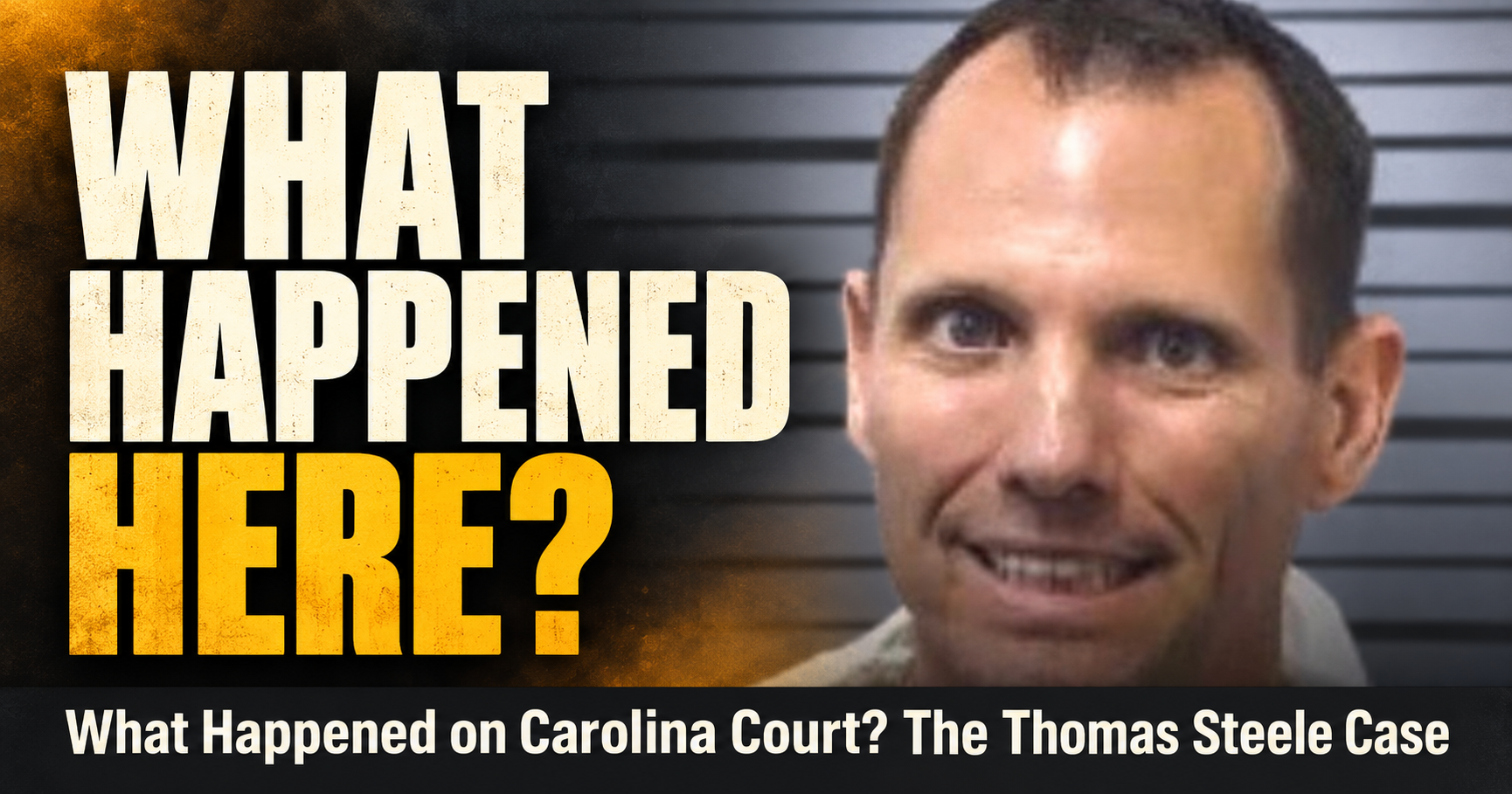
What Happened on Carolina Court?
The Mobile Police Department places the initial response at approximately 1:36 p.m. on Monday, October 12, in the 2400 block of Carolina Court.
Its statement says officers discovered the women inside the home and alleges that a male family member intentionally caused their deaths with a bladed instrument. Steele was arrested and taken to Metro Jail.
That is the initial official account.
The statement does not describe a motive or reconstruct the events leading up to the deaths. It does not establish who made the call or what happened before officers arrived.
Those gaps matter.
A response time tells us when police were called to investigate. It does not, by itself, establish the precise time of an alleged killing.
I would be careful about reading more into that timestamp than the statement provides.
Why the Chainsaw Allegation Appeared in Later Headlines
The police release uses the broader description “bladed instrument.”
The First Alert 4 report you may have seen attributes the chainsaw allegation to court documents. It reports that those documents accuse Steele of killing and decapitating both women.
That is an allegation attributed through reporting on court records. This article has not independently inspected the underlying complaint.
The distinction is worth preserving because headlines can make an accusation sound like the final account of a completed trial.
At this stage, the sources establish that an investigation and prosecution are underway. They do not provide a verdict.
The alleged manner of the killings explains the national attention. Repeating the graphic detail throughout the story would add little to understanding what happened.


What Happened at Steele’s First Reported Hearing?
WALA’s October 13 courtroom report says a judge denied bond on both capital murder charges and appointed a public defender after Steele said he did not have an attorney.
The station also reports that he was removed from the courtroom after making a remark. Its reporter could not establish whom the remark was directed toward.
That uncertainty should remain intact.
An unclear comment is not a reliable basis for building a theory about motive or intent. It may become relevant through later proceedings, but a reader should not be asked to supply the missing context.
There is also a change between the earliest article and the hearing coverage. The initial syndicated report described two murder counts; the later courtroom report described capital murder charges.
The later account is the more specific reporting available here. The charging documents themselves would be needed to explain the exact statutory basis.
A Mental Evaluation Is Planned
WALA reports that Mobile County District Attorney Keith Blackwood said Steele would undergo a mental competency evaluation. The station reported that Steele lived with his grandmother and aunt and that investigators had not released a motive.
The evaluation raises a question that often causes confusion in criminal coverage.
Is the court asking whether someone can participate in a trial now?
Or whether that person was legally responsible for an alleged act in the past?
Those are different questions.



What Does Competency to Stand Trial Mean?
Alabama’s criminal procedure rules focus on a defendant’s present ability to consult with counsel and rationally understand the facts and legal proceedings.
In ordinary terms, the issue concerns whether the defendant can understand the case and meaningfully assist in the defense.
An evaluation does not automatically establish incompetence.
It also does not decide guilt.
The rule’s commentary explains that the presence of a mental disorder, by itself, is not sufficient to establish that someone is incompetent to stand trial. The legal question concerns the person’s functional abilities in the proceedings.
I find that distinction useful because public discussion often jumps from “evaluation ordered” to a diagnosis or an assumed outcome.
Neither follows automatically.
Is That the Same as an Insanity Defense?
No.
Competency concerns the defendant’s current ability to participate in the case. A defense based on mental disease or defect concerns the person’s mental condition at the time of the alleged offense.
Alabama’s rules expressly distinguish the two purposes for examination.
Someone’s ability to speak with a lawyer today does not answer every question about their mental state during an earlier event.
Likewise, a claim about the earlier mental state does not automatically establish an inability to participate in court now.
For this case, the announced evaluation should be reported as a pending part of the process. We should not predict its findings or assume a particular defense will follow.

Readers interested in how separate legal questions affect a case’s timeline can explore the decisions that can stretch a capital case over years. That broader explanation does not predict Steele’s outcome.
What the Booking Photo Cannot Tell Us
The image circulating with this story shows Steele smiling.
It is easy to notice. It is also easy to overinterpret.
A single booking photograph cannot establish a motive, a diagnosis, remorse, or an understanding of the allegations. Those questions require evidence beyond facial expression.
I would not build the article around what his smile supposedly means.
The investigation, records, and eventual findings are more useful than a theory drawn from one image.
The photograph may explain why someone stopped scrolling. It cannot explain the case.
Why the Victims’ Names Were Initially Withheld
Mobile police said the women’s names would be released after next of kin had been notified.
That means the absence of names in the first release was not an invitation to identify them through rumors or social media guesses.
For now, their lives are less publicly documented than the allegation against Steele.
That imbalance is common in early crime coverage. A suspect’s booking photograph can circulate immediately, while the people killed remain unnamed.
I want a fuller account of these women when reliable information becomes available: their names, their lives, and what their family chooses to share. Those details should come from identifiable sources.
Inventing ordinary domestic scenes would make the story more vivid while making it less trustworthy.


The Questions Still Open
The sources reviewed here do not establish a public explanation for why the women were killed.
They also do not establish the result of the competency evaluation, Steele’s eventual plea, or the outcome of the prosecution.
Those are substantial unanswered questions.
The next useful information would come from official identification of the victims, accessible charging documents, further court orders, and reporting that clearly identifies its sources.
A new allegation should be attributed. A court finding should be labeled as a finding. A verdict, if one eventually occurs, belongs to a different stage again.
That is how this page can remain useful as the case develops without turning uncertainty into a story of its own.
Questions About the Thomas Steele Case
Where did the investigation begin?
At a home in the 2400 block of Carolina Court in Mobile, Alabama.
Has Steele been convicted?
The information available for this account concerns his arrest and early proceedings. It does not report a conviction.
Have investigators explained the motive?
The latest local report reviewed here says they have not publicly released one.
Does a mental evaluation mean the charges are dismissed?
No such outcome has been established here. The evaluation concerns a legal question that must be assessed through the court process.
Can the booking photograph explain his behavior?
No. It is an image from a particular moment, not a substitute for evidence or an evaluation.
Is this a real investigation?
Yes. Mobile police published an official statement, and local journalists reported the subsequent court hearing. The allegations remain subject to the legal process.
The Story Beyond the Headline
Two women died inside a home.
A family is facing that loss while an investigation and court case begin.
The alleged weapon is the detail spreading fastest. I think the more important work now is following what can actually be established, keeping the women visible in the account, and leaving room for answers that have not yet been released.
The headline can tell us why people noticed.
The record must tell us what happened.
By Miles Rowan for Stories in the Static, examining criminal cases through careful sourcing and the lives behind the headlines.