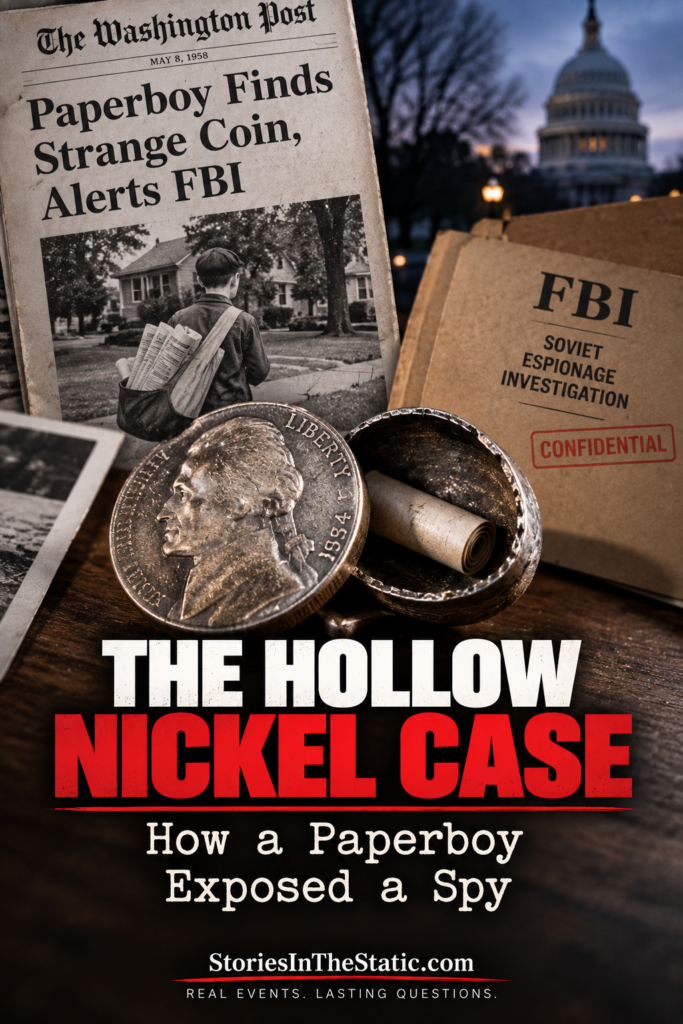
A nickel falls to the floor. It splits open.
Inside is a tiny photograph covered in numbers.
That sounds like the beginning of a spy movie. In Brooklyn in 1953, it was something a newspaper delivery boy found in his change. The discovery became known as the Hollow Nickel Case, an investigation that eventually helped expose a Soviet intelligence officer living under a false identity.
But finding the message was the easy part.
For four years, the FBI had the coin, the photograph, and the numbers. It still couldn’t read what someone had gone to such trouble to hide.
I find that harder to shake than the secret compartment itself. Someone had built an object small enough to disappear into a handful of change, yet important enough to contain an encrypted message.
Then it ended up in a paperboy’s hand.
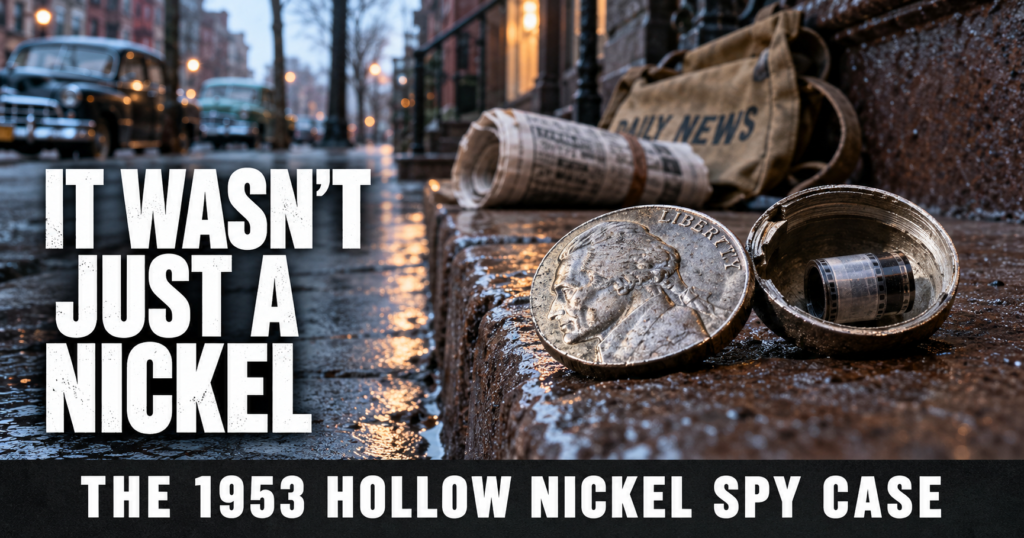
Five cents with something inside
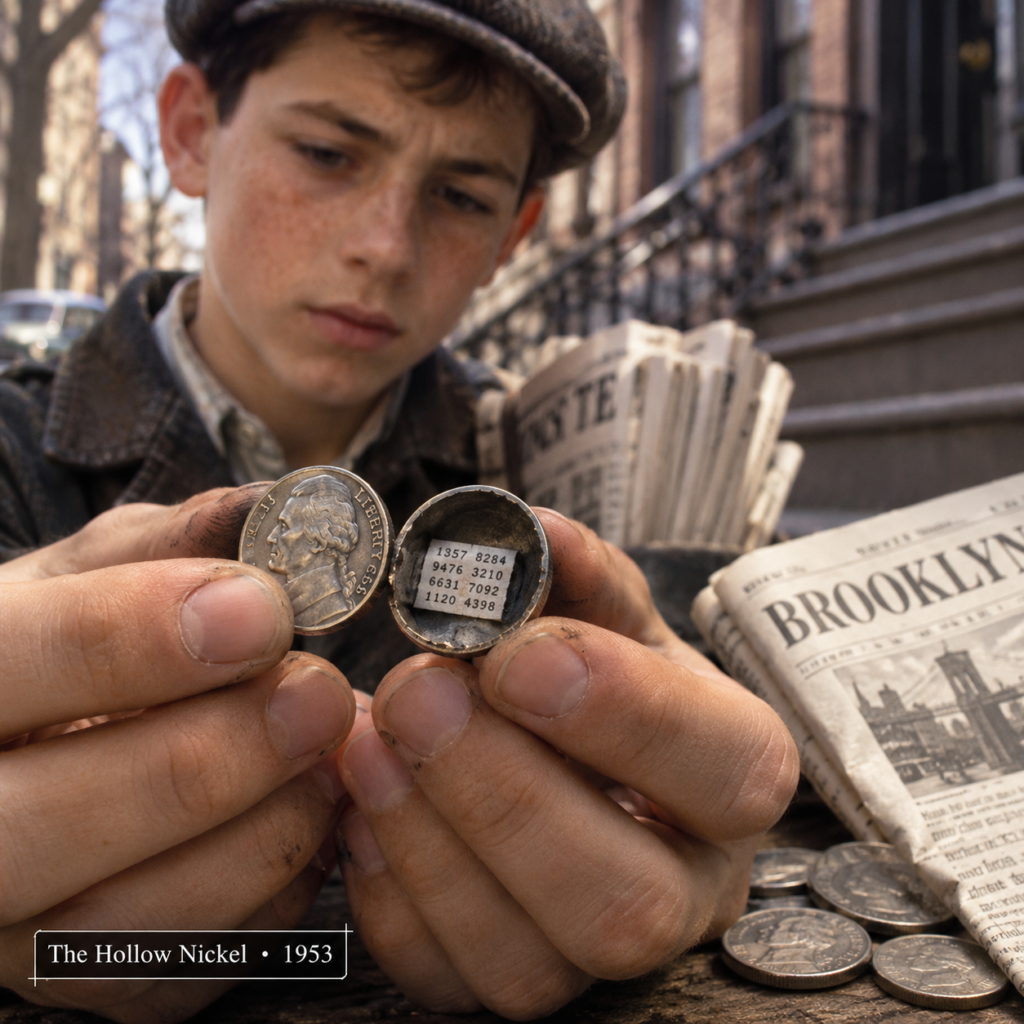
On June 22, 1953, a Brooklyn Eagle delivery boy named Jimmy was collecting payment from customers. After receiving change at an apartment building, he noticed that one nickel felt unusually light.
When he dropped it, the coin came apart. Inside was a microphotograph containing columns of five-digit numbers. The discovery reached the FBI.
There’s something wonderfully unsettling about the scale of it.
A secret document in a locked briefcase announces its importance. A nickel asks for almost no attention at all. You count it, pocket it, spend it. Its usefulness as a hiding place depends on how little it matters to everyone else.
Investigators tried tracing it backward. They questioned the women who had supplied the change and checked novelty shops for similar objects. Those inquiries produced no useful lead. Laboratory examination suggested that the message had been prepared on a foreign typewriter.
They had evidence of a secret.
They didn’t have its owner.
Opening the coin didn’t open the message
The nickel had failed as a hiding place. The encryption was still doing its job.
That distinction matters. Concealment keeps you from noticing a message. Encryption keeps you from understanding it after you find it.
The numbers were plainly visible once the photograph was examined. Their meaning remained inaccessible until information supplied by a Soviet defector helped the FBI Laboratory decipher them in 1957.
This is the same unnerving separation between hearing something and understanding it that runs through what numbers stations are used for. You can possess every number in the message and still be locked outside it.
The coin’s discovery had exposed a communication method. It hadn’t yet exposed the people using it.
The break came from a man afraid to go home
Reino Hayhanen was a Soviet intelligence officer operating in the United States. In 1957, after being ordered back to the Soviet Union, he defected.
His information connected investigators to hidden message containers and put them on the trail of his superior, a spy he knew as “Mark.”
A hollow nickel is a clever piece of engineering. It cannot control whether the person trusted with the operation will remain loyal.
That is where this case turns. The crucial opening came through a human being.
Hayhanen’s cooperation also revealed the meaning of the photograph found four years earlier. By June 3, 1957, investigators had its full text. It apparently had been intended for Hayhanen himself.
The man helping the FBI read the secret was the man who was supposed to receive it.
What did the hollow nickel’s message say?
Its opening was almost cheerful:
“WE CONGRATULATE YOU ON A SAFE ARRIVAL.”
The remaining instructions addressed money for establishing cover, communications procedures, and family news. One warned against putting all his identifying information into a single encrypted message.
I expected the contents to feel more cinematic. A target. A deadline. Something that explained the elaborate container at a glance.
Instead, the message reads like the administration of a secret life.
And that makes it more revealing.
Cover identities need financing. Communications need rules. Someone arriving in a foreign country needs instructions from the people who sent him.
The small, practical details make the operation feel inhabited. This wasn’t just a mysterious object. It belonged to people managing an ongoing assignment.
A Brooklyn photographer had another job
The investigation led to a man living as Emil R. Goldfus, a photographer and artist in Brooklyn.
His real name was Vilyam Genrikhovich Fisher, also commonly rendered as William Fisher. He had entered the United States illegally through Canada in 1948. His intelligence assignment included seeking atomic secrets and information concerning the United Nations and American military installations.
That is the detail that changes the neighborhood in my imagination.
Photography supplies were part of a believable civilian occupation. Behind that occupation was an entirely different purpose.
Fisher was taken into custody on June 21, 1957. He identified himself as Rudolf Abel, the name by which the case became famous. Investigators found equipment including shortwave radios, cipher pads, microdot materials, and hollow containers.
The nickel was one example of a broader method: ordinary objects adapted to carry extraordinary secrets.
It hadn’t caught him by itself. Hayhanen’s cooperation supplied the connection investigators had been missing.
The story ended on a bridge
Fisher was convicted in 1957 and received a 30-year sentence, with shorter sentences running concurrently.
Then another Cold War operation changed what his captors could do with him.
On May 1, 1960, CIA pilot Francis Gary Powers was shot down over the Soviet Union during a U-2 reconnaissance mission. He survived and became a Soviet prisoner.
Now each side held someone the other wanted.
On February 10, 1962, Powers and the man known as Rudolf Abel were exchanged at the Glienicke Bridge in Berlin. The CIA’s account describes them passing near the middle, barely acknowledging each other.
It is an enormous ending for an investigation that began with loose change.
A paperboy’s discovery. Years of unreadable numbers. A defector. A photographer with another identity. Finally, two prisoners walking across a bridge.
The part I keep coming back to
The Hollow Nickel Case is easy to remember as a story about a brilliant gadget.
I remember it as a story about the distance between finding evidence and knowing what it means.
The FBI could hold the secret in its hands. It could examine the container and enlarge the photograph. What it needed was a connection to the life behind those numbers.
When that connection finally arrived, the message turned out to include a greeting to the very man helping expose it.
That is what makes this case linger. The astonishing object leads you into the story, but the human reversal gives it its weight.
Before the laboratory, the surveillance, the conviction, and the exchange, it was simply a nickel someone had accepted as change.
Until it hit the floor.
Why hide a message in something you could accidentally spend?
The hollow nickel has an obvious weakness: it looks enough like money that it can be treated as money.
But that is also its advantage.
A person carrying a sealed envelope marked confidential has something that invites questions. A person carrying change has something nearly everyone else carries.
Once I look at the coin that way, the design makes more sense. Its disguise worked because the object was ordinary. The trouble came when it passed into ordinary hands.
The encryption provided another layer of protection after the hiding place failed. Finding the photograph didn’t immediately give investigators a readable message or identify the person behind it. The FBI’s forensic account describes the years between discovery and successful decoding.
That gives the case a more interesting tension than a gadget that simply breaks open and reveals everything. The container failed first. The secret inside held out longer.
The spy became something worth trading
Fisher’s capture eventually gave the United States a prisoner it could exchange for an American held by the Soviet Union.
According to the CIA, attorney James B. Donovan had argued against executing the Soviet spy partly because he might someday be useful in such a trade. Donovan later helped negotiate the exchange that brought Gary Powers home.
That detail changes how I read the bridge scene.
The exchange wasn’t simply an unexpected escape from a prison sentence. Keeping Fisher alive had preserved an option. When Powers was captured, that option became valuable.
An investigation can end with a conviction while the person convicted remains part of a much larger story.
Questions about the Hollow Nickel Case
Was the hollow nickel a real spy device?
Yes. The FBI documented the coin and the coded microphotograph found inside it. Its discovery became part of a counterintelligence investigation, rather than remaining an unexplained novelty.
Did the paperboy catch Rudolf Abel himself?
He found the clue that started the investigation. Identifying and capturing the spy required further investigative work and information from defector Reino Hayhanen.
Is this connected to the movie Bridge of Spies?
Yes. The FBI identifies the 2015 film Bridge of Spies as a dramatization connected to Fisher’s case. The real history includes the hollow nickel investigation, his capture, and his eventual exchange for Powers.
Written by Dax Weaver for Stories in the Static, where I explore the documented details behind strange true stories.