
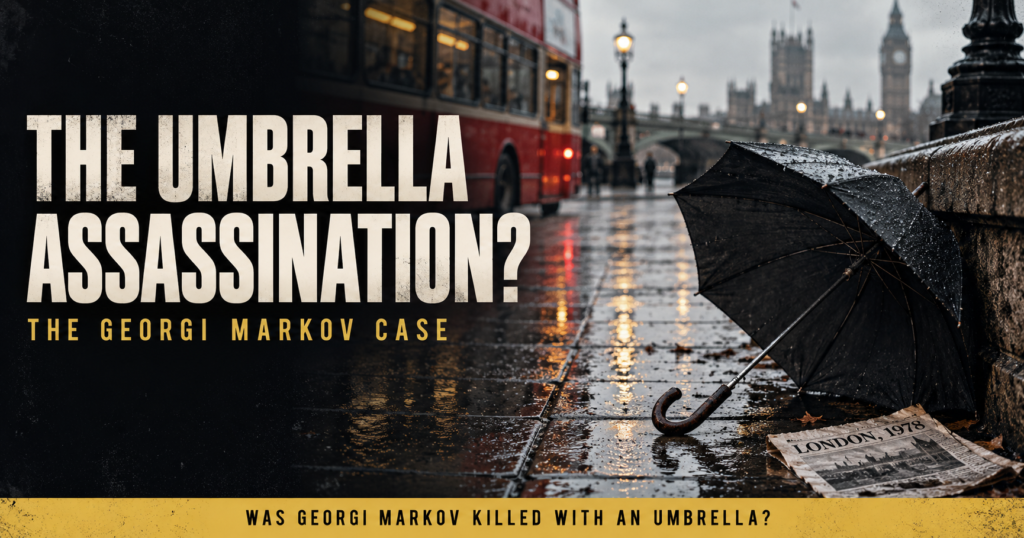
The stranger apologized.
That is one of the details Georgi Markov remembered after feeling a sharp sting in his thigh while waiting for a bus in London. He turned and saw a man picking up an umbrella. The man said he was sorry, then left in a taxi.
Four days later, Markov was dead.
The Georgi Markov umbrella assassination was a real killing involving a tiny metal pellet implanted in his leg. A coroner’s inquest attributed his death to ricin poisoning. An umbrella became the suspected delivery device, although exactly how the pellet entered his body remains a disputed part of the case.
I keep coming back to that apology.
It belongs to the kind of encounter you normally forget before you get home. Somebody bumps you. Something catches your leg. They apologize, and you both move on.
Markov’s account describes an encounter that small. The evidence found afterward made it horrifying.
September 7, 1978, on Waterloo Bridge
Markov was on his way to work at the BBC when the incident happened near a bus stop on Waterloo Bridge.
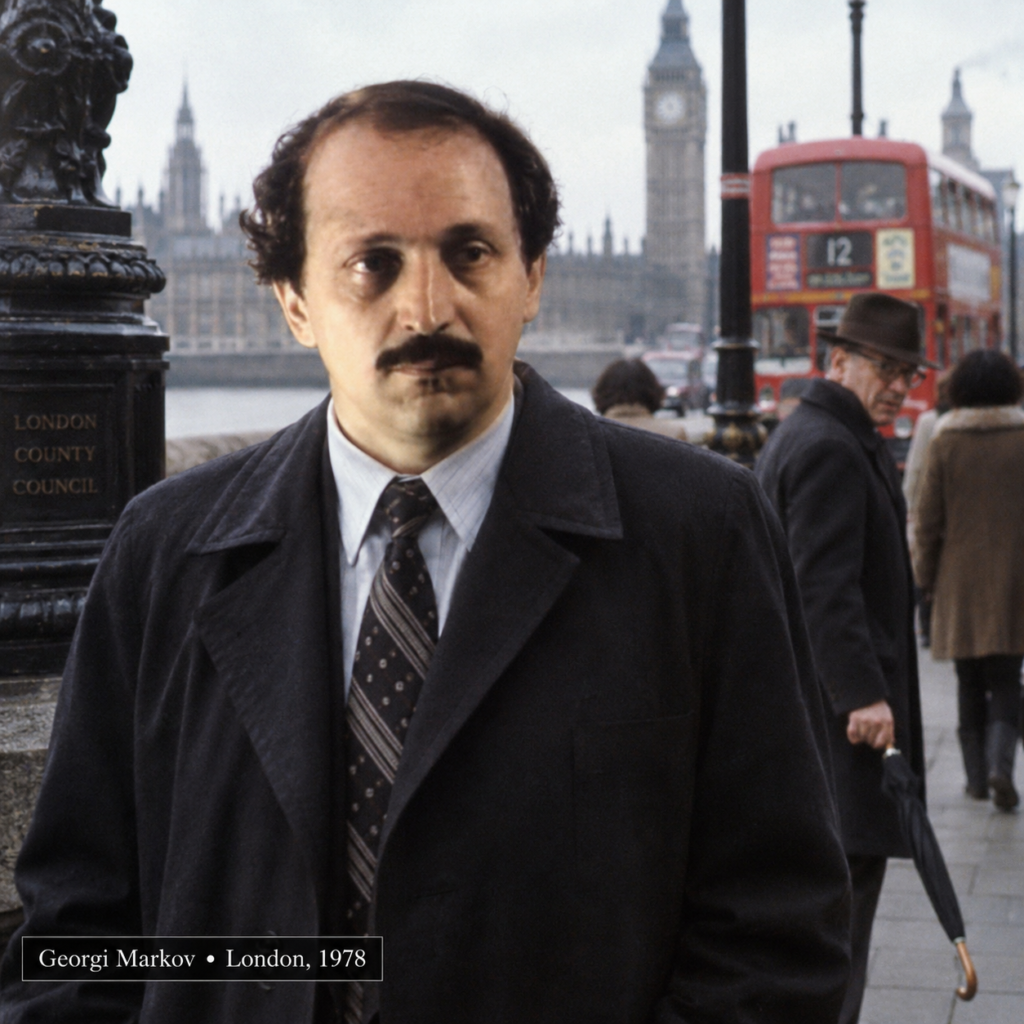
His account of feeling a sudden pain and seeing a man with an umbrella appears in the U.S. State Department’s historical record of the case.
There was no obvious shooting to explain what had happened. No weapon left beside him for investigators to examine.
The thing that mattered was already beneath his skin.
Markov died on September 11, 1978, at age 49. He left behind a wife and daughter.
The familiar nickname, “the umbrella murder,” can make the case sound like an ingenious puzzle. But a man had gone out to work and never came home again.
The object doctors found in his leg
After his death, investigators recovered a tiny metal pellet from Markov’s leg. Forensic specialist Christopher C. Green, who helped analyze the evidence, described it as a platinum-and-iridium alloy pellet.
Its importance was much greater than its size.
This was physical evidence that gave investigators something concrete to examine alongside Markov’s account of the stranger.
PBS’s investigation explains that scientists considered ricin as a possible poison. They also examined whether a coating could have kept material inside the pellet until after it entered the body. That coating was an explanation investigators explored, rather than something still present on Markov’s recovered pellet.
The January 1979 inquest ruled that Markov had been poisoned by ricin.
That sequence matters. The famous umbrella draws your attention, but the pellet is where the investigation becomes more than a strange story told from a hospital bed.

We saw a different use of concealed objects in the hollow nickel that led investigators into a Soviet spy case. There, an ordinary object carried a hidden message. Here, an ordinary object was suspected of concealing a way to kill someone.


Another man had survived something similar
The most unsettling turn in this case happened outside London.
Another Bulgarian exile, Vladimir Kostov, had survived an attack in Paris. Investigators recovered a second pellet from a wound in his back. PBS’s forensic account describes that pellet as identical to the one found in Markov.
Suddenly, the London evidence had a counterpart.
An isolated pellet presents one set of questions. A matching pellet recovered from another Bulgarian exile presents a much narrower and more disturbing set.
The State Department’s historical account records that, in October 1978, the CIA advised American diplomats that the poison-delivery method in the two cases was identical.
Kostov’s survival gave investigators evidence that Markov could no longer provide.
It also made the possibility of a repeated operation much harder to dismiss.
Why would anyone want Georgi Markov dead?
Before becoming the subject of a murder investigation, Markov was an acclaimed novelist and playwright.
He defected from Bulgaria in 1969 and later worked in broadcasting for the BBC, Deutsche Welle, and Radio Free Europe. His work included criticism of Bulgaria’s communist leadership, drawing on his personal knowledge of its ruler, Todor Zhivkov.
That personal knowledge matters.
A critic can argue that a government is dishonest. Someone who has moved through its intellectual and political circles can describe the people behind it, their behavior, and the gap between what they say publicly and how they live.
Markov’s broadcasts brought that kind of criticism to listeners. His series about meetings with Zhivkov made the leader himself a subject.
Leaving Bulgaria had put distance between Markov and the government he criticized. Broadcasting meant his words could still travel back.
That is the grim geography of the case: his audience remained within reach of his voice, while he apparently remained within reach of an attacker.
Was the umbrella definitely the murder weapon?
This is where the familiar version gets ahead of the evidence.
Markov reported seeing an umbrella immediately after feeling the pain. The device became central to accounts of the assassination. But seeing the object and proving its internal mechanism are different things.
In 2008, a senior Bulgarian investigator told Reuters that the theory of a poison-delivering umbrella had not been confirmed. The report preserved both the familiar account and that objection.
PBS’s interview with Green also describes the pellet as having been delivered “possibly” by a converted umbrella gun.
The careful answer is that Markov was fatally poisoned in the attack associated with the stranger and his umbrella, but the exact delivery device should not be treated as a fully settled fact.
I don’t think that uncertainty weakens the story. It reveals how much of the attack investigators could reconstruct, and where the reconstruction stopped.
A pellet was recovered. A man died. The object he noticed at the moment of injury became famous, while its precise role remained open to challenge.
What was the alleged KGB connection?
Former KGB general Oleg Kalugin later alleged that Bulgarian intelligence had requested Soviet assistance with Markov’s assassination.
The State Department’s historical account summarizes his claim that the request came on Zhivkov’s orders and that the KGB supplied expertise involving the poison and delivery method. It presents those statements as Kalugin’s allegations.
That attribution is important. A former intelligence officer’s account can be significant evidence without becoming a court verdict.
The case drew sustained attention to cooperation between Bulgarian and Soviet intelligence. Reporting based on communist-era files added further allegations about an agent known as “Piccadilly.”
But a suspected operation, a suspected organizer, and a proven individual killer are separate questions.
The last of those remained especially difficult.
The files didn’t produce a murder trial
Bulgaria closed its investigation in September 2013, when the applicable 35-year time limit expired.
Prosecutors had failed to identify, charge, or arrest anyone for the crime, according to reporting on the closure.
That is a very different outcome from the conviction in the paperboy’s discovery of a coded spy message. The Markov investigation uncovered extraordinary evidence without reaching the same kind of courtroom resolution.
Later archival reporting also challenged rumors that Markov himself had worked for Bulgarian foreign intelligence. A document dated December 1990 stated that he had not belonged to that service’s undercover apparatus.
Even the victim’s history had become something researchers needed to disentangle from claims circulated about him.
Questions About the Georgi Markov Murder
When did Georgi Markov die?
He died in London on September 11, 1978, four days after the attack on September 7. He was 49.
What poison killed Georgi Markov?
The coroner’s inquest attributed his death to ricin poisoning. Investigators recovered a tiny metal pellet from his leg during the forensic investigation.
Did Vladimir Kostov survive the other attack?
Yes. Kostov survived, and investigators recovered a matching pellet from his back. That evidence became an important point of comparison in the Markov case.
Was anyone convicted of killing Georgi Markov?
The Bulgarian investigation closed in 2013 without charges or arrests. Suspicions and intelligence accounts did not produce a conviction through that investigation.
Written under the pen name Evan Mercer for Stories in the Static, exploring documented spy cases, strange broadcasts, and the unanswered questions behind real mysteries.