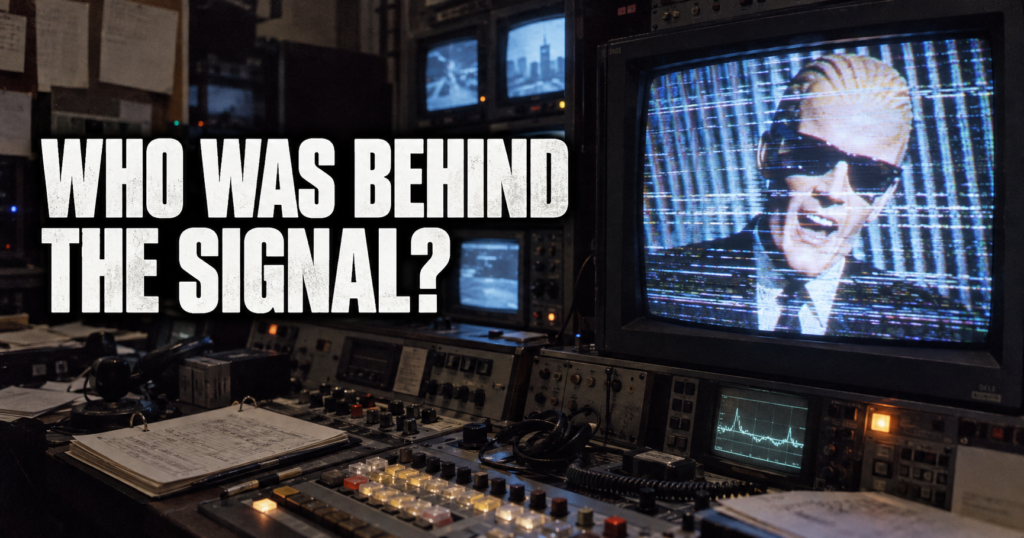
Someone interrupted the evening news wearing a rubber mask. The station stopped the intrusion, restored its programming, and continued the broadcast.
About two hours later, the masked figure appeared on another channel.
This time, the interruption lasted longer. There was distorted speech, a moving metal backdrop, and a performance that became increasingly bizarre. Then the picture disappeared, and the scheduled program returned.
That happened in Chicago on November 22, 1987. Two television stations had been hijacked in one night. The people behind the Max Headroom incident have never been publicly identified through a confirmed investigation. The available record still describes an unresolved case.
What makes this story unsettling is that the footage survives. We can see what viewers saw. We can hear much of what they heard.
But seeing someone perform a crime is different from knowing who they are.
The First Interruption Was Over Almost Immediately
The first target was WGN-TV.
At approximately 9:14 p.m., during the station’s evening sports coverage, an unauthorized image replaced the broadcast. A person wearing a Max Headroom mask swayed in front of a corrugated metal background. There was no intelligible speech.
The intrusion lasted less than half a minute. A WGN engineer changed the frequency of the link carrying programming from the studio to its transmitter, breaking the interfering signal’s hold. Contemporary reporting described the interruption as 28 seconds.
That first appearance could have remained a strange local television incident: a brief interruption, an apology, and a return to the sports report.
Instead, the person or group responsible tried another station.
Then the Figure Appeared During Doctor Who
Later that evening, WTTW viewers were watching Doctor Who when their program disappeared.
The masked figure returned in a longer intrusion, this time with audible but distorted speech. The segment lasted approximately 90 seconds.
In WTTW’s retrospective, air director Paul Rizzo recalled the staff’s growing stress as the station remained unable to remove the unwanted broadcast. The pirate signal eventually disappeared on its own, and Doctor Who resumed.
That difference between the two intrusions matters.
WGN interrupted the intruder. At WTTW, the staff could not immediately regain control.
For viewers, both appeared on the same familiar device in their living rooms. Behind the scenes, the stations faced different circumstances when trying to restore their programming.

What Was Actually in the Broadcast?
The recording is strange, but it is not completely random.
The figure wore a mask and sunglasses, moving in front of a metal panel that imitated the real Max Headroom character’s shifting background. The distorted speech included a reference to WGN personality Chuck Swirsky.
The performer also held up a Pepsi can and used the advertising phrase “Catch the wave,” a joke involving a character associated with Coca-Cola commercials. Contemporary reporting documented those details.
The segment ended with a crude prank involving another participant before normal programming returned.
There is no need to reproduce the explicit portion to understand the case. The important point is that the intrusion was a prepared performance, rather than an unexplained picture accidentally appearing on a television.
Someone wanted an audience.
The unresolved question is what they wanted that audience to understand.
Why Use Max Headroom?
Max Headroom was an established television character, not an identity invented for the hijacking.
The character’s artificial-looking presentation, irregular speech, and association with television made the disguise recognizable. His fictional world also involved the power of broadcasting and unauthorized transmissions.
That made the choice particularly fitting for a real intrusion into television programming.
Still, the choice of character does not establish a motive. It could support several interpretations: a parody, a technical stunt, a complaint about broadcasting, or an attempt to create something people would remember.
A fitting costume is evidence of a deliberate choice. It is not proof of the reason behind that choice.
That distinction is easy to lose when a mystery has been retold for decades.
How Could Someone Hijack a Television Station?
The leading technical explanation involves the links carrying programming from the stations’ studios to their transmission sites.
An interfering microwave signal could overwhelm the legitimate signal being received at the broadcast facility. Contemporary engineers discussed that possibility immediately after the incident.
This was not the same as breaking into a modern streaming account. It involved broadcast equipment and knowledge of the transmission system.
WTTW engineer Al Skierkiewicz later described the necessary expertise as a combination of broadcast, satellite, or amateur-radio knowledge.
The technical explanation helps make the event understandable. It also supplies a useful boundary: this was not something an ordinary viewer could accomplish simply by owning a television.
But knowing what skills an intruder probably needed does not identify the intruder.
What Investigators Had to Work With
The Federal Communications Commission investigated.
People who had seen the interruptions offered recordings, giving investigators material to examine rather than relying entirely on witnesses’ memories. That cooperation was reported shortly after the hijacking.
The footage provided the mask, background, speech, references, and visible performance.
Each detail might narrow a search. None necessarily points to a unique person.
A reference to a local broadcaster could come from an employee, a former employee, or a viewer. Technical ability could belong to someone working in broadcasting or someone with relevant experience elsewhere.
The temptation is to turn those possibilities into a profile so precise that it feels like an identification. The evidence does not justify that step.
Was It an Inside Job?
An inside job is one of the familiar theories.
The intruder’s technical knowledge and references to WGN make the idea understandable. Someone familiar with broadcasting might know where a system could be interrupted.
However, there is no confirmed public finding that a station employee carried out the hijacking.
Historical accounts also discuss people from the amateur-radio or hacker communities as possible participants. Those remain possibilities rather than established identities.
My concern with the inside-job theory is how quickly a reasonable question becomes a confident claim.
“Could an employee have done this?” is fair.
“An employee must have done this” requires evidence we do not have.
Did the Equipment Have to Cost a Fortune?
Early reporting included very high estimates for equipment powerful enough to cause the interference.
Later reporting presented a different assessment. WIRED described the lead FCC investigator’s view that surplus amateur-radio equipment could have been sufficient, provided the operators had substantial technical knowledge.
That disagreement is worth preserving.
We cannot inspect the actual equipment used, because the perpetrators have not been conclusively identified. Estimates depend on assumptions about how they operated and what equipment they obtained.
An expensive setup is possible. A less expensive arrangement using surplus equipment is also part of the published discussion.
Neither estimate supplies a name.
Captain Midnight Shows What a Solved Case Looks Like
The Chicago hijacking was not the first widely reported television signal intrusion.
In April 1986, a man calling himself Captain Midnight interrupted HBO with a message protesting subscription charges. Investigators identified John MacDougall, and the case produced a guilty plea.
Our account of how investigators caught Captain Midnight after the HBO hijacking follows the transmission requirements, equipment clues, and reported tip that helped narrow that investigation.
The comparison is useful because both stories involve an unauthorized broadcast, but their outcomes differ.
Captain Midnight has an identified perpetrator and a documented court outcome. The Max Headroom case has a surviving performance and an unresolved identity.
A similar crime does not guarantee a similar trail of evidence.
What Later Retellings Often Make Too Certain
Some versions of this story turn the unknowns into settled details.
They describe the intruders as employees, assign them a precise budget, or state that they operated from a particular rooftop. They may also assume that the longer WTTW performance proves WGN was the original target.
Those ideas can be discussed, but they should be identified as interpretations.
The broadcast’s references to WGN support interest in that station. They do not reveal every decision made before the intrusion.
Likewise, a technically plausible location is not a confirmed location.
An explanation can sound convincing while still depending on facts nobody has established.
The Recording Answers One Question and Leaves Another Open
The surviving footage makes it difficult to dismiss the event as an invented internet story. Contemporary reporting and the stations’ own accounts establish that the interruptions happened.
WTTW later revisited the experience with people who were there, including a viewer and station staff.
What the recording cannot do by itself is remove the disguise.
I think that is why this particular mystery holds attention. Usually, seeing the person responsible feels like a major step toward solving a case.
Here, the public can watch the performer repeatedly and remain no closer to a confirmed identity.
Was the Max Headroom hijacker ever caught?
The available public record does not establish that the perpetrators were caught or conclusively identified. The FCC investigation failed to identify the people responsible.
Did the hijacking happen in 1987 or 1989?
It happened on November 22, 1987. Contemporary newspaper coverage and WTTW’s retrospective support that date. Some later accounts contain an incorrect year.
Were both interruptions on the same station?
No. The first interrupted WGN-TV’s evening news. The second interrupted Doctor Who on WTTW later that night.
Was Captain Midnight the person wearing the Max Headroom mask?
There is no confirmed evidence connecting John MacDougall to the Chicago intrusion. Captain Midnight was a separate, identified perpetrator in the earlier HBO case. The Max Headroom perpetrators remain unidentified in the public record.
About this story: This is a real, documented event, not original fiction. Written by the Stories in the Static editorial team using contemporary reporting and broadcaster accounts, with theories clearly separated from established facts.
Pingback: Was the Vrillon Broadcast Real? The 1977 TV Mystery – Stories In The Static
Pingback: Why Does UVB-76 Keep Buzzing? The Russian Radio Mystery – Stories In The Static