
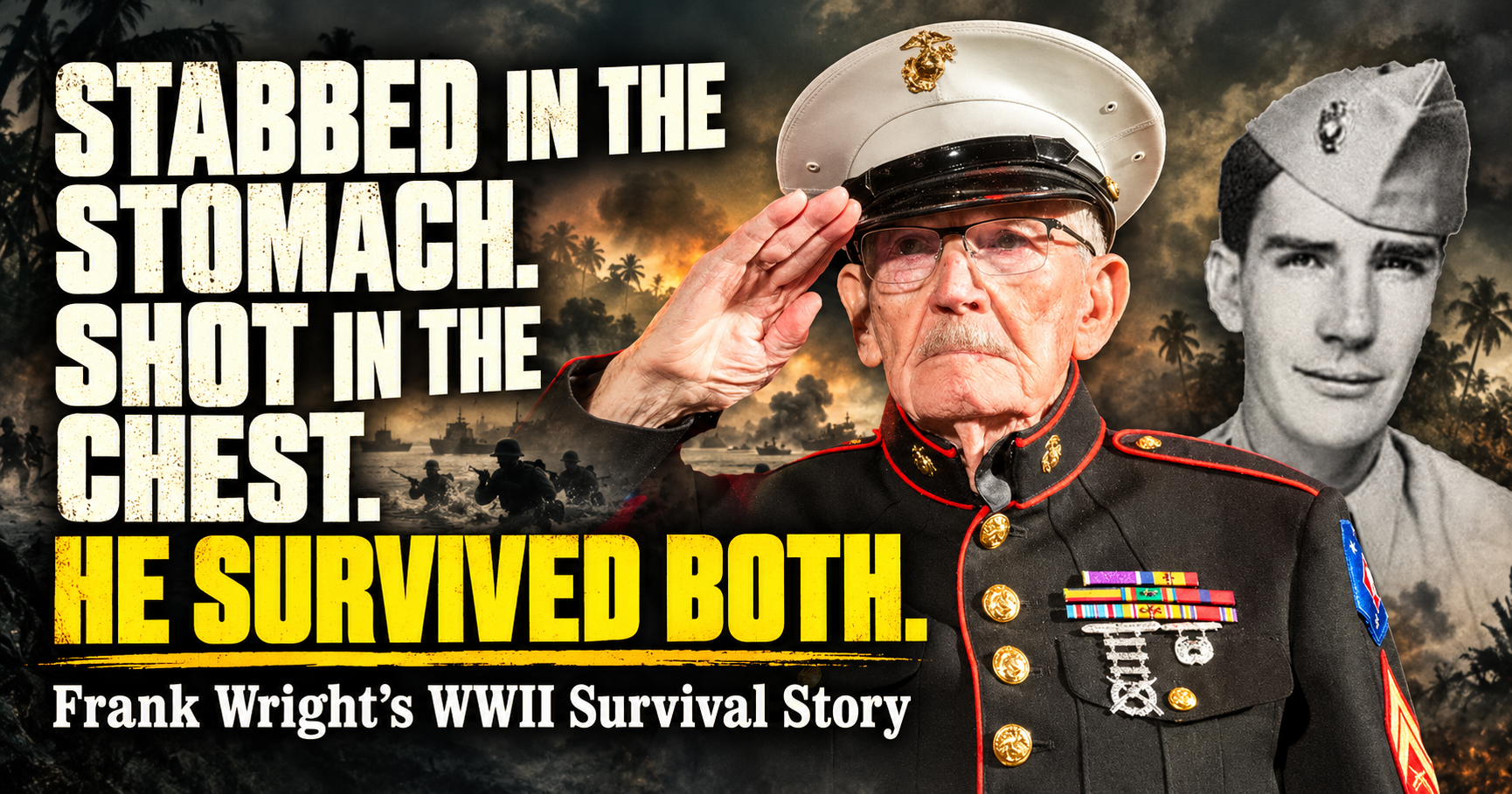
Frank Wright ran out of ammunition while enemy soldiers were still coming.
On Guam in 1944, the young Marine found himself fighting a Japanese soldier at bayonet range. Wright remembered being forced backward toward a foxhole he had been digging.
Then he lost his footing.
As he fell, the soldier stabbed him in the stomach.
Wright survived the attack. He later recalled that a Navy corpsman dressed his wound and told him to finish the patrol because he could still walk.
Months later, he was fighting on another Pacific island. This time, machine-gun fire struck his upper body, damaging his collarbone and puncturing a lung.
He survived again.
When I read about Wright, it is that return to combat that stays with me. The bayonet wound was already part of his past when he arrived on Iwo Jima. He had lived through something most of us struggle to imagine, and another battlefield was waiting.
He was still only 19.
The Bayonet Attack That Could Have Ended His Life
Wright described the fighting on Guam as close enough that the distance between two men could disappear in a few steps.
He recalled a Japanese attack, an empty rifle, and an opponent who pushed him backward. His fall exposed him at the moment the soldier thrust forward.
In his account, the attacker fell onto him after stabbing him.
The Marine Corps’ account of the struggle on Guam describes another Marine shooting the Japanese soldier during the encounter.
It is a grimly physical detail: Wright was wounded, on the ground, with the man who had stabbed him on top of him.
There is no comfortable distance in that kind of fighting. No hillside viewed through binoculars. No enemy position hundreds of yards away.
The threat was close enough to reach him with a blade.
Wright lived long enough to describe the encounter decades afterward. That distance in time can make a story feel safer to read. But knowing that an old man survived does not change what was happening to the young man on the ground.
He had no way to know how many more years were ahead.
“Able to Walk” Meant the Patrol Wasn’t Finished
The next part of Wright’s recollection is difficult to shake.
A corpsman treated his stomach wound. According to Wright, he was then told to finish the patrol because he remained able to walk.
That account appears in reporting drawn from Wright’s descriptions of his combat wounds.
The surviving public accounts do not give us a complete medical record of the stabbing. They do not explain the precise depth of the wound or identify everything the blade struck.
What Wright described was treatment followed by continuing the patrol.
I keep coming back to how differently that sentence reads from a civilian perspective. Being able to walk after a stabbing sounds like a reason to get someone to a hospital.
In Wright’s recollection, it meant he could keep going.
His survival on Guam did not bring his combat service to an end. He remained a Marine in a war that was moving toward Japan.



He Had Been Too Young and Too Light to Enlist
Two years earlier, Wright had faced a very different problem.
He wanted to join the Marine Corps, and the recruiting requirements stood in his way.
He was 16 when he enlisted on January 21, 1942. Using his older brother’s birthdate helped him get around the age requirement. Another account of Calvin Graham’s underage enlistment shows how some teenagers also concealed their ages to enter the military during World War II: Calvin Graham’s underage enlistment
He also needed to weigh more.
Wright described putting bananas in his clothing to add weight. The episode is included in the World War II Foundation’s documentary about his underage enlistment and Pacific service.
It is almost a funny image until you place it beside what came afterward.
A teenager was trying to make himself heavy enough to qualify for military service. He was solving the immediate problem in front of him.
He could not have known that the decision would carry him into a bayonet fight on Guam, or that he would later leave Iwo Jima with a damaged lung.
The boy who bent the rules to get into the Marines would spend the next several years discovering what that uniform could require.
How a Marine Raider Reached Guam and Iwo Jima
Wright served with the 4th Raider Battalion, one of the original Marine Raider units.
His service took him through the Solomon Islands before he fought on Guam and Iwo Jima. After the Raider units were disbanded in 1944, their Marines continued serving in other formations.
Wright later fought with the 21st Marines, 3rd Marine Division.
Those changes matter because his war was a succession of assignments, movements, and battles. He did not survive one extraordinary encounter and immediately go home.
Guam became something he had already endured.
Then came Iwo Jima, a small volcanic island where American forces landed in February 1945.
For Wright, it would become the place where his combat service finally ended.
The Famous Flag Photograph Wasn’t the End of the Battle
Most of us recognize Iwo Jima through one image: Marines raising an American flag on Mount Suribachi.
Joe Rosenthal took that photograph on February 23, 1945.
Wright’s reported gunshot wounds came on March 3.
That gap changes how I look at the picture.
The flag had gone up. The moment that would appear in history books had already happened. Wright was still on the island, and the injury that would force his evacuation was still ahead.
As the National Museum of the Pacific War’s history of Iwo Jima explains, the battle continued until March 26.
The photograph gave the world an enduring symbol. It could not show all the fighting that followed it.
For men still advancing against Japanese positions, the danger remained immediate.
Gunfire Struck His Chest and Punctured His Lung
On March 3, Wright was advancing uphill when enemy fire struck him.
Published descriptions of his wounds include damage to his chest, collarbone, lung, and arm.
After surviving the stabbing on Guam, he had now survived another attack capable of killing him.
This time, he was medically evacuated.
There would be no finishing the patrol as he had described doing after the bayonet wound. He needed treatment away from the fighting.
It is tempting to turn these two encounters into a story about a man who simply could not be killed. But that phrase makes his survival sound inevitable.
It wasn’t.
The wounds were real. So was the need to evacuate him. His story is remarkable because he lived through those injuries, not because he was somehow beyond their reach.
The second encounter finally took him out of combat.
It did not take him out of the Marine Corps.
He Recovered and Became a Drill Instructor
Wright recovered sufficiently to return to duty and serve as a drill instructor.
Think about the experience he carried into that job.
He had joined as a teenager. He had served with the Raiders, survived close combat on Guam, and been evacuated from Iwo Jima after being shot.
Now he was helping prepare other Marines.
He was honorably discharged in January 1946 as a corporal.
A civilian life followed. He earned a business degree, pursued a career as a business consultant, and remained involved with the military community.
There were decades beyond the wounds.
That is something I appreciate about being able to follow Wright’s story past the war. We get to see the person who continued living, working, and talking to younger generations.
He also wrote about his experiences in books, including Battles in the Pacific: World War II, My Personal War Causing PTSD and Iwo Jima: My Twelve Days in Hell.
The young Marine’s memories became something he could put into other people’s hands.
Eight Decades Later, His Sons Helped Promote Him
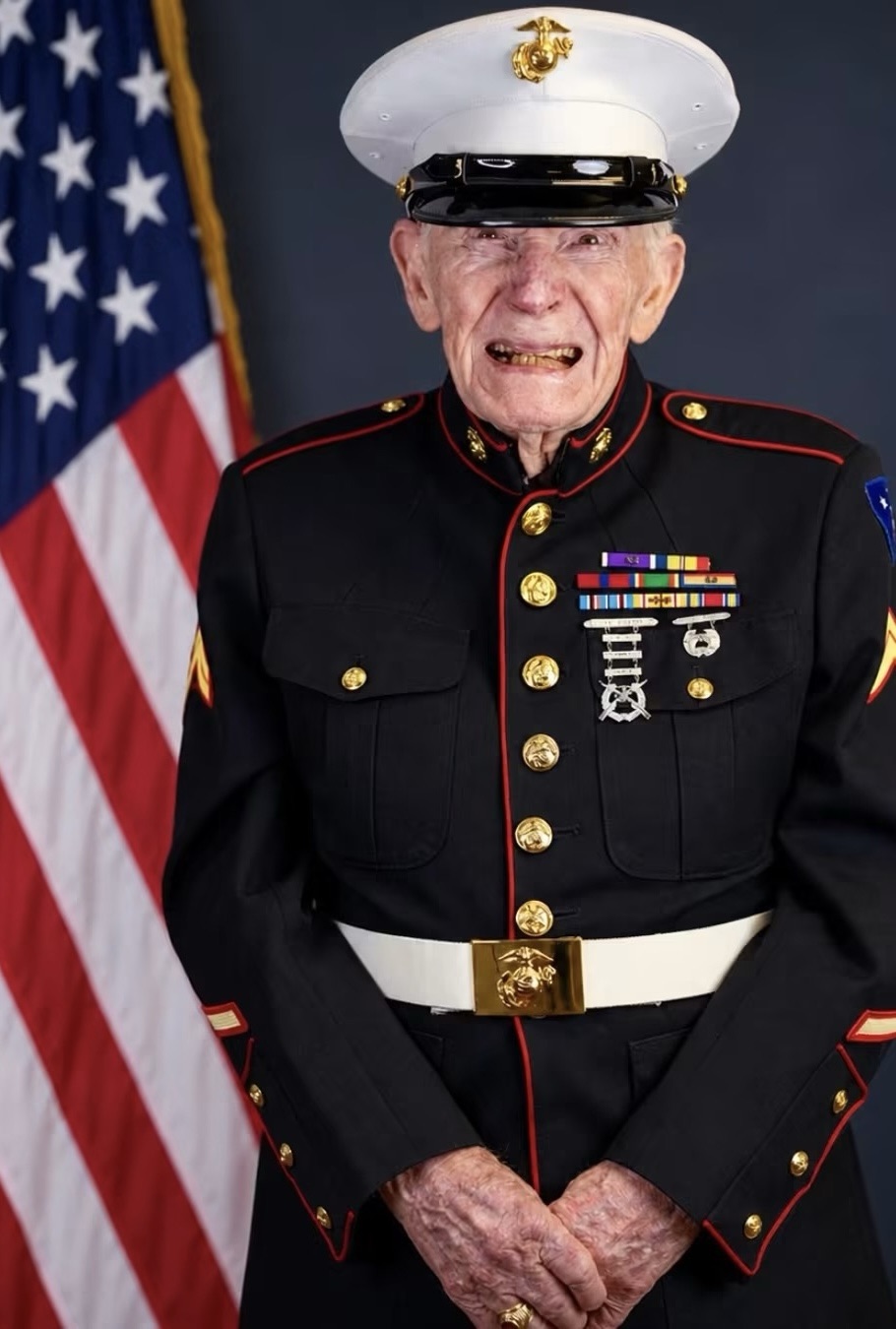
On August 31, 2025, Wright stood in a World War II-era Marine uniform at a ceremony in Stockton, California.
He was 100 years old.
His two sons placed sergeant’s chevrons on his uniform during an honorary promotion approved by Marine Corps Commandant Gen. Eric M. Smith.
According to the account of Wright’s promotion and his sons’ participation, becoming a sergeant had remained something he wanted long after leaving active service.
The honor recognized both his wartime service and his continued work within the Marine community.
Wright also wanted to know about the back pay.
After the bayonet, the gunfire, and the evacuation, there is something welcome about hearing that he could still make people laugh.
The Marine Corps feature records another statement from him:
“I am a Marine. Not was. Am.”

Questions About Frank Wright’s WWII Survival Story
Was Frank Wright stabbed in the stomach?
Yes. Wright recalled being stabbed with a bayonet during close combat on Guam in 1944. His account appears in interviews, reporting based on his memoir, and a Marine Corps feature.
Was he shot in the same battle?
No. The bayonet wound happened on Guam. His later gunshot wounds occurred during the Battle of Iwo Jima in 1945. These were separate encounters on different islands.
How did he survive the bayonet wound?
Wright described receiving treatment from a Navy corpsman and continuing the patrol. The published accounts do not provide a detailed medical explanation of why the abdominal wound was survivable.
What injuries did he suffer on Iwo Jima?
Published accounts describe gunshot wounds involving his chest and arm, a damaged collarbone, and a punctured lung. He was medically evacuated.
How old was Frank Wright during World War II?
He enlisted at 16 in January 1942. He was 19 during the fighting on Guam in 1944 and when he was wounded on Iwo Jima in March 1945.
Did he really become a sergeant at 100?
Yes. He received an honorary promotion in Stockton, California, on August 31, 2025. He had left active service as a corporal in January 1946.
Is this a true story?
Yes. Wright’s service, accounts of his combat wounds, and honorary promotion are documented. The details of the bayonet encounter come from his recollections of the fighting.
By Miles Rowan for Stories in the Static.