

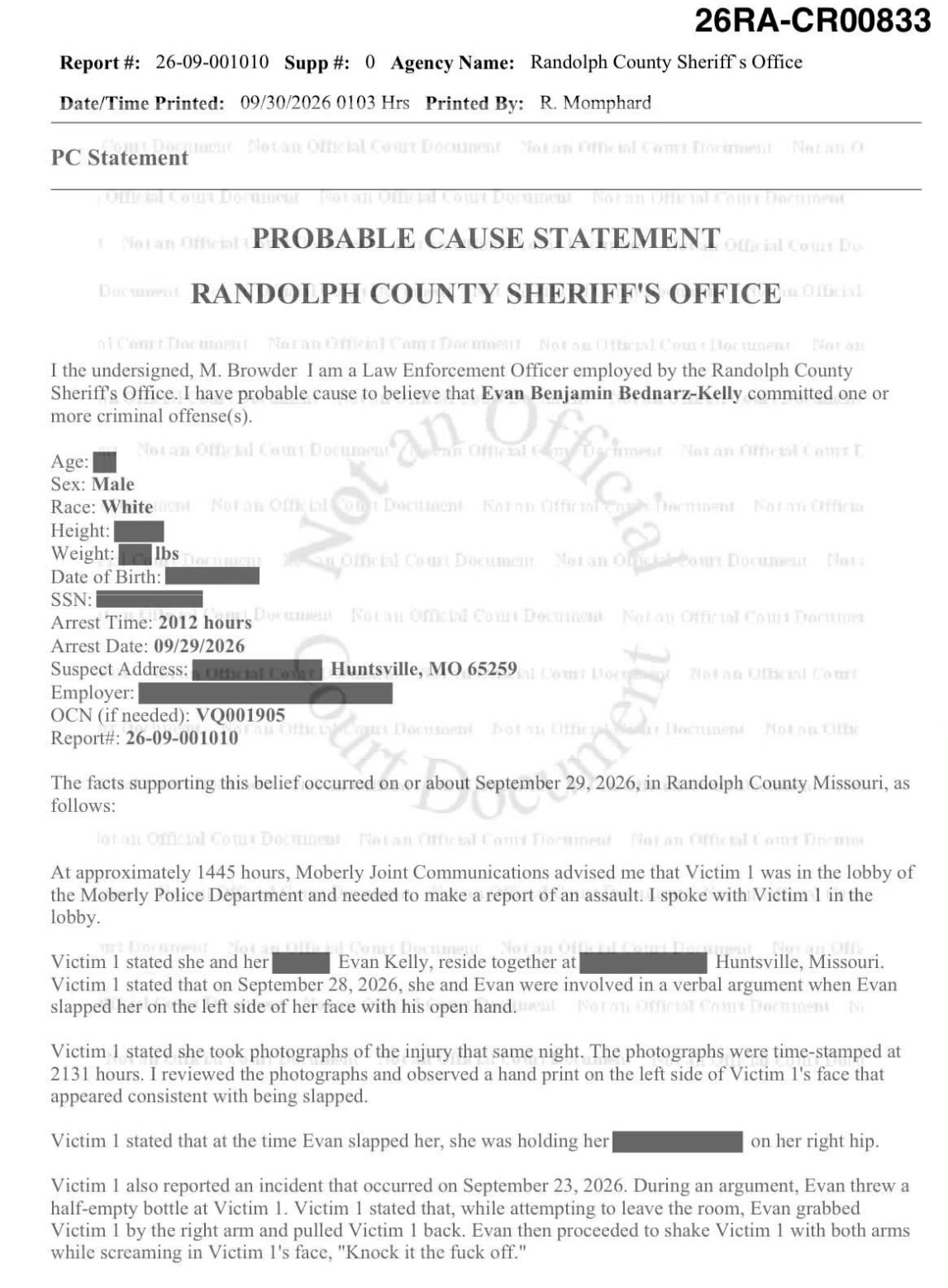
A woman told investigators she tried to leave the room.
According to her account, Evan Kelly grabbed her right arm and pulled her back. She said he shook her with both arms while shouting in her face.
Five days later, she reported another incident: an open-handed slap that allegedly left a handprint on her cheek.
By the following afternoon, she was at the Moberly Police Department reporting an assault.
Those allegations form the account recorded in a Randolph County probable cause statement naming Evan Benjamin Bednarz-Kelly. A social media post identifying him lists third-degree domestic assault, a Class E felony. Readers following allegations from Randolph County can also compare them with the Huntsville hammer-attack case, where the account includes a hospital departure and escape investigation.
The case has not been established by a conviction in the information available for this article. Bednarz-Kelly is presumed innocent unless proven guilty.
But the allegations deserve a closer look than a mugshot and a short caption. They describe two confrontations inside a shared home, including a moment when the woman said she attempted to walk away.
The Woman’s Account Began With an Earlier Argument
The first alleged incident described chronologically occurred on September 23, 2026.
The woman told investigators that during an argument, Evan threw a half-empty bottle at her.
The statement does not say the bottle struck her. It also does not identify what was inside it.
She said she then attempted to leave the room.
That was when, according to her account, he grabbed her right arm and pulled her back. She alleged that he shook her while shouting, “Knock the fuck off.”
The attempt to leave is the detail that stands out to me.
An argument can be described in a dozen ways. People can disagree over what was said, who raised their voice, or who started it. Here, the woman alleged a specific physical act: being pulled back when she tried to move away.
That allegation does not establish what happened by itself. It does explain why describing the complaint merely as a “dispute” leaves out a significant part of her account.
The statement does not tell us what started the argument or what happened immediately afterward. There is no basis to invent either.
Five Days Later, She Reported Being Slapped
The second alleged incident occurred on September 28.
According to the statement, the woman said she and Evan were involved in a verbal argument when he slapped the left side of her face with an open hand.
She told the officer that she photographed the injury that evening.
The officer, identified in the statement as M. Browder, wrote that he reviewed those photographs and observed a handprint on the left side of her face that appeared consistent with being slapped.
That gives this part of the account two distinct elements.
There is what the woman said happened. Then there is what the officer reported observing afterward.
The photographs reportedly showed an injury. Her account identified the person she said caused it and described the circumstances.
Neither should be stretched beyond what it establishes. An officer’s description of an injury is not a verdict about who caused it. But it is a concrete observation recorded alongside the allegation.



The Report at the Moberly Police Department
On September 29, at approximately 2:45 p.m., Moberly Joint Communications advised the officer that the woman was waiting in the lobby of the Moberly Police Department.
She needed to make an assault report.
The officer wrote that he spoke with her there. During that interview, she described the alleged slap from the previous evening and the confrontation she said had happened five days earlier.
She also reported that she and Evan lived together in Huntsville, Missouri.
That places the alleged events in the context of a shared home. The account concerns people living together, rather than an encounter between strangers.
What the statement does not establish is the full history of that household.
Two reported incidents should not be turned into an invented account of months or years of abuse. Nor should the absence of that history be mistaken for proof that these were the only problems.
The available account gives us two dates and the woman’s descriptions of what happened on them.
What the Injury Photographs Add to the Case
The officer recorded the photographs as having a timestamp of 9:31 p.m. on September 28, the same evening as the alleged slap.
That timing connects the pictures to the woman’s account of documenting the injury that night.
It does not tell us the exact time of the alleged assault. It also does not mean the officer witnessed the incident.
Those distinctions are easy to lose once a case begins circulating online.
A statement that an officer saw a mark “consistent with” a slap can become a claim that police proved every part of the allegation. A reported arrest can become a claim that someone has already been convicted.
The actual account is narrower, but still serious: a woman reported being struck, said she photographed the injury, and an officer described seeing a handprint in the pictures he reviewed.
Whether that evidence supports a conviction is a question the initial report cannot answer.



The Arrest Listed in the Statement
The statement lists Bednarz-Kelly’s arrest date as September 29, 2026, with an arrest time of 8:12 p.m.
The accompanying Central Dispatcher post identifies the allegation as third-degree domestic assault, a Class E felony.
An arrest is a development in a case, not its outcome.
The information reviewed for this article does not establish a conviction, a guilty plea, or a final disposition. It also does not establish his current custody status or provide a verified account of his response to the allegations.
There is no reason to treat those unanswered questions as evidence against him.
They are simply parts of the case that remain unconfirmed.
Why a Slap Can Lead to a Felony Allegation in Missouri
Some readers may see “third-degree” and assume the allegation is relatively minor.
Missouri law gives that term a specific meaning.
Under the statute applicable at the time of these alleged incidents, third-degree domestic assault includes attempting to cause physical injury or knowingly causing physical pain or illness to a person covered by the law’s definition of a domestic victim. It is classified as a Class E felony.
The classification does not require us to speculate about injuries that were never reported.
It explains why an allegation involving a slap and physical pain can be treated seriously under the law, even when the available account does not describe hospitalization or a life-threatening injury.
Prosecutors still must establish the elements of the offense. The label attached to an allegation does not do that work for them.
Huntsville, Moberly, and the County Confusion
The social media caption describes a “Macon County man,” while the statement identifies a shared residence in Huntsville and places the alleged events in Randolph County.
Moberly appears in the account because that is where the woman reported the alleged assault to police.
Those locations describe different parts of the story: where the woman said they lived, which county the statement associates with the alleged events, and where she spoke with an officer.
The available account does not explain the Macon County description. It should not be used to relocate the alleged incidents.
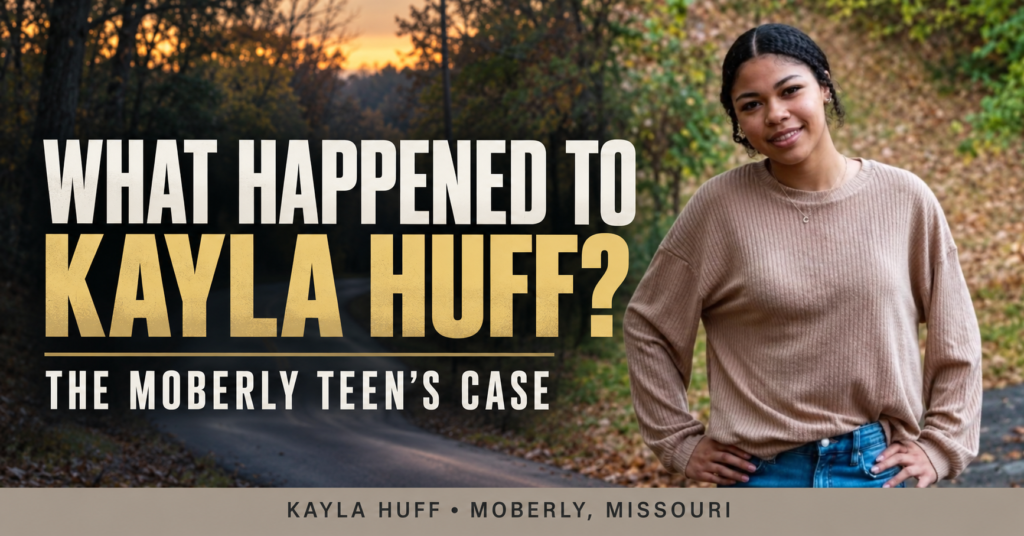
For readers following other cases from the area, our coverage of the Kayla Huff case in Moberly examines a separate story. There is no connection established between the two cases.
What Happens After an Allegation Reaches Court?
A probable cause statement is an early account of the facts an officer presents as grounds for believing an offense occurred.
Missouri’s felony rules distinguish that stage from a final determination of guilt. Sufficient facts showing probable cause can support a summons or, when the required circumstances exist, an arrest warrant.
For someone following this case, the next meaningful developments would be the exact filed charge, the defendant’s response, any court rulings, and the eventual disposition.
Those developments matter more than how many times a booking photograph gets shared.
The woman’s reported account is serious. So is the obligation to describe the accused person’s status accurately. Both can be respected without weakening the story.


Questions About the Evan Bednarz-Kelly Case
What is Evan Bednarz-Kelly accused of?
The Central Dispatcher post lists third-degree domestic assault. The accompanying statement records a woman’s allegations that he slapped her during one argument and threw a bottle, grabbed her arm, and shook her during an earlier confrontation.
When did the alleged incidents happen?
The woman reported incidents on September 23 and September 28, 2026. The statement lists an arrest on September 29.
What did the officer say about the photographs?
The officer wrote that photographs taken after the alleged September 28 incident showed a handprint on the left side of the woman’s face that appeared consistent with being slapped.
Did the bottle allegedly hit the woman?
The visible statement says she reported that a half-empty bottle was thrown at her. It does not say the bottle struck her.
Has he been found guilty?
A conviction was not established in the information reviewed for this article. Bednarz-Kelly is presumed innocent unless proven guilty.
Is this the complete account of the case?
No. The available probable cause statement is an unofficial copy of page one of a two-page document. The complete filing and current court docket were not independently verified.
By Miles Rowan for Stories in the Static.