
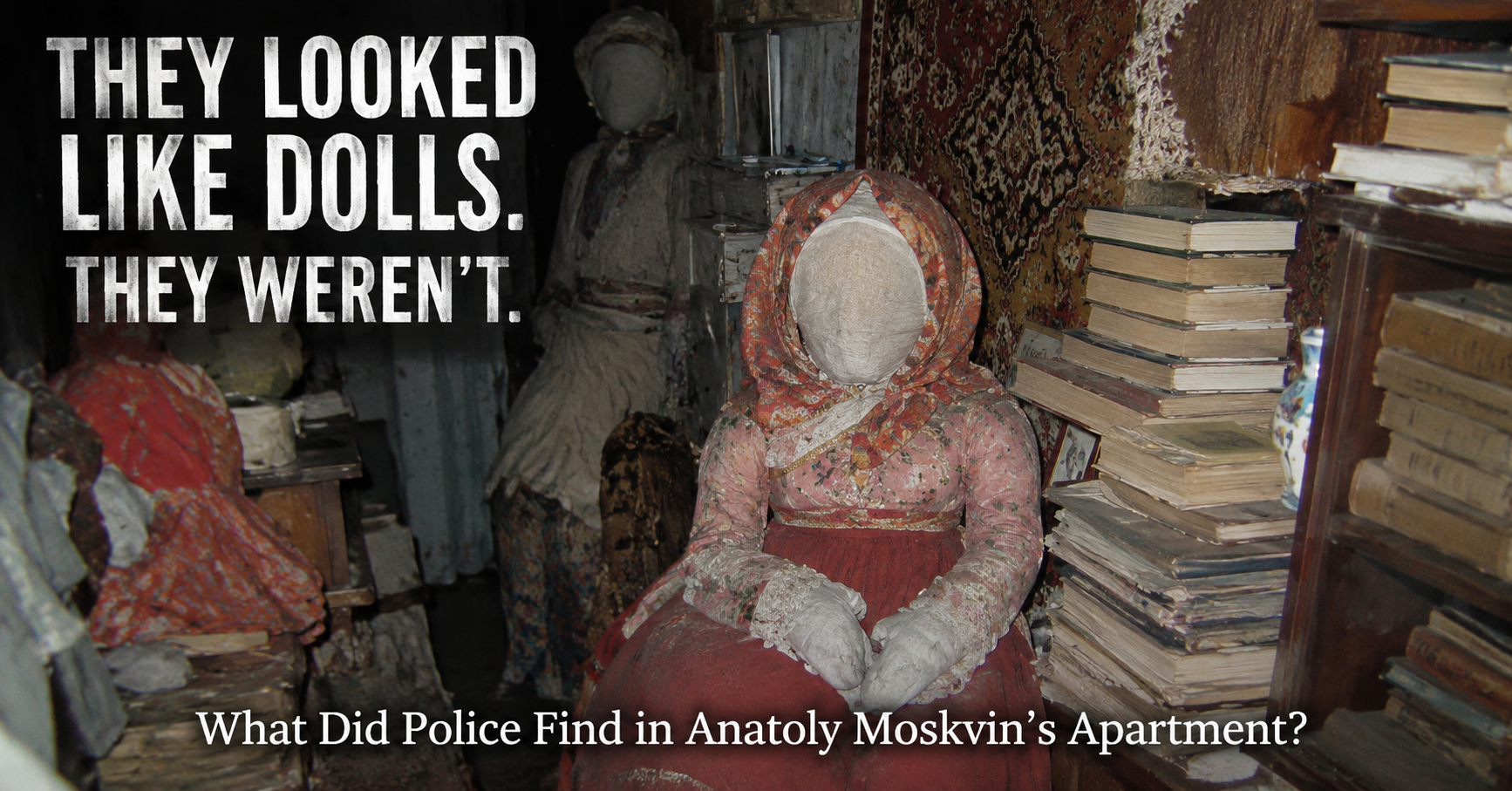
The figures wore dresses.
They sat among books, papers, and the everyday clutter of an apartment in Nizhny Novgorod, Russia. At a glance, they resembled large homemade dolls.
Then investigators discovered what was inside them.
In November 2011, police revealed that Anatoly Moskvin had been taking human remains from cemeteries and turning them into figures he kept at home. The discovery became international news, accompanied by police footage of the crowded rooms.
What unsettles me most is the setting.
An apartment is supposed to be familiar territory. Somewhere people read, eat, leave things on chairs, and go about their lives. In this one, human remains had become part of the furnishings.
But calling Moskvin a killer would tell the wrong story.
The case concerned the desecration of graves and bodies. The people whose remains he took were already dead.
That distinction makes what happened different. It does not make it easy to comprehend.
What did police find in Anatoly Moskvin’s apartment?
Police found doll-like figures containing human remains taken from graves. They had been dressed and positioned around the apartment.
Early official statements described 28 figures in the home and another body in a garage. Later accounts commonly identify 26 bodies, so the widely repeated number 29 should be understood as the initial reported count rather than an uncontested final total.
The discovery went beyond a collection of disturbing objects. Investigators were looking at the remains of people who had been buried, removed, and brought into someone else’s home.
A cemetery normally gives a family a place to return to.
Moskvin had broken the connection between the marker aboveground and the person believed to be resting beneath it.
The historian who knew the cemeteries
Moskvin was 45 when the discovery became public.
He was known locally for his work on cemeteries and regional history. His interest in burial grounds was not a secret that emerged after his arrest. It was part of his public identity.
That detail changes the way I read the case.
Someone spending hours in cemeteries might ordinarily attract questions. For a person known to study them, the same activity could appear entirely consistent with his work.
It would be unfair to suggest that studying graves is itself suspicious. Historians, genealogists, and preservation volunteers do valuable work in cemeteries.
The disturbing part is what investigators found behind this particular researcher’s public reputation.
His knowledge of burial places existed alongside his removal of the people buried there.

The moment a “doll” became something else
In a later television interview, retired police colonel Alexei Trifonov recalled officers finding unusually large figures.
When they moved them, their weight prompted closer inspection. An officer opened the clothing and found human remains inside.
The investigator’s recollection of the apartment search describes a discovery that became more disturbing as officers examined what they were seeing.
That is the point in the story I keep returning to.
Before the discovery, a figure might be understood as an eccentric homemade object. Afterward, the same clothing and shape mean something entirely different.
Nothing in the room has changed.
The explanation has.
Why the ordinary details matter
The early police footage showed books, fabric, furnishings, and figures positioned around the rooms.
Those surroundings matter because they place the discovery inside a lived-in home. This was not a collection arranged in a sealed underground chamber.
The horror comes from recognizing the setting and then having to reconsider it.
I do not need an invented account of a strange smell, a neighbor hearing something, or an officer whispering a dramatic line. The documented discovery already gives us enough to sit with.
How was Anatoly Moskvin caught?
The search developed out of an investigation into cemetery desecration.
Investigators were examining damage to burial sites when their inquiries led to Moskvin. Searching his property exposed the human remains.
Later reporting connects the inquiry with vandalism at Muslim graves, although accounts of the broader case contain different descriptions of individual offenses and motives.
The basic sequence is important: investigators following damage in cemeteries discovered what had been taken into a home.
A retrospective examination of the cemetery investigation describes how the search brought those two parts of the case together.
That is a more useful account than assuming someone simply noticed a creepy collection and called the police.
It also brings us back to the graves. The story did not begin at the apartment door.

Were the remains those of children?
Later accounts of the investigation describe the remains of young girls, including children.
Early international reports were less consistent, referring variously to female bodies, young women, girls, skeletons, and mummified remains.
Those differences help explain why summaries of the case can look contradictory.
For a reader encountering the story today, the essential point is that this involved the removal and treatment of children’s remains, not merely discarded objects or unidentified anatomical specimens.
It is easy for the word “dolls” to take over the story.

But each set of remains belonged to a person. Before the apartment and the police footage, there had been a life, a death, and a burial. A related case shows how the identity of a dead person could also disappear behind the public display of the story of Elmer McCurdy’s remains.
The nickname describes what Moskvin made. It should not replace who those people were.
Why did Moskvin keep the bodies?
Accounts of his explanations describe him treating the figures as children and referring to them as daughters.
Other reported statements describe beliefs about communicating with the dead or eventually restoring them to life.
Those are accounts of his beliefs. They are not evidence that he could communicate with anyone who had died.
They also do not give us a simple, complete explanation for his actions.
I think “he wanted a family” is too tidy a way to summarize this case. It can make the removal of someone else’s child from a grave sound like a dark but understandable substitute for parenthood.
The people involved already belonged to families.
Whatever meaning Moskvin attached to the figures, he had no right to replace those relationships with his own.
Understanding a belief does not make it true
It is possible to report what Moskvin said without adopting his description of events.
That distinction matters particularly when someone describes a violation as an act of care or rescue.
The claim tells us something about how the person explains his behavior. It does not establish that the behavior helped anyone.
The court’s response would depend heavily on psychiatric findings rather than on the public’s reaction to the photographs.
Was Anatoly Moskvin a serial killer?
The documented case does not establish that Moskvin killed the people whose remains he kept. His legal proceedings concerned the desecration of bodies and burial places.
That is why describing the apartment’s contents as a murder victim count would be inaccurate.
Someone can commit a serious offense involving human remains without having caused the person’s death.
The distinction also matters when discussing what actually makes someone a serial killer. The number of bodies associated with a person does not, by itself, establish a series of killings.
Moskvin’s case is disturbing on its own terms.
Adding murders that the evidence does not establish makes the account less truthful without making it more revealing.
What happened to him after the discovery?
Moskvin underwent psychiatric assessment.
Reporting on the proceedings described a diagnosis of schizophrenia and findings that he could not understand or control his actions in the manner required for criminal responsibility.
He was placed under compulsory psychiatric treatment beginning in 2012. The courts subsequently reviewed and repeatedly extended that treatment.
That outcome should not be confused with a conventional prison sentence.
A fixed sentence counts down toward a specified end. Compulsory treatment involves a different legal process, including medical assessments and court decisions about whether it should continue.
It would also be wrong to treat one extraordinary case as an explanation of schizophrenia generally. Reporting a diagnosis in a particular proceeding does not make everyone with that diagnosis resemble the person involved.

Where is Anatoly Moskvin now?
The latest court update verified for this article reported another extension of his inpatient treatment on July 31, 2026.
Kommersant reported that the Leninsky District Court in Nizhny Novgorod extended the compulsory medical measures by six months.
The July 2026 report on his continued treatment attributed the information to the court. It supports a dated account of his status rather than an open-ended claim that his circumstances can never change.
That date matters when older stories circulate again.
A headline saying someone “could be released” does not mean a release occurred. A proposal, an assessment, and a court order are different events.
Why this case feels different from other preserved-body stories
We have explored remains preserved by freezing, scientific intervention, and circumstances that sent bodies into public display.
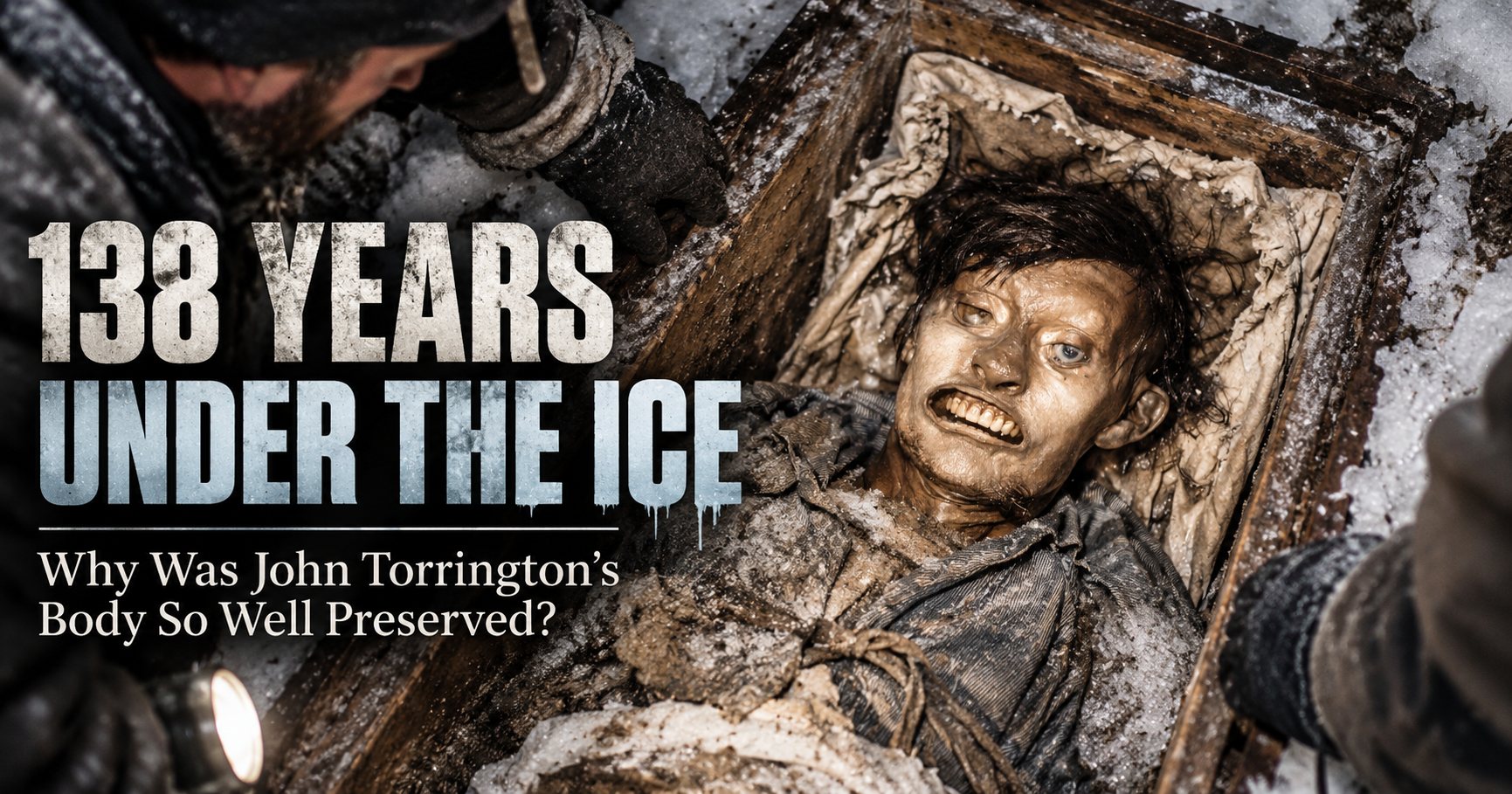
In John Torrington’s frozen Arctic grave, researchers temporarily opened a burial to investigate a historical disaster.

The history behind Diogo Alves’s preserved head raises different questions about punishment, scientific beliefs, and the treatment of the dead.
Moskvin’s apartment presents another situation: remains taken from graves and incorporated into a private world.
What unsettles me is the removal of choice.
The dead could not object. The families had not agreed. An individual’s beliefs had overridden the burial arrangements other people understood to be final.
Questions about Anatoly Moskvin
Was the Anatoly Moskvin doll story real?
Yes. Police publicly reported the discovery in 2011 and released footage of the apartment. Subsequent legal and medical proceedings are also documented.
How many bodies were found?
Initial reports described 29, including one found in a garage. Later accounts commonly identify 26 bodies. The difference should be acknowledged rather than disguised as a perfectly settled count.
Did Anatoly Moskvin murder anyone?
The documented case concerned grave and body desecration. It does not establish that he murdered the people whose remains he removed.
Did his parents live in the apartment?
Reports describe him sharing the apartment with his parents. Accounts of exactly what they understood about the figures should be treated carefully rather than used to invent an explanation of their knowledge.
Why was he sent to a psychiatric hospital?
Psychiatric findings led to compulsory treatment rather than an ordinary criminal punishment. Courts repeatedly reviewed and extended those medical measures.
Was he released?
The July 31, 2026, court update verified for this article reported another six-month extension of inpatient treatment.
Why are the figures called dolls?
The remains had been dressed and arranged to resemble large human figures. “Dolls” describes their outward presentation. Beneath that appearance were the remains of real people.
There is a point where the apartment photographs stop being enough.
The dresses explain why the discovery attracted attention. The graves explain why it mattered.
Somewhere outside those rooms were markers bearing names, places people had expected to remain undisturbed. That is the part of the story I would keep in mind after closing the photographs.
Written by the Stories in the Static team, exploring unsettling history, unusual criminal cases, and the people behind the headlines.