
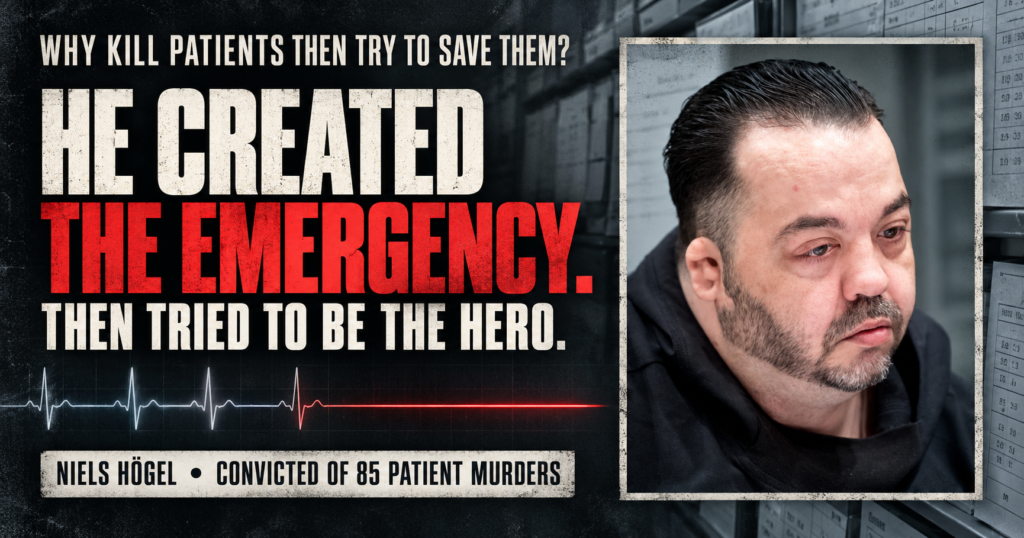
When a patient’s heart stopped, Niels Högel wanted to be the person who brought them back.
A former colleague described him pushing other staff aside during resuscitations. Less experienced doctors appreciated his help. His colleagues gave him a nickname: “resuscitation Rambo.”
What they did not know was that he was creating medical emergencies himself. He administered drugs that put patients’ lives in danger, then participated in the effort to revive them.
The apparent rescue was part of the attack.
That is the detail I keep coming back to. Someone could watch Högel working desperately to save a patient and believe they were witnessing the best of nursing. They were watching the man responsible for the crisis.
In June 2019, a German court convicted him of 85 murders. Those convictions concerned patients at hospitals in Oldenburg and nearby Delmenhorst.
But the question behind this case goes beyond how many people died.
Why would someone deliberately endanger a patient, try to save them, and then do it again after the rescue failed?
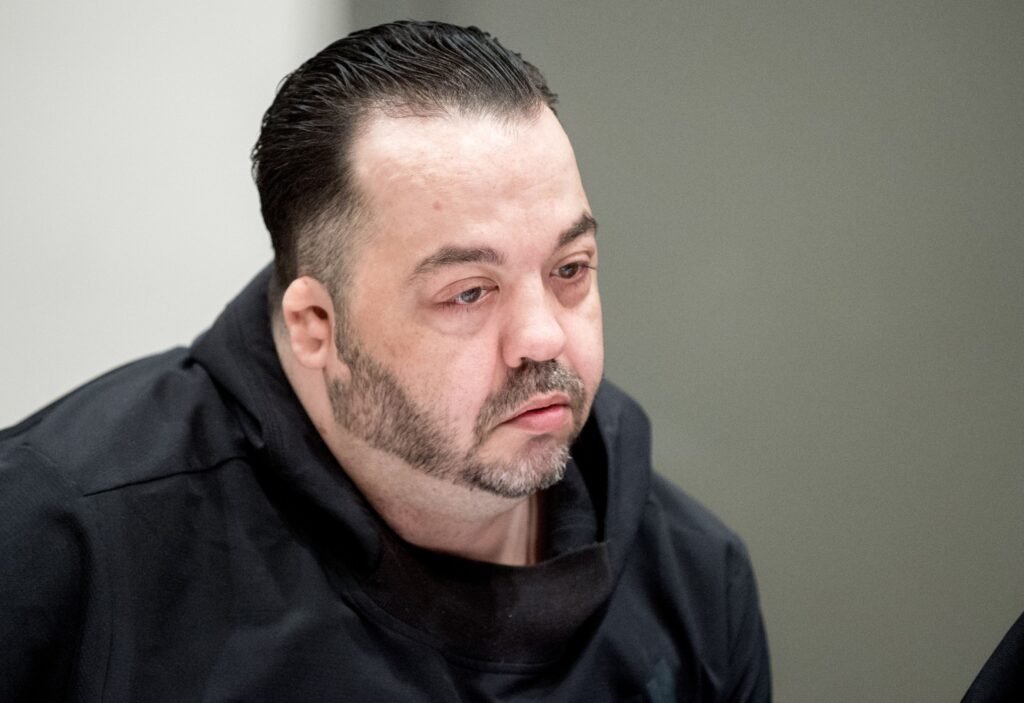
He Wanted the Emergency, the Excitement, and the Credit
The court’s explanation centered on boredom and a desire to demonstrate his resuscitation skills.
According to reporting on the written judgment, Högel deliberately brought patients into life-threatening situations so he could present himself as a hero. He also regarded many doctors and fellow nurses as incompetent and considered himself superior.
In that pattern, a patient’s deteriorating condition gave him something he wanted: an opportunity to perform.
Psychiatrist Karl Beine, who has studied killings by healthcare workers, told Deutsche Welle that Högel sought recognition from colleagues and the excitement of a successful resuscitation. Beine’s assessment was that external admiration supported Högel’s unstable sense of self. That is an expert interpretation, rather than a complete account of every thought behind his crimes.
The behavior itself is easier to establish.
He created a crisis. He stepped into it. If the patient survived, he had an opportunity to receive praise.
If the patient died, that did not stop him from endangering someone else.

Our look at high-victim serial killers and their motives includes Högel because his case exposes how recognition and access can become part of a repeated killing pattern.
Were the Deaths Just Failed Rescue Attempts?
Calling them failed rescues leaves out the first thing Högel did.
The patients needed emergency treatment because he had deliberately put them in danger.
He administered medications without a legitimate medical reason, triggering potentially fatal cardiac or circulatory crises. His later participation in resuscitation did not undo that initial act. The court convicted him of murder, and Germany’s Federal Court of Justice upheld the judgment in 2020.
A rescue attempt can look compassionate when viewed on its own.
Here, it belonged to a sequence that began with deliberate harm.
That also explains why the familiar description of a healthcare killer “ending suffering” does not fit the court’s account of Högel’s motive. His patients became opportunities to display his abilities.
Some were seriously ill. Others were recovering. The victims in the 2019 case ranged from 34 to 96 years old.
Being in a hospital made them accessible to him. It did not make their deaths inevitable.


The Warning That Followed Him Out of One Hospital
Before Högel was caught in Delmenhorst, concerns had already developed at Oldenburg.
Reporting on the written judgment describes unusual events during his shifts and a decision to remove him from his position. He was offered a choice: move to a role transporting patients, or leave with continued pay for several months and a favorable employment reference.
He chose to leave. He subsequently worked at Delmenhorst.
That employment reference deserves more attention than it usually gets.
A reference is how one workplace tells another what kind of employee it is receiving. In this case, the favorable assessment traveled onward while the concerns failed to stop him from obtaining another hospital job.
Suspicion at one institution became a fresh opportunity at another.
For me, that is one of the most revealing parts of the case. Högel’s access did not depend only on fooling individual patients. It also depended on decisions made by people who already had reasons to question him.
The related story of how Harold Shipman continued killing his patients raises a similar question: what happens when a trusted medical professional becomes the subject of concern, but the response fails to protect the next patient?
What Finally Exposed Him?
In June 2005, fellow nurses at Delmenhorst caught Högel manipulating a patient’s syringe driver, the device used to administer medication.
A colleague observing an act was different from colleagues noticing a troubling pattern.
It gave investigators a specific event to examine.
Even then, catching him did not immediately reveal the scale of the killings. The case expanded through successive proceedings and further investigation. In 2015, he received a life sentence for two murders and two attempted murders. Investigators subsequently examined hundreds of deaths.
The investigation required going backward through hospital deaths that families had already mourned.
More than a hundred bodies were exhumed and examined for traces of medication. Medical experts became central to determining which deaths could be attributed to Högel.
Stopping him and reconstructing what he had done were separate tasks.
The second took years.


Why the Court Could Not Give Every Family an Answer
Högel faced 100 murder charges in the trial that ended in June 2019.
The court convicted him on 85 counts and acquitted him on 15. Medical evidence in those 15 cases did not establish his responsibility with the certainty required for a conviction.
The court also described difficulties caused by the years between the deaths and the investigation, unreliable statements from Högel, and witnesses who appeared unwilling to provide truthful accounts.
There was another permanent obstacle: some possible victims had been cremated. Their remains could no longer be examined.
An acquittal on a particular charge therefore should not be rewritten as proof that investigators established a natural death. It means the prosecution did not prove that murder charge to the required standard.
For a family, that can leave the central question unresolved.
They know Högel killed patients. They know their relative was under his care. They may still never know whether their own loss belongs to the murder series.
That is why our comparison of serial killers’ victim totals separates established findings from larger suspected counts. A missing piece of evidence cannot honestly be replaced with a more dramatic number.
Were His Former Colleagues Convicted Too?
No. In October 2022, the Oldenburg court acquitted all defendants in the related proceedings against hospital employees.
The court found that considerable mistrust of Högel had developed at Oldenburg. However, the evidence did not establish the intent required to convict the defendants of assisting killings through a failure to act. Potential negligence offenses were time-barred.
This complicates the easy version of the story in which everyone around him knowingly allowed murder.
The findings support a more precise account: there were serious concerns, but the later criminal case did not prove the particular charges against those employees.
That leaves room to examine the hospital decisions without falsely calling acquitted people accomplices.
The Names Behind the Number
At the 2019 verdict, the presiding judge read the victims’ names individually. The court also acknowledged that it had been unable to give every participating family certainty.
That act of reading the names brings the case back into focus.
Högel sought attention for his ability to intervene in emergencies. The investigation forced attention onto the people whose lives he had used to create them.
The number tells us the scale. The names tell us what was lost.
Frequently Asked Questions
Why did Niels Högel kill patients?
The court’s account identified boredom and a desire to impress colleagues through resuscitation. He deliberately created life-threatening situations so he could demonstrate his skills and appear heroic.
Did Niels Högel really try to save his victims?
He participated in attempts to resuscitate patients after deliberately causing their medical emergencies. That involvement did not erase his responsibility for putting them in danger. Many patients died.
How many murders was Niels Högel convicted of in 2019?
He was convicted of 85 murders in the 2019 trial and acquitted on 15 additional charges. The figure describes that trial’s verdict, rather than establishing a complete total for every suspected death.
How was Niels Högel caught?
Fellow nurses caught him manipulating a patient’s syringe driver at Delmenhorst in June 2005. Later investigations uncovered a much larger pattern.
Was Niels Högel found legally responsible for his actions?
Yes. Reporting on the written judgment states that his criminal responsibility was not diminished. His murder convictions were subsequently upheld on appeal.
By Miles Rowan for Stories in the Static, examining criminal cases through overlooked evidence, unresolved questions, and the lives behind the headlines.