

The television picture kept going. The voice no longer belonged to the program.
On November 26, 1977, viewers in parts of southern England heard an unfamiliar speaker interrupt their evening television. The voice claimed to represent an extraterrestrial organization and delivered a warning to humanity.
The interruption became known as the Vrillon broadcast, or the Southern Television broadcast interruption. It was a real intrusion into television audio. That does not establish that the speaker was an alien.
That distinction is where I think this story gets interesting.
Someone apparently made an extraordinary claim through an ordinary television system. Decades later, people still argue about the claim, while some surprisingly basic details of the event remain inconsistent.
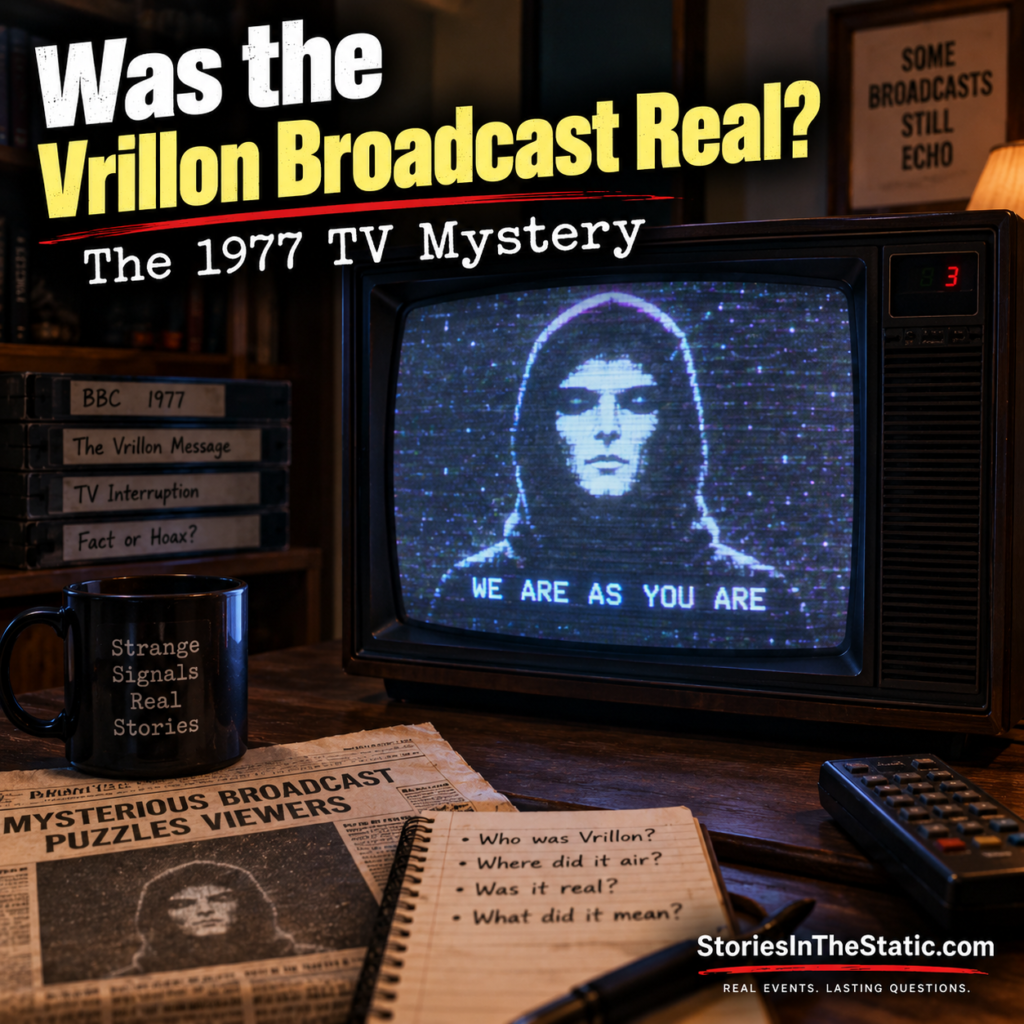
A Voice With a Message for Humanity
The interruption happened shortly after 5 p.m. on a Saturday, during Southern Television’s early-evening programming.
Accounts describe a distorted voice identifying itself as Vrillon, a representative of the Ashtar Galactic Command. Its message urged humanity to abandon weapons and live peacefully.
There was no spacecraft on the screen. No visitor standing beside the newsreader. No demonstration that the speaker possessed knowledge beyond human reach.
The claim of an alien identity came from the voice itself.
I would keep that in mind before interpreting anything else. A stranger saying they speak for another civilization is a statement we can investigate, not evidence that the civilization sent them.
Still, choosing television gave the statement an audience that had not volunteered to hear it.
The Picture Stayed Familiar. The Sound Did Not.
The intrusion mainly affected the audio.
Viewers could continue seeing ordinary programming while hearing the unauthorized message. It was not a complete replacement of the screen with an alien announcement.
To me, that mismatch is the most unsettling feature of the incident.
An obviously separate video might look like an inserted sketch. A voice speaking over a familiar program creates a different question: is this coming from the station, the television, or somewhere else?
I cannot tell you exactly how every viewer reacted. But I can understand why the combination would be confusing. The picture suggested normal service. The sound suggested somebody else had control.
How Could a Human Voice Get Into the Broadcast?
The technical explanation centers on the Hannington transmitter.
Historical accounts describe Hannington receiving Southern Television’s programming over the air from the Rowridge transmitter, then rebroadcasting it. An unauthorized nearby transmission could interfere with that incoming signal.
That is the essential distinction: the audience heard the message through a broadcasting system with a potential point of interference.
We do not need an extraterrestrial explanation to account for how an outside voice could reach television viewers.
However, explaining a possible method does not identify the person responsible.
Those are separate questions. A case can have a plausible technical explanation and still lack a confirmed perpetrator.
Even the Famous Name Is Less Certain Than It Looks
“Vrillon” is the name most commonly associated with the event today.
But historical accounts also record versions such as Asteron and Gillon. The differences appear in reporting and later descriptions of what people heard.
I find that detail useful because it pushes back against the polished version of this mystery.
Online, the story often comes packaged with a definite name, a precise time, a complete transcript, and a confident explanation. The surviving accounts are messier.
A distorted voice is not an ideal source for spelling an unfamiliar name.
That does not make the intrusion imaginary. It means the record should retain the uncertainty instead of quietly smoothing it away.
How Long Did the Vrillon Broadcast Last?
You will often see the interruption described as lasting six minutes.
But the published accounts do not all agree.
An archive-based review identifies a contemporary report describing about three minutes, another describing more than six, and a later broadcasting-history account giving five and a half minutes.
I would describe it as lasting several minutes rather than pretend we have an uncontested stopwatch reading.
It is possible that different accounts measured different things, such as the spoken message versus the entire audio disturbance. That is a possible explanation for the discrepancy, not something I can establish from the sources.
The disagreement matters because it shows how repetition can turn an estimate into an apparently exact fact.
My Leading Explanation Is a Deliberate Human Intrusion
My strongest interpretation is that someone with relevant technical knowledge deliberately placed the message into the broadcast.
That judgment fits the reported signal arrangement and the carefully constructed speech.
It does not require us to assume who the person was, whether they worked in broadcasting, or whether they sincerely believed the message.
There are several possible motives. I would weigh them differently.
A Technical Prank
Someone may have wanted to prove that they could interrupt television.
The alien identity supplied a dramatic disguise. A message to humanity ensured that the stunt would sound larger than a local interference incident.
Why I find it plausible: the performance depended on claiming an identity, not proving it.
What remains missing: a verified confession or evidence connecting a particular prankster to the transmission.
A Sincere Message Delivered Under an Invented Identity
Another possibility is that the person wanted to promote peace or spiritual beliefs and chose an extraterrestrial speaker to give the message authority.
The name Ashtar already existed in UFO-contact belief traditions before this broadcast. It was not a concept that first appeared on television that evening.
Why I consider this possibility: the speech sounds like an appeal, not simply a random burst of noise.
Why I would not name a group: resemblance to a belief tradition does not prove that any particular organization carried out the intrusion.
An Actual Extraterrestrial Communication
This is the possibility that gives the story its headline.
It is also the one I find least supported.
The speaker claimed an alien identity, but the claim supplied no independently verifiable proof of an extraterrestrial source.
An unidentified human speaker is still a sufficient explanation. Failing to identify that speaker does not turn the broadcast into evidence of alien contact.
“They Never Found the Person” Is Not Proof of Aliens
This is the reasoning jump I would avoid most carefully.
A mystery can remain unresolved because evidence was incomplete, a lead failed, records became difficult to find, or the responsible person stayed quiet.
None of those possibilities requires an extraordinary source.
When a stranger calls from an unknown number, not recognizing the voice does not tell us where in the universe the caller lives.
The same principle applies here. The unanswered identity question is real. The alien interpretation remains unsupported.
The Most Useful Recent Detail Is About the Archive
In May 2026, Ofcom responded to a request for a recording and archival material concerning the interruption.
The regulator said it did not hold the requested information. It explained that material it had held from the earlier broadcasting authorities had been transferred to Bournemouth University and suggested directing the inquiry there.
That is a small administrative detail, but I think it is more valuable than another dramatic theory.
It provides a possible direction for research.
It also prevents a misleading conclusion. Ofcom saying it does not hold a tape is not the same as saying no tape exists anywhere. It is certainly not proof that somebody destroyed evidence.
The response identifies an archive location to investigate, without promising what that archive contains.
Was the Person Behind Vrillon Ever Identified?
I did not find a publicly verified identification supported by an official case outcome or independently corroborated evidence.
A 2023 interview about the investigative podcast The Interruption described the continuing search for the person responsible. Its host discussed archival research, leads, and the influence of his own beliefs on the investigation.
I appreciate that last point.
Investigating a strange event means deciding where to look. If you begin convinced it was an alien message, you may spend your time examining UFO beliefs. If you begin convinced it was a broadcasting prank, you may search technical communities.
Neither starting point guarantees that you will find the right person.
A good theory should guide a search while remaining open to being wrong.
Why This Story Belongs Beside Max Headroom
Ten years after the Southern Television incident, a masked figure interrupted two Chicago stations.
The details were different, but the central experience was similar: ordinary television suddenly carried something its audience was not supposed to see or hear.
Our account of the unidentified people behind the Max Headroom hijacking examines the recordings, technical explanations, and limits of the available evidence.
What connects the stories for me is the use of a disguise. One intrusion offered a mask. The other offered a claimed identity.
Both encouraged viewers to concentrate on the character while the actual operator stayed out of sight.
Captain Midnight Offers a Useful Comparison
The earlier HBO intrusion known as Captain Midnight gives us a different outcome.
Investigators connected that broadcast to John MacDougall, and the case ended with a guilty plea.
In the evidence trail that exposed HBO’s Captain Midnight, the equipment and circumstances helped turn an anonymous message into an identifiable act.
That comparison keeps me grounded when reading about Vrillon.
Broadcast intrusions can be human acts with discoverable perpetrators. When one remains unresolved, I would investigate what evidence is missing before reaching for a more extraordinary explanation.
Was the Vrillon broadcast a real event?
Yes. The Southern Television audio interruption was a real, reported event. Calling it real does not validate the voice’s claim to represent aliens.
Did it interrupt every television in Britain?
No. Accounts place the affected broadcast in parts of southern England served by the relevant transmission system. It was not a nationwide takeover of every television channel.
Was the message definitely six minutes long?
Six minutes is widely reported, but accounts differ. Several minutes is a more cautious description when discussing the conflicting record.
What do I think happened?
I think a technically capable person or group used an alien identity to deliver a deliberate message through a vulnerable broadcast system. Whether the motive was humor, belief, publicity, or something else remains uncertain. That is my interpretation, not a solved finding.
About this story: This is a real, documented broadcast interruption, not original fiction. The alien identity was the speaker’s claim, not an established fact. Written by the Stories in the Static editorial team, with first-person interpretations clearly distinguished from documented evidence.
Comments
One response to “Was the Vrillon Broadcast Real? The 1977 TV Mystery”
[…] contrast is clear in the real 1977 television interruption attributed to “Vrillon”. That voice claimed to address humanity. The Buzzer’s traffic appears directed toward particular […]