
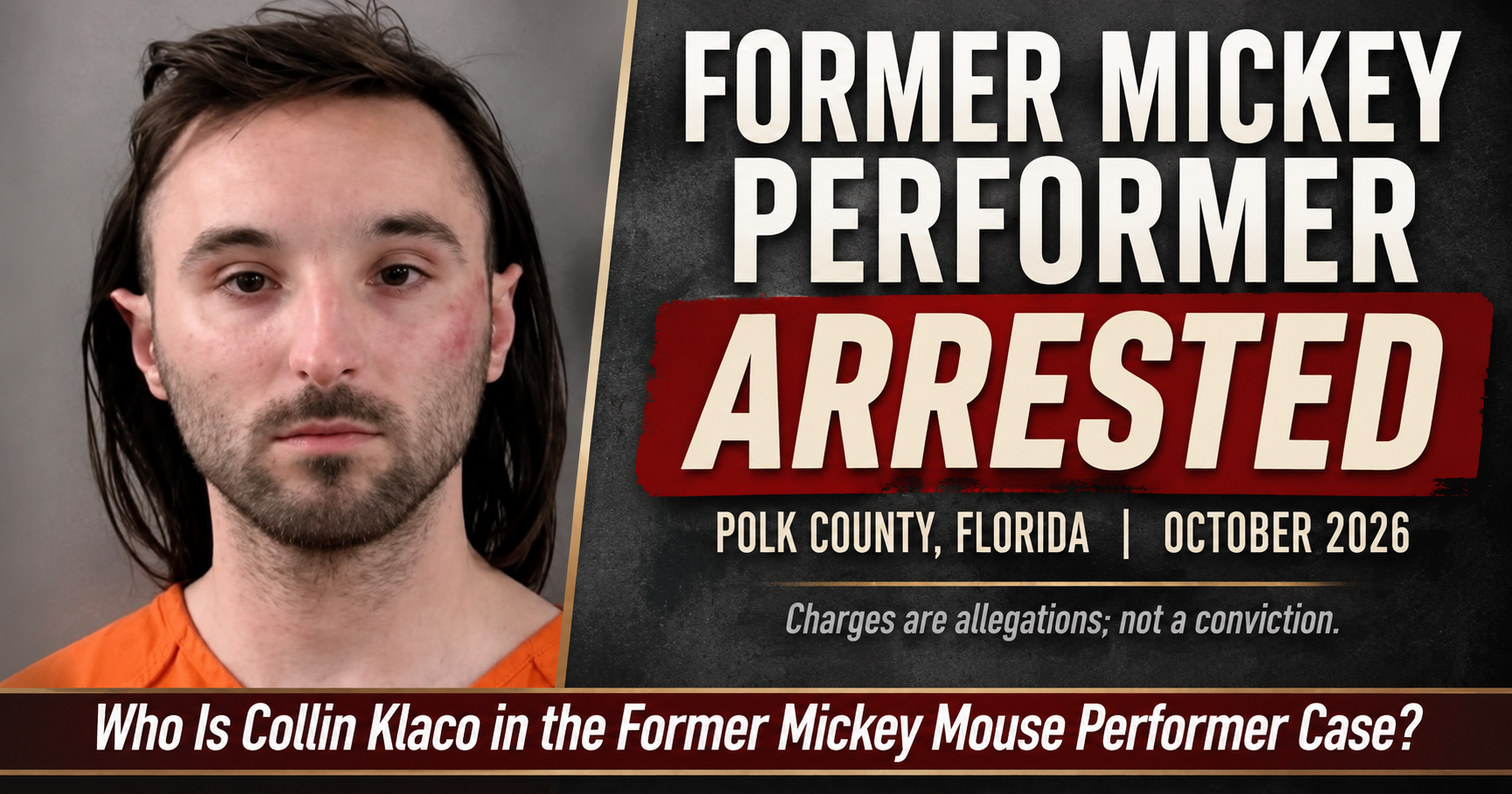
The child he allegedly traveled to meet was not waiting for him.
Detectives were.
According to the account presented by Polk County Sheriff Grady Judd, Collin Klaco had communicated online with someone he believed was the guardian of a 13-year-old boy. Investigators say he then arrived at an undercover location carrying supplies connected to the encounter he allegedly intended.
The person answering those messages had been a detective.
Days later, at an October 30 news conference, Judd revealed another detail that sent the case across the internet: Klaco had told investigators he once worked as a Mickey Mouse character performer at Walt Disney World.
That connection explains the headlines.
But the part I find most disturbing comes before the famous character enters the story.

Authorities allege that an adult moved beyond messages and traveled to meet someone he believed was a child.
The arrest interrupted that alleged plan. Whether prosecutors can prove the charges is now a question for the criminal justice system.
Who is Collin Klaco?
Collin Klaco is a Clermont, Florida, man arrested during a Polk County undercover operation targeting suspected child exploitation and other offenses.
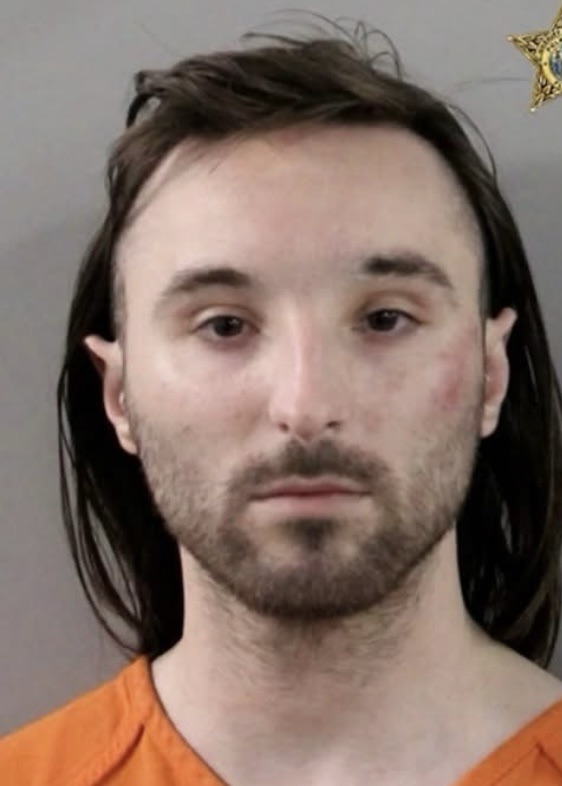
Sheriff Judd identified him as a former Disney character performer who had portrayed Mickey Mouse, based on what Klaco reportedly told investigators.
The allegation at the center of his case concerns an attempted meeting arranged online. It is not a reported incident involving a child at a Disney park.
Klaco has been accused of criminal conduct. An arrest is not a conviction, and the allegations remain subject to proof in court.
The conversation investigators say brought him there
The reported undercover contact involved an investigator posing as a child’s guardian.
That is an important distinction. Some abbreviated accounts make it sound as though Klaco was speaking directly with an actual boy.
According to the sheriff’s account, investigators allege that he sought an unlawful encounter involving the supposed child and then traveled to the arranged location.
WFLA’s report on the alleged meeting and arrest describes Judd’s account of the communications and the items deputies said they found when Klaco arrived.
There is no need to invent the drive.
We do not know what he was thinking at each intersection, what he expected when he approached, or the exact words exchanged when officers moved in.
What authorities allege is already serious: the conversation had progressed into an attempted real-world encounter.



What deputies say they found in the backpacks
Judd said detectives found two backpacks containing diapers, along with wipes. He alleged that the items were connected to Klaco’s intended conduct.
That detail became one of the most widely repeated parts of the announcement.
The items are ordinary household products. The significance comes from the purpose investigators allege they were brought to serve.
Possession of diapers by itself proves nothing about a crime. Prosecutors would need to connect the items with the communications, the alleged intent, and the other evidence.
For me, that connection is the unsettling part of the allegation.
A message exists on a screen. A packed bag is something someone has physically prepared.
The court will have to decide what that preparation establishes in this case.
Did he really work as Mickey Mouse at Disney?
The employment connection comes from the sheriff’s description of what Klaco told detectives.
Judd also emphasized that Klaco was no longer employed by Disney when the alleged incident occurred.
That timing should stay attached to the story every time it is repeated.
The available reporting does not establish that Klaco used a character appearance to facilitate the alleged offense, that the supposed meeting involved a park guest, or that the alleged conduct occurred inside Walt Disney World.
A former job can explain why a case attracts attention without proving a connection between that workplace and the alleged crime.
Why the character detail hits so hard
Mickey Mouse carries a particular meaning for families.
The character belongs to vacation photographs, childhood memories, and moments parents usually expect to be joyful.
That association makes the allegation emotionally jarring. I understand why someone seeing the headline immediately starts thinking about children who may have met a performer.
But concern cannot fill gaps in the evidence.
We should not invent additional victims, workplace incidents, or warnings that the reporting has not established.
The question is what this defendant allegedly did and what investigators can prove.


What charges were reported against Collin Klaco?
News 6 reported four charges associated with the arrest: traveling to meet a minor, using a computer to solicit a guardian, using a two-way communication device to commit a felony, and attempted lewd and lascivious battery involving a minor.
The report identifying Klaco and the listed charges places his arrest within the broader operation announced October 30.
Those charge names describe accusations. They do not establish that a completed assault occurred.
The undercover account concerns a fictitious child. That does not make the alleged attempt meaningless, but it does change how the event should be described.
How can someone face charges if there was no actual child?
Florida law addresses conduct involving a person the defendant believes is a child.
It also addresses certain communications with someone believed to be a parent, legal guardian, or custodian.
The Florida statute covering online solicitation and travel to meet a minor includes provisions relevant to undercover investigations. The involvement of an officer does not, by itself, defeat a prosecution under those provisions.
That is why the evidence can extend beyond who was physically waiting at the destination.
What was communicated? What did the accused person believe? What conduct followed?
Those are factual questions that have to be proved. A sheriff’s announcement begins public understanding of a case. It does not replace the case.
The 281 arrests were not 281 identical cases
Klaco’s arrest was announced as part of Operation Polk Around and Find Out II, a seven-day, multi-agency effort.
Authorities reported 281 arrests across the operation.
That total has frequently appeared beside the words “child predator,” but the arrests covered different categories. News 6 reported 239 prostitution-related arrests, 31 associated with the child-predator investigation, and 11 for other offenses.
The sheriff’s description of the sweep was much broader than one undercover scenario.
This is where a large number can overwhelm the facts.
A reader may come away believing hundreds of people were accused of the exact same conduct. They were not.
Each defendant has an individual case. The evidence against one person cannot be borrowed to make another person’s allegation sound worse.
What about the other theme park employees?
Authorities also identified current theme park workers among those arrested in the wider operation.
Reporting described 17 workers associated with Disney World and Universal, including seven arrested in the child-predator portion of the investigation.
Those employment figures do not turn the operation into proof of a coordinated theme park conspiracy.
They identify workplaces associated with particular suspects.
FOX 13’s coverage of the wider operation and its different cases explains that the sweep involved multiple undercover investigations and defendants accused of different offenses.
Klaco’s reported former employment also needs to remain separate from the employment status of others arrested.
Similar headlines do not make those details interchangeable.


The people behind the arrest total
Another finding deserves attention: authorities said specialists identified 11 trafficking victims during the operation.
Detectives worked with social service advocates, including One More Child and the Florida Department of Children and Families, to assess people for exploitation and offer assistance.
That part of the story is easier to lose beneath the mugshots.
An enforcement operation can produce arrests while also identifying people who need help. Reducing everyone involved to a single label obscures those differences.

The same care matters whenever we follow a developing case, including the allegations behind the Ryan Grey Hunter investigation. Public attention can arrive long before every question has an answer.
What parents can take from this without living in fear
The most useful response is more specific than deciding that every unfamiliar adult is dangerous.
Children need to know they can tell someone about an uncomfortable interaction, including one involving a person they recognize or have previously trusted.
The National Center for Missing & Exploited Children’s guidance for talking about online enticement advises adults to respond calmly and keep listening when a child discloses something upsetting.
It also emphasizes that the child is not at fault.
I think that is one of the most important practical details in this entire story.
A child should not have to work out whether telling the truth will cost them their phone, their friendships, or an adult’s approval before asking for help.
The conversation needs to leave room for an answer a parent did not expect.
Where suspicious contact can be reported
Suspected online child exploitation can be reported through NCMEC’s CyberTipline reporting system. Immediate danger should be reported to 911 or local police.
The FBI also advises preserving communications and seeking help from a trusted adult or law enforcement rather than trying to manage threats alone.
Questions about the Collin Klaco case
Was Collin Klaco arrested at Disney World?
The reporting reviewed for this article describes an arrest connected to an undercover meeting location in Polk County. It does not establish that he was arrested inside a Disney park.
Was he still working for Disney?
According to Sheriff Grady Judd’s account, Klaco said he was no longer employed by Disney at the time.
Was an actual 13-year-old involved in the undercover conversation?
The reported conversation was with a detective posing as the guardian of a fictitious 13-year-old boy.
Why do the headlines mention Mickey Mouse?
Judd said Klaco told investigators he had previously worked as a Mickey Mouse character performer. That reported employment history became the most recognizable detail in the coverage.
Were all 281 people arrested accused of targeting children?
No. The overall operation included different categories of alleged offenses. Authorities identified 31 arrests as part of the child-predator investigation.
Has Collin Klaco been convicted?
The sources reviewed for this November 2 account report an arrest and charges, not a conviction. His guilt has not been established by the reporting presented here.
What makes this allegation so disturbing?
For me, it is the alleged movement from conversation to arrival.
The messages were being answered by an investigator. The child existed only in the undercover scenario. According to authorities, the person who traveled there did not know that.
That is the point at which the story stops being about a famous costume.
It becomes a question about what someone believed would be waiting when they arrived.
Written by the Stories in the Static team, covering unsettling true stories with attention to the evidence, the people involved, and the difference between an allegation and a finding.