
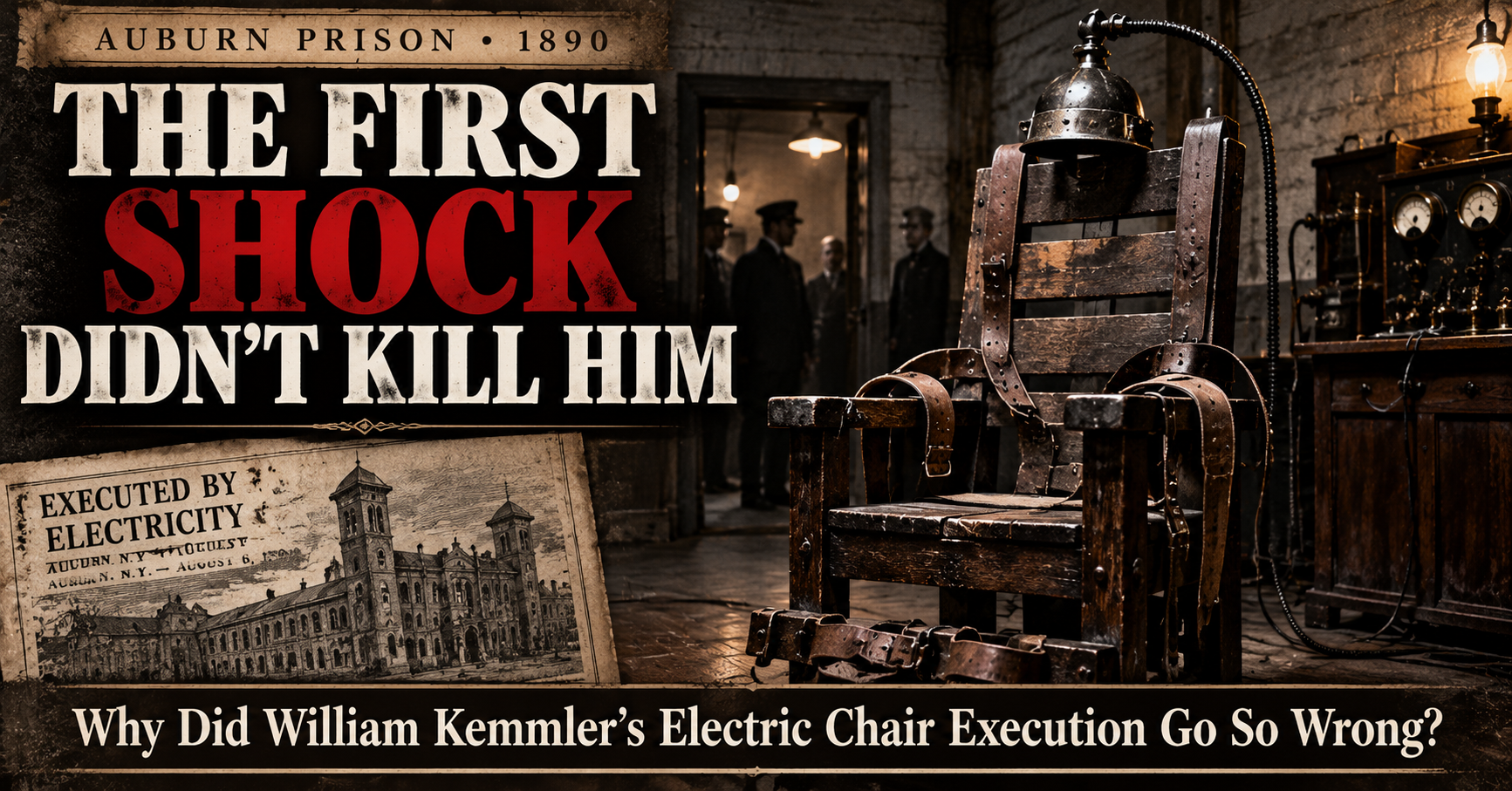
The current stopped. William Kemmler remained strapped to the chair.
For a moment, the men watching believed New York had demonstrated a better way to execute someone.
Then they saw signs of life.
On August 6, 1890, at Auburn Prison, Kemmler became the first person executed in an electric chair. The method was supposed to replace the uncertainties of hanging with a swift, scientifically controlled death. That earlier execution belongs to the longer history behind America’s last public execution.
Instead, officials applied electricity, stopped, and then applied it again while witnesses struggled to understand what they were seeing.
William Kemmler’s execution went wrong because the first application of current did not produce the clear, immediate death officials expected. They interrupted the procedure after roughly seventeen seconds, observed apparent breathing afterward, and resumed it. Reports described burning at the electrical contacts and a deeply shaken group of witnesses.

The disturbing part reaches beyond the machinery. Before Kemmler entered that room, courts had already accepted assurances that electrocution would bring an essentially instantaneous, painless death.
Before the Electric Chair, There Was Tillie Ziegler
The woman Kemmler murdered was Matilda “Tillie” Ziegler.
He killed her with a hatchet in Buffalo in 1889. The Historical Society of the New York Courts describes repeated blows to her head, neck, and shoulders.
Kemmler was convicted of first-degree murder that May.
It is easy for Tillie to disappear from accounts of the case. His execution became a technological milestone, a legal dispute, and an episode in the rivalry between competing electrical systems. Her death is often reduced to the sentence that explains why he was there.
But the history begins with a woman being killed.
Questioning what happened to Kemmler afterward does not require overlooking what he did to her. The state’s responsibility for carrying out a punishment was a separate matter from his responsibility for the murder.
Why Did New York Invent a New Way to Execute People?
Hanging could go horribly wrong.
Supporters of reform wanted a method they believed would be quicker and more dependable. Electricity seemed to offer exactly that.
In an age when electrical power was transforming American life, the idea carried the authority of modern science. A controlled current would replace the rope. Officials would manage the equipment. Death would follow.
New York passed its electrocution law in 1888, applying it to crimes committed after January 1, 1889.
The change was presented as an improvement in how the state carried out a death sentence. The early newspaper record of the electric chair’s introduction shows how closely the method was associated with technological progress.
I find that confidence more unsettling than the chair’s appearance.
The people promoting it believed they were removing uncertainty from the execution room. Kemmler would be the first condemned person to test that belief.
A Dentist Helped Set the Idea in Motion
Alfred P. Southwick, a Buffalo dentist, was an important advocate for execution by electricity.
He served on the commission examining alternatives to hanging. Other people handled the electrical installation and the chair’s development.
The final chair used at Auburn was built by prisoners working in the prison’s furniture shop.
That detail is almost too ordinary for the role the object would play. Men working in a furniture shop assembled an oak chair that would become a new instrument of execution.
Kemmler Challenged the Method Before Anyone Used It
His lawyers argued that electrocution risked torture and unnecessary pain.

The legal question reached both New York’s courts and the U.S. Supreme Court. These challenges took place before the execution, when judges were evaluating the proposed method rather than reviewing what had actually happened to him. The broader process of how death sentences undergo legal review helps distinguish challenges before an execution from later appeals and postconviction proceedings.
New York’s courts accepted the legislature’s decision to adopt electricity. They relied on the investigation and testimony supporting its expected effectiveness.
The Supreme Court’s decision in Kemmler’s case also left the execution authorized.
That ruling needs to be understood in its nineteenth-century legal setting. It should not be reduced to a modern claim that courts had proved electric-chair executions painless.
The judges were deciding a legal challenge on the record before them.
The physical test still lay ahead.
What Happened During William Kemmler’s Execution?
On the morning of August 6, 1890, Kemmler was secured in the chair at Auburn Prison.
Electrodes were positioned to pass current through his body.
The switch was operated. His body stiffened.
After roughly seventeen seconds, the current was stopped.
Several accounts describe an initial belief that he was dead, followed by apparent respiration or other signs that alarmed the witnesses. Officials ordered electricity applied again.
The procedure continued beyond the first application. Reports described smoke or burning at the contact points, along with the smell of burned flesh.
There was no clean demonstration of the promised instantaneous death.
The people in the room had to make another decision while the condemned man remained strapped in front of them.
The Moment the Room Changed
The first application could still have been interpreted as success while Kemmler remained motionless.
Movement and apparent breathing changed the situation.
They raised a question the procedure was supposed to have eliminated: had the man in the chair actually died?
Contemporary coverage captured the confusion. The Evening World’s reporting from the day of the executiondescribed witnesses initially pronouncing death, then observing signs of life and calling for more current.
The newspaper also carried differing accounts of how many separate applications occurred.
That disagreement matters. A precise-looking reconstruction can make the procedure seem more orderly than the reporting supports.


Why Wasn’t the First Shock Enough?
The straightforward answer is that officials stopped the initial application before achieving an unmistakable result.
The harder question is exactly how the equipment, current, contact points, and medical judgments contributed.
Historical accounts give conflicting voltage figures. They also differ over the duration of later applications and the time taken by the entire procedure.
It would be misleading to choose one electrical measurement and present it as the settled explanation for everything that happened.
What the accounts consistently establish is the failed expectation: one brief application was supposed to produce an immediate death. Officials instead observed signs they considered serious enough to require further current.
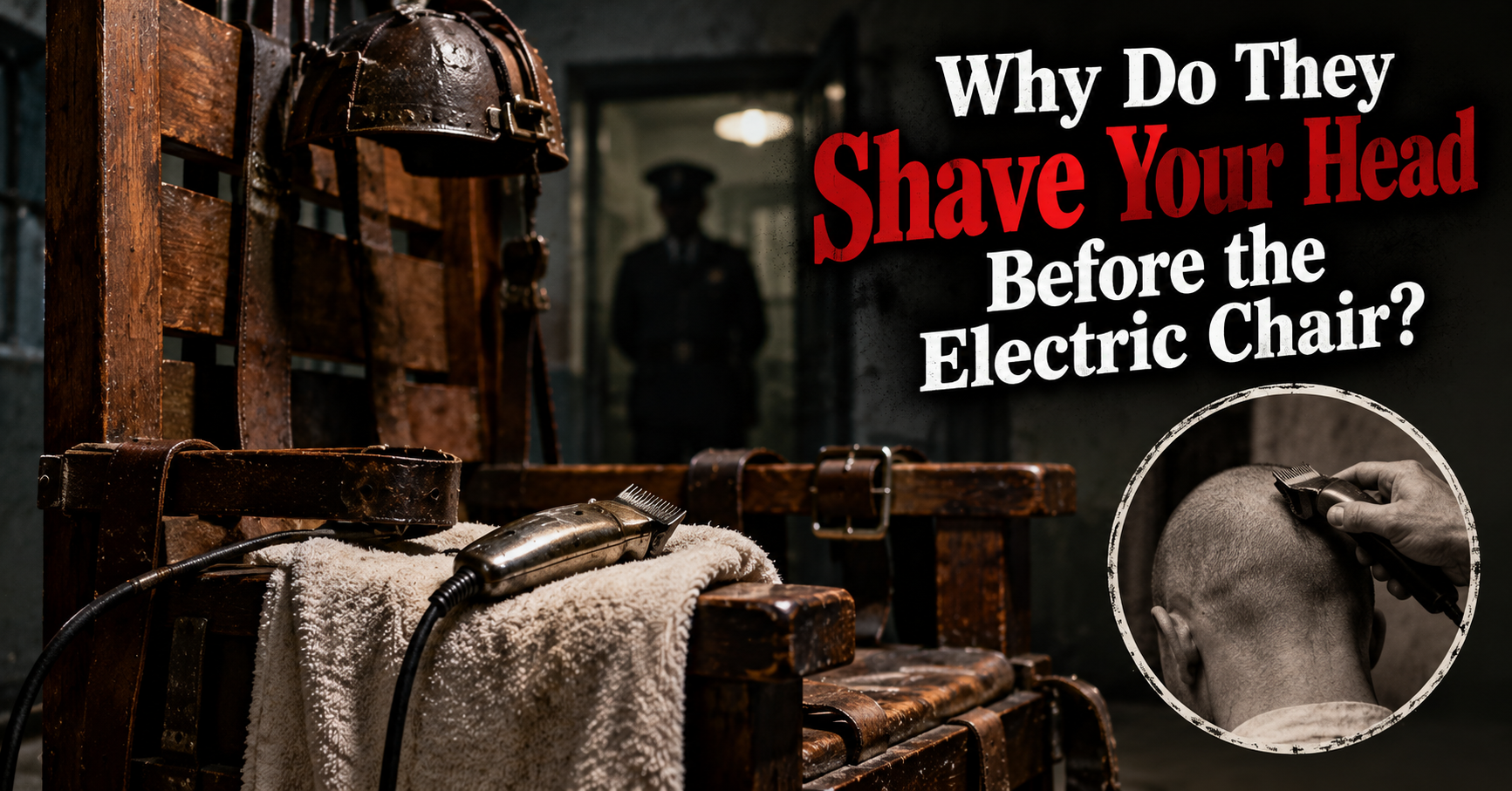
The preparation of electrical contacts would remain an important part of later electrocutions, including why prisoners’ heads were shaved before the electric chair.
But Kemmler’s death cannot be confidently explained by a single preparation mistake.
Was Kemmler Conscious After the First Shock?
We cannot establish his experience with certainty.
Some doctors maintained that he was unconscious after the first application and felt nothing afterward. Contemporary reports also recorded disagreement over whether the movements and sounds represented returning life or involuntary activity.
Those observations do not let us reconstruct what he could hear, feel, or understand.
Calling the execution instantaneous ignores the interruption and renewed applications. Claiming to know that Kemmler consciously experienced every moment goes further than the evidence permits.
The uncertainty is frightening enough.
The men responsible for declaring him dead were also trying to interpret what his body was doing in front of them.
Where Do Edison and Westinghouse Fit Into the Story?
Kemmler’s execution became entangled with the competition over electrical power.
Thomas Edison was associated with direct current. George Westinghouse promoted alternating current.
The chair used alternating current.
Associating a rival’s electrical system with death had obvious commercial consequences. The execution debate therefore involved more than prison officials choosing equipment.
Edison supported the use of alternating current for execution, while Westinghouse opposed its association with his system.
But the familiar shorthand that Edison simply “invented the electric chair” leaves out the other people who advocated, designed, modified, and installed it.
Southwick, electrician Harold P. Brown, physician George Fell, prison officials, and Auburn’s furniture workers all appear in the chair’s development.
Kemmler entered a room where penal reform, medical authority, and a fight over electrical technology had converged.
He was the person strapped into the result.
Did the Disaster End the Electric Chair?
No.
The method spread despite the reaction to Kemmler’s execution.
The promise survived its first disastrous demonstration. Other states adopted electrocution, and New York continued using it.
That is one of the most consequential parts of the story. An execution can provoke horror without ending confidence in the method that produced it.
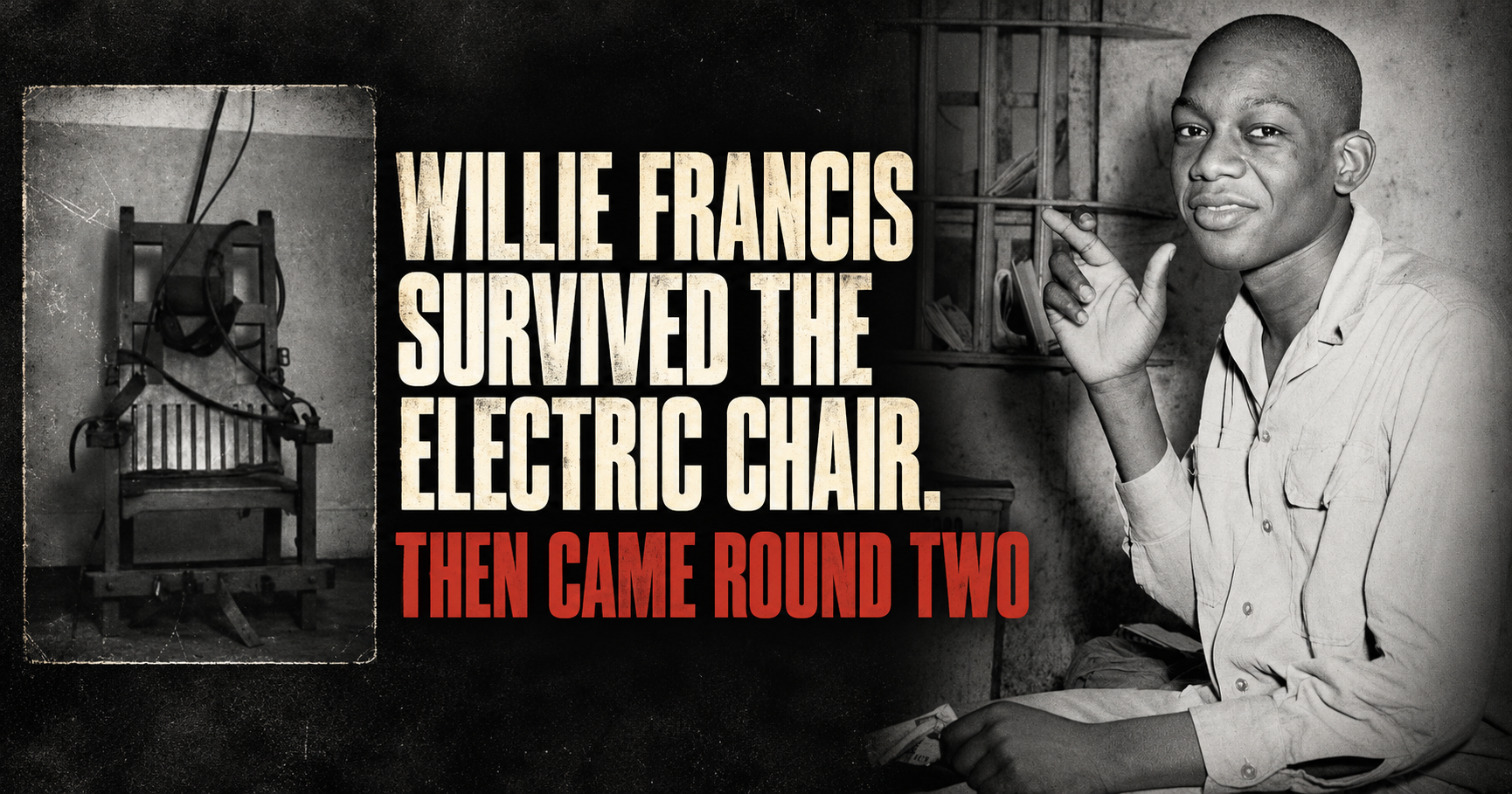
Decades later, Willie Francis survived an electric-chair attempt and faced another execution. His experience was different from Kemmler’s, but it exposed the same frightening gap between an execution plan and its physical outcome.
Kemmler died during the procedure at Auburn. Francis was removed alive after an unsuccessful attempt and returned to custody.
Those histories should not be collapsed into one legend about a person “surviving the chair.”



Questions About William Kemmler’s Execution
Who was the first person executed in the electric chair?
William Kemmler was the first. New York executed him at Auburn Prison on August 6, 1890, following his conviction for murdering Matilda “Tillie” Ziegler.
Did William Kemmler survive the electric chair?
He showed apparent signs of life after the initial application of current, prompting officials to apply electricity again. He did not survive the completed execution or leave the procedure alive.
That differs from cases involving someone who survives an interrupted attempt and returns to prison, which raise separate questions about what can happen after an execution attempt fails.
How long did Kemmler’s execution take?
The initial application lasted approximately seventeen seconds. The entire procedure took several minutes, with accounts differing over the timing and number of later applications. Seventeen seconds describes the first stage, not the whole execution.
Was Thomas Edison present?
The sources used for this account establish Edison’s involvement in the broader electrical controversy, rather than placing him at the execution. Supporting the method and operating the equipment were different roles.
Why did officials think electricity would be more humane?
They believed it could cause death rapidly and avoid the failures associated with hanging. That expectation influenced the legislation and the legal defense of the new method.
What happened to the original electric chair?
Auburn’s original chair was destroyed during the prison fire and riot of July 28, 1929.
The object disappeared. The questions raised during its first use remained in newspaper accounts, medical arguments, and the court record: when had death occurred, what had the witnesses actually seen, and how much could the men in the room honestly claim to know?
About the Author
The Stories in the Static team explores unsettling history through court records, historical reporting, and the details that familiar retellings leave behind. Read more strange true accounts at Stories in the Static.