

At 2:03 a.m., an elevator camera caught Bob Lee and Nima Momeni riding down to the lobby of San Francisco’s Millennium Tower. They walked out of the building together and got into Momeni’s BMW.
About half an hour later, police found Lee on Main Street with stab wounds. He had managed to call 911 himself. “Someone stabbed me,” he said. The 43-year-old creator of Cash App died at a hospital.
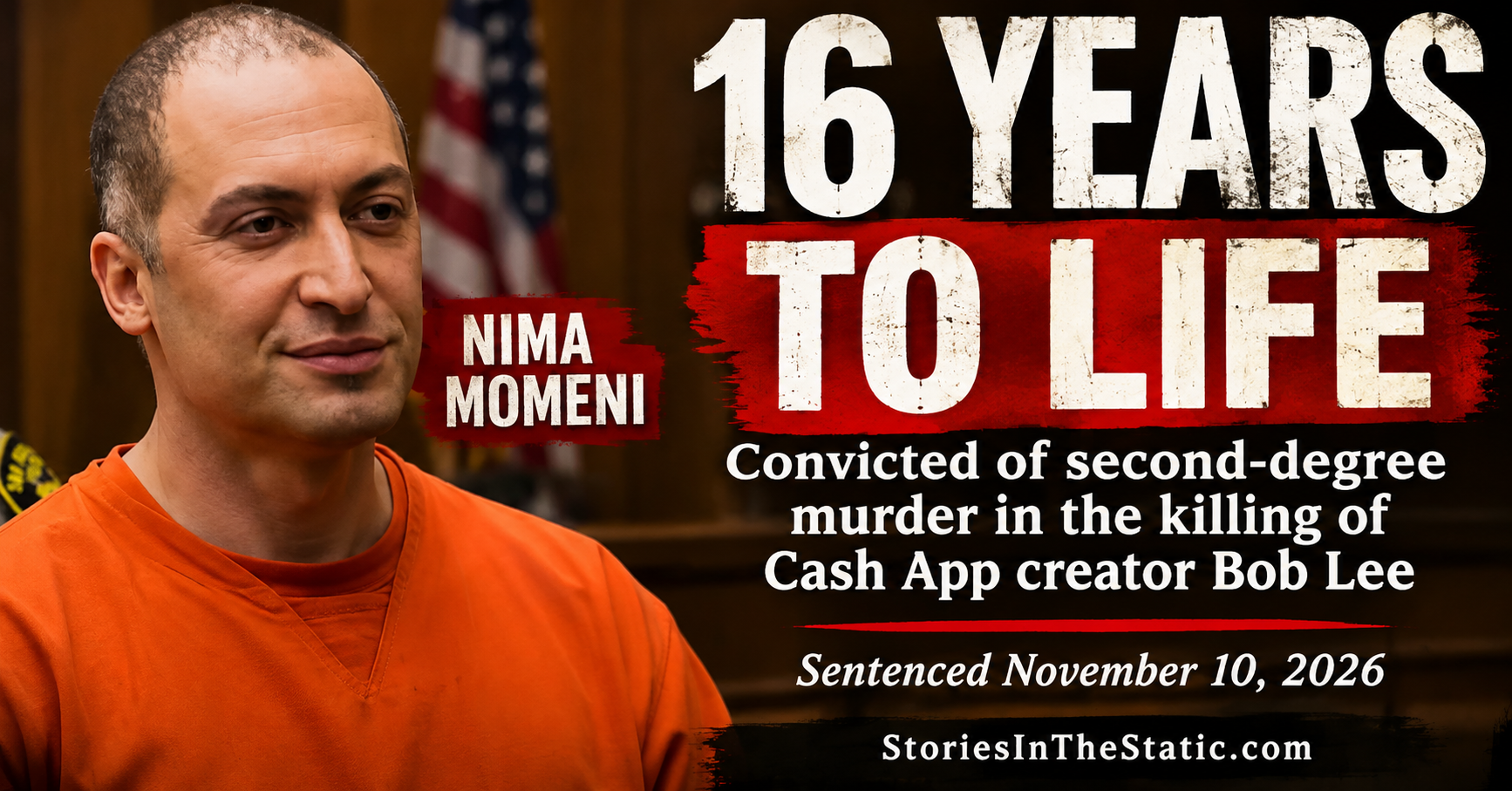
Lee and Momeni knew each other. That detail, which became public when Momeni was arrested nine days later, changed how people understood the case. So did what happened in court: in December 2024, a jury rejected Momeni’s claim of self-defense but acquitted him of first-degree murder. It convicted him of second-degree murder instead. On November 10, 2026, a judge sentenced him to 16 years to life in prison.
What happened between that elevator ride and the 911 call was the part jurors had to piece together. They had footage from more than one camera, a knife, and testimony from the only one of the two men who could still tell them what happened.
Bob Lee was back in San Francisco for a visit
Lee had moved from the Bay Area to Miami and returned to California for a visit. He was known publicly for creating Cash App at Square, where he had been chief technology officer. By the time of his death, he was working as chief product officer at MobileCoin. His former wife and their two children still lived in the Bay Area.
In the first days after he was killed, much of the public discussion treated the stabbing as random street violence. The initial facts were sparse: a man had been found wounded on a downtown street before dawn. The story the public could see started with Lee looking for help. The story investigators were building began hours earlier, with people he already knew.
The hours before the elevator ride
On April 3, the day before the stabbing, Lee had been at an apartment with Momeni’s sister, Khazar, and others. A witness later described hearing Momeni question Lee about what had happened there and whether his sister had been doing drugs or anything inappropriate. According to the timeline ABC7 reconstructed from court filings, the conversation took place in Lee’s hotel room, hours before the two men would leave Millennium Tower together.
That conversation became part of the prosecution’s explanation for the killing. Khazar testified that after Lee left the earlier gathering, she was given drugs and sexually assaulted while unconscious. Prosecutors argued that Momeni blamed Lee for introducing her to the man involved and for putting her in that situation. The allegation Khazar described concerned another man, and the prosecution’s theory was about why Momeni held Lee responsible.
At 12:39 a.m., a camera recorded Lee arriving at Millennium Tower, where Khazar lived. At 2:03 a.m., he and Momeni were in the elevator. The defense disputed that Momeni left the building intending to hurt Lee. Both sides agreed that the men left together in his car.
That’s the detail I keep coming back to. The clearest footage shows something ordinary: two men who know each other leaving a building together. The camera that captured the encounter near the bridge gave jurors a much harder picture to read.



The footage showed them getting out of the car
The BMW stopped on a secluded block near the Bay Bridge. In the footage described by the San Francisco Chronicle’s reporters who covered the trial, two figures can be seen outside the car. The image was grainy enough that the figures were easier to distinguish by their light and dark jackets than by what their hands were doing. There was no independent record of what they said or who first brought out the knife.
Prosecutors said Momeni had taken a kitchen knife from his sister’s apartment, driven Lee there, and stabbed him. Momeni testified that Lee pulled the knife after taking offense at a remark he’d made about Lee spending more time with his family. He said he defended himself and didn’t realize Lee had been wounded when he drove away.
Once the men separated, the footage was easier to follow. Momeni got back into his car and drove off. Lee stayed on foot. The cameras followed him down the block as he used his phone. At trial, the jury heard what he was saying into it.
The 911 call the family heard in court
The San Francisco Standard’s early reporting on the 911 call describes Lee holding his side as he walked along Main Street. The Chronicle later reported that his calls for help grew fainter on the recording played at trial. The man the cameras showed walking was running out of strength.
The call told jurors that Lee knew he’d been stabbed and was trying to get help. It didn’t record the encounter at the car. That’s a hard distinction to hold onto when the recording is the most immediate piece of evidence in the room. You can hear exactly what happened to him in the minutes afterward and still need other evidence to figure out how it started.
Lee’s brother put an arm around their father as the audio played. By then, the family had already lived through the call that told them Lee was gone. In court, they had to sit through the call he made while he was still trying to survive.



What the knife could tell jurors
Police recovered a knife near the scene. Prosecutors presented DNA evidence linking Momeni to the handle and Lee to the blade. That gave jurors something to weigh against Momeni’s account that Lee had pulled the knife and Momeni had turned it against him. The test didn’t come with a sequence attached. It could connect each man to part of the knife, but it couldn’t date each contact or tell jurors who first held it.
There was also a dispute over a different video, taken earlier in the evening. The defense argued it showed Lee holding what might have been a knife. Lee’s former wife said the object was a collar stay, the small stiffener that goes inside a shirt collar. The footage was grainy, and the Standard’s reporting on the disputed object did not identify it conclusively. Even identifying the object would still leave a separate question: whether it was the same knife police recovered.

That difference between connecting someone to evidence and proving what they did also mattered in the Wonderland trial, where a palm print linked John Holmes to the scene. In Lee’s case, jurors had to read the DNA alongside the footage and testimony. Each piece could help them judge the competing accounts without settling the whole case by itself.
Why the verdict was second-degree murder
The jury announced its verdict on December 17, 2024. It acquitted Momeni of first-degree murder, convicted him of second-degree murder, and found that he personally used a deadly weapon.
Here’s the distinction that gets lost in a one-line headline. To win on its first-degree theory, the prosecution had to prove a deliberate, premeditated killing. Second-degree murder still requires the mental state California law calls malice, which can mean an intent to kill or acting with conscious disregard for human life. It does not require the same finding of premeditation.
So jurors could reject self-defense and find Momeni guilty of murder while still concluding that prosecutors hadn’t proved the planned killing they described. The verdict also didn’t tell us that jurors agreed on every detail of the prosecution’s motive theory. That’s why “Why did he do it?” has a more careful answer than “What was he convicted of?”
The sentencing came nearly two years later
By September 2026, NBC Bay Area was still covering the fight over a new trial. One challenge under California’s Racial Justice Act had been denied, and Momeni’s lawyers were pursuing a separate motion. On November 10, Judge Alexandra Gordon denied the new-trial request and imposed the sentence. His attorneys said they planned to appeal.
The sentence was 15 years to life for second-degree murder, plus one year for the deadly weapon finding. The judge also noted 1,377 days of custody credit. That credit matters, but adding 16 years to the sentencing date won’t give you a release date. Under California’s rules for parole eligibility, applicable credits can affect when someone serving a life term is eligible for consideration. Being considered for parole and actually being released are separate decisions.
Scout Lee was 14 when her father was killed. She was 18 when she addressed Momeni at sentencing. She spoke about the future she had expected to have with her dad. For the court, almost two years had passed between the verdict and the sentence. For Scout, the time that mattered started before either of those dates, on the morning her father called for help.