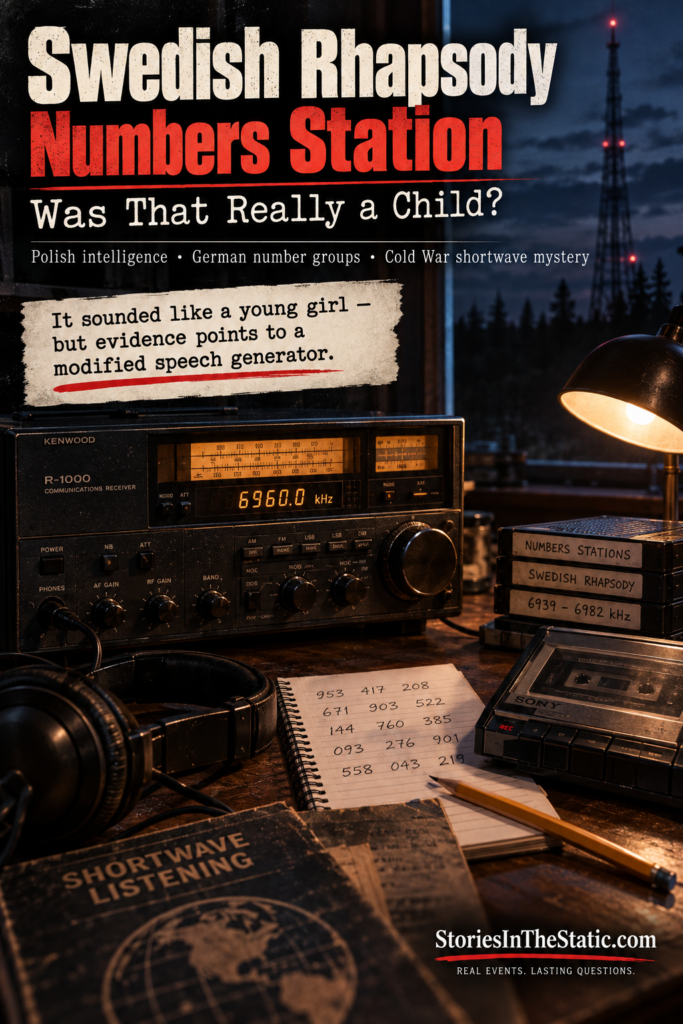
A little music-box tune plays. Then a high, strange voice reads numbers in German.
This was Swedish Rhapsody, a real spy-radio broadcast known to monitoring enthusiasts as G02. Its voice was automated and often mistaken for a child’s. Its operator was associated with Polish intelligence, despite the Swedish nickname.
What catches my attention is how much the sound encourages you to imagine.
A child at a microphone. Someone standing nearby. A room you cannot see.
But the surviving evidence leads somewhere more concrete: recorded speech, mechanical equipment, and instructions telling an agent exactly how to listen.
One of those instructions even warned against recording the broadcast.
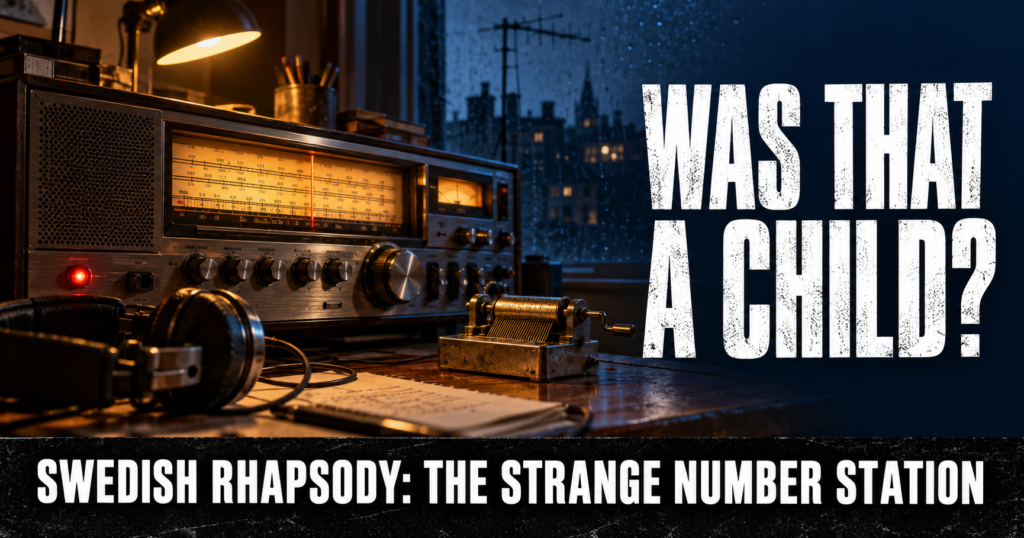
The Music Was There to Help Someone Find the Signal
The melody sounds like the part a horror movie would use to make an ordinary room feel wrong.
Its documented job was practical.
A translated Polish communication agreement dated May 30, 1975, describes a music-box melody identifying the transmitting center. It was played for six minutes so the recipient could tune the radio. The translation appears in the May 2014 issue of Numbers & Oddities, which also notes difficulties interpreting the original bureaucratic Polish.
That changes the scene for me.
An outsider hears a mysterious tune repeating. The intended listener hears a useful signal: time to get the receiver adjusted.
The repetition had a reason.
Our explanation of why spies sent coded instructions over public radio signals covers the broader method. Swedish Rhapsody gives that method a particularly unsettling sound.
Was a Little Girl Actually Reading the Numbers?
The childlike sound is not evidence that a child was reading messages live.
Priyom’s station archive describes G02’s voice as female and automated. That is a much narrower, better-supported description than the familiar image of a little girl endlessly counting into a microphone.
There is also surviving equipment showing how intelligence services automated these broadcasts.
Crypto Museum documents an East German machine called Schnatterinchen, or Device 32028. Inside it, a motor turned a drum carrying 13 wheels.
Each wheel held a short piece of magnetic audio tape.
The recordings supplied the digits zero through nine, plus three words used to organize a transmission. The machine selected the appropriate recording as it worked through a message supplied on punched paper tape.
I find that detail more memorable than the ghost stories.
The voice could keep reading because pieces of tape kept turning.
There was no need for someone to sit through the entire broadcast, patiently repeating every number.
This equipment history explains the mechanism behind automated spy voices. It does not identify the precise machine used for every surviving G02 recording.
Thirteen Recorded Sounds Could Read an Entire Message
The machine’s vocabulary was tiny.
Ten digits. “Attention.” A separation word. “End.”
Those were enough to assemble long numerical transmissions. Crypto Museum’s surviving examples show how a limited collection of recorded sounds could replace people reading messages individually.
Later equipment stored speech digitally.
Device 32620, developed in East Germany in the early 1980s, could hold a message and output it as either spoken numbers or Morse code. Operators could enter information through a keypad or load it using paper tape. The museum holds and documents an example of this machine.
The distinction matters: these were machines playing recorded speech, rather than a mysterious intelligence inventing words.
Their job was reliable repetition.
To an agent, that was useful. To an accidental listener, the same detached delivery could sound deeply unnatural.
You can see the physical equipment in Crypto Museum’s photographs of the mechanical voice generator.
A Woman Later Described Recording the Spy Voice
There is a human story behind this machinery.
Crypto Museum preserves a January 2010 letter from a woman who described providing German voice recordings for East German numbers-station equipment.
She recalled recording individual words on short pieces of tape. “Achtung,” meaning “attention,” and “Sieben,” meaning “seven,” were especially difficult to fit and pronounce properly. She also described later recording Spanish words.
These were small recording tasks with a long afterlife.
The museum explains that the German and Spanish recordings were subsequently digitized for the newer equipment. It also recounts how the speaker later tuned into shortwave transmissions to check whether her voice was still being used.
Imagine that experience: turning on a radio and hearing a younger version of your own voice delivering messages you did not personally compose.
That is my interpretation of what makes this account striking. It is not a claim that she described feeling frightened or surprised.
Her letter concerns the East German voice-equipment history. It should not be stretched into a complete identification of every voice heard in Swedish Rhapsody recordings.
Why Was a Polish Station Called Swedish Rhapsody?
The nickname can send you in the wrong direction before the voice even starts.
Priyom identifies Polish State Security, the SB, as the operator associated with the station family in declassified documents. Its successor, the Office for State Protection, or UOP, continued the operation after the political changes of 1990.
“Swedish Rhapsody” was a listener nickname, not proof of a Swedish intelligence operation.
Even the music identification has a wrinkle.
Priyom reports that documents name the introductory piece as “Luxembourg Polka.” The archive explains that the portion used in the broadcast matches a passage associated with “Swedish Rhapsody,” helping explain the familiar name.
I would keep both details together.
Simply announcing that everyone got the tune wrong makes the story sound cleaner than the evidence warrants. The nickname endured, while the documents supplied a different title.
A name can be useful for recognizing a recording without being an accurate description of its origin.
The Listening Instructions Are Stranger Than the Nickname
The translated 1975 agreement gives us something more revealing than another theory about the sound.
It instructed the recipient to use a battery-powered receiver, its built-in antenna, and headphones with the loudspeaker switched off.
Listening in public places was forbidden.
Recording the transmission on tape was discouraged because a tape could be difficult to erase or destroy quickly.
That last detail stays with me.
Today, people encounter these broadcasts through recordings shared for curiosity or entertainment. In this historical instruction, making a recording created a problem.
The same sound could be a fascinating collectible to one listener and sensitive material to another.
These were instructions for a particular communication arrangement. They should not be presented as universal rules followed by every numbers-station recipient.
The translated Polish radio instructions in Numbers & Oddities provide the source behind these details.
What Happened to Swedish Rhapsody?
The familiar German-language G02 broadcast did not simply remain unchanged forever.
Monitoring records place its replacement by the English-language station E23 in April 1998. Priyom records E23’s last reported activity in January 2007.
That makes “Swedish Rhapsody disappeared” an incomplete description.
The recognizable sound ended, but a successor continued.
E23 used a different voice and a format that produced a continuous sequence of five-digit groups. Its archive also records repeated messages within a weekly schedule.
For someone who knew the old music and German voice, the change would have removed the features that made the station immediately recognizable.
For researchers, the relationship between the transmissions mattered more than the nickname.
What to Notice When You Hear a Recording
Priyom’s Swedish Rhapsody archive and audio sample offer a useful starting point.
Listen for the change from the musical introduction to the voice. Notice how the numbers arrive in organized groups rather than conversational sentences.
The archive documents repeated groups and structured message formats. Those details are clues to a communication procedure, even when the message itself remains unreadable.
I would also pay attention to what your imagination supplies.
The voice does not explain its surroundings. The music does not reveal who is waiting at the other end.
It is easy to fill those gaps with a frightening scene. The documented machinery and listening instructions give us a better place to begin.
Questions About the Swedish Rhapsody Numbers Station
Was Swedish Rhapsody a real broadcast?
Yes. Monitoring archives preserve recordings and describe its formats. The station family is also associated with Polish intelligence through documents discussed by researchers.
Did Swedish Rhapsody broadcast in Swedish?
The familiar G02 transmissions used German. Its Swedish nickname came from the musical introduction, rather than the spoken language. Its successor, E23, used English.
Can we identify the child people thought they heard?
The evidence does not establish a child reading messages live. The documented broadcast used an automated female voice. Identifying a source speaker requires more evidence than deciding that a recording sounds young.
Does knowing how the voice worked reveal the messages?
No. Reconstructing the speech equipment explains how a machine could read the numbers. It does not, by itself, explain what those numbers instructed a recipient to do.
A voice machine is the delivery mechanism. Understanding that machine and understanding a secret message are separate tasks.
Written by Dax Weaver for Stories in the Static, exploring strange broadcasts, overlooked history, and the documented details behind stories that sound impossible.