
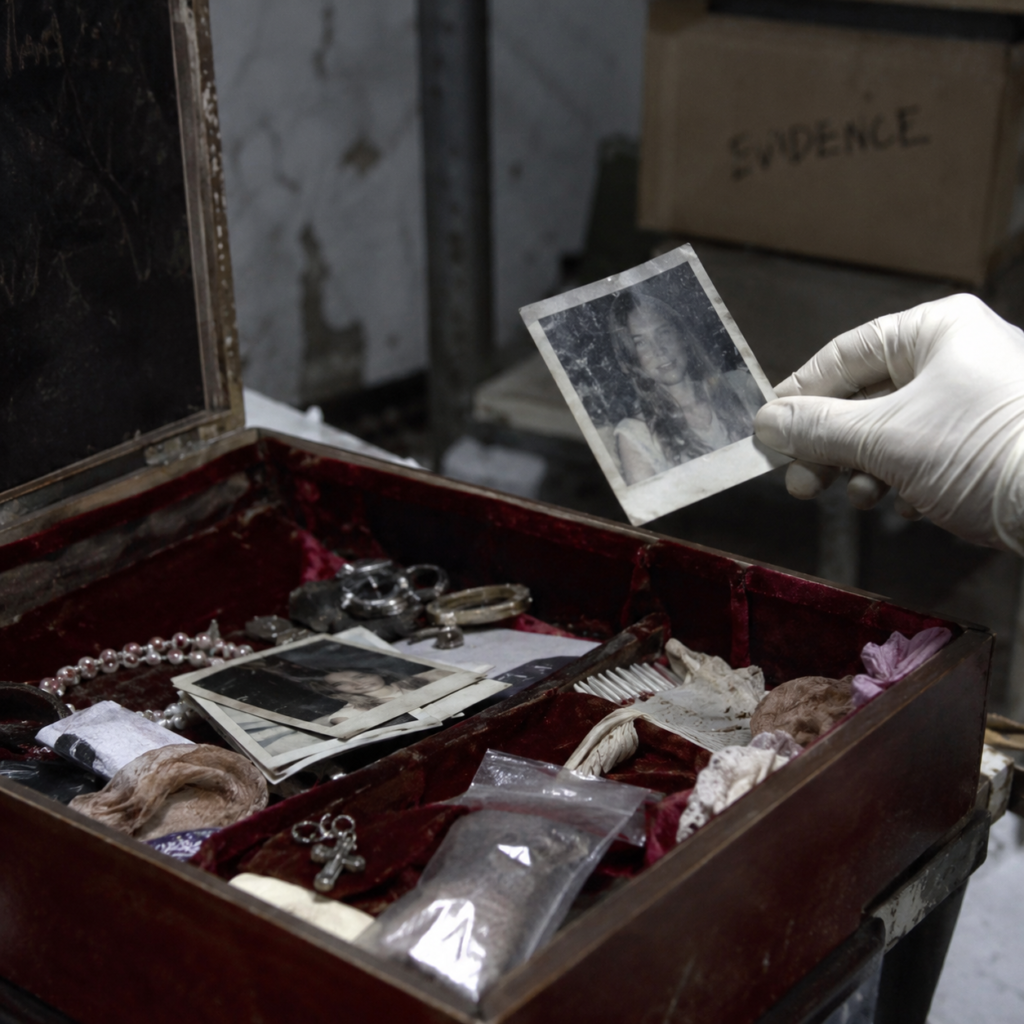
When investigators searched Dennis Rader’s home after his arrest in 2005, they found items the FBI described as “souvenirs” from his victims.
Rader was the BTK killer. Years earlier, he had sent police and the media letters and crime scene photographs. Inside his home, investigators found more evidence connecting his private life to his crimes.
The unsettling question is why he kept any of it.
Why hold on to something that could help prove what you did?
Some serial killers keep victims’ belongings to revisit the crime, reinforce a feeling of power, or support violent sexual fantasies. Research on serial sexual offenders describes collections whose psychological importance can help explain why an offender preserves such incriminating material.
But there is a complication that gets lost in many accounts: taking an object and keeping a trophy are not automatically the same behavior.
To understand the difference, we have to look beyond what was missing.
What Makes an Object a Trophy?
A piece of jewelry can have several meanings.
It might be stolen for its value. It might become a reminder of the crime. An offender might regard it as proof of having dominated another person.
Research distinguishes a souvenir, associated with remembering the offense, from a trophy, associated with achievement or conquest in the offender’s mind. However, researchers have not always used those terms consistently.
The object alone cannot settle the question.
That is why I am cautious about descriptions that label every missing necklace or wallet a “trophy.” The label makes a claim about motive. Establishing that motive requires more than noticing that something was taken.
Our look at prolific serial killers and their motives shows how much offenders differ. One explanation should not be stretched across every case.
The Collection Can Keep the Crime Present
A 2013 paper by Janet Warren, Park Dietz, and Robert Hazelwood examined serial sexual offenders who preserved collections connected to their crimes.
The researchers described materials used to relive offending experiences and generate sexual fantasy. Their cases included different kinds of sexual offenders, so the findings should not be treated as a description of every serial killer.
The useful insight is that an offense can continue to occupy an offender’s private life after the physical attack ends.
A retained object can provide a connection to a particular victim or event. For some offenders, keeping that connection appears important enough to accept the risk of discovery.
I find that more disturbing than the familiar image of a hidden collection. The collection has a purpose. It can be something the offender returns to.

Power and Sexual Fantasy Can Overlap
For some sexually sadistic offenders, an item can represent control over the victim while also supporting sexual arousal. Those functions can overlap rather than fit neatly into separate categories.
That does not establish the motive of someone whose case has not been examined.
A 2021 Murdoch University honors thesis explored trophy-taking through five serial killer cases. It identified possible relationships between retained objects, sexual fantasy, and the desire for control, while emphasizing the need for further research.
Five cases can raise useful questions. They cannot tell us what every offender thinks.
The strongest explanation remains specific: what did this person keep, how did they use it, and what evidence supports the interpretation?
A Trophy May Look Like an Ordinary Gift
One detail in the research is especially hard to forget.
A 2024 paper, discussing earlier case research, described an offender who gave a victim’s jewelry to his wife and daughter. Another kept items in his mother’s attic, where he regularly visited.
A collection does not necessarily sit in an obvious hiding place inside the killer’s home.
An object can move into someone else’s everyday life. A person receiving a gift may have no idea where it came from.
For the offender, its history can remain significant. For everyone else, it may look completely ordinary.

This is one reason the question of why serial killers can evade detection for years deserves more than an answer about clever criminals. People cannot recognize a connection they have no reason to suspect.


Do Most Serial Killers Take Trophies?
There is no reliable universal percentage established by the sources discussed here.
An FBI study examined 480 murders committed by 92 serial offenders. In 54 percent of the cases, offenders removed multiple items from the crime scene.
Clothing, shoes, jewelry, wallets, purses, and money appeared among the items taken. But the researchers explicitly said they recorded the removals without interpreting the objects’ underlying meaning.
That finding does not mean 54 percent of serial killers collect trophies.
It describes cases, not the proportion of offenders. It also records removal, not proof that something was preserved for psychological reasons.
This is the distinction I would want readers to remember when they encounter a dramatic statistic: an item taken from a crime scene is a fact to investigate. Calling it a trophy is an interpretation that still needs support.
Can Keeping Trophies Help Get a Killer Caught?
Yes, preserved material can become evidence.
In Rader’s case, the FBI’s account describes a deleted file on a computer disk he sent to investigators. It contained the name “Dennis” and information about a Wichita church. Investigators developed further evidence, arrested him, and searched his home.
The victim souvenirs were part of what that search uncovered. They were not the initial computer clue that pointed investigators toward him.
That distinction keeps the story accurate. A collection may strengthen an investigation after police identify a suspect, even when it did not trigger the arrest.
Jeffrey Dahmer’s case shows the importance of examining retained material rather than merely describing it as horrifying.
Following his arrest in July 1991, investigators found the remains of 11 victims in his apartment. The FBI performed DNA testing and other forensic examinations on submitted evidence to help establish what had happened and identify victims.
An offender’s reasons for retaining something and its value to investigators are separate questions.
For a family, the second question can be vital.
A Victim’s Belonging Still Belongs to a Person’s Story
“Trophy” is a term describing the offender’s relationship with an object.
It should not become the only way we describe that object.
A necklace had a history before a killer touched it. A photograph showed a person with a life beyond the crime. Something treated as a possession by an offender can help investigators recover part of that person’s story.
That is the perspective I try to keep in our examination of serial murder cases and disputed victim totals. Explaining an offender’s behavior should help us understand what happened to people, without letting the offender’s view define them.
Frequently Asked Questions
What kinds of trophies do serial killers keep?
Documented collections can include victims’ personal belongings and records of the offenses, such as photographs or writings. Some cases involve human remains. The meaning of each item needs to be established individually.
What is the difference between a trophy and a souvenir?
A common distinction is that a souvenir helps an offender remember the crime, while a trophy represents perceived success or domination. Researchers use the terms inconsistently, and the same object may serve overlapping purposes.
Do all serial killers keep trophies?
No. Trophy-taking is not a requirement for serial murder. Research documenting items removed from crime scenes also does not prove that those items were kept as trophies.
Does keeping evidence mean a killer wants to get caught?
It does not establish that. Research on offenders who maintain collections suggests the material can have strong psychological value despite its ability to incriminate them. The risk of discovery and the reason for preserving it can coexist.
By Miles Rowan for Stories in the Static, examining criminal cases through overlooked evidence, unresolved questions, and the lives behind the headlines.