For 46 years, she was known as Macon Jane Doe.
Investigators eventually connected her death to Samuel Little. But knowing who killed her did not immediately tell them who she was.
That answer came later.
In May 2023, Georgia authorities announced her identity: Yvonne Pless. She had been approximately 20 years old when Little murdered her in 1977. Genetic genealogy helped investigators find her relatives and restore her name.
Her case reveals something a headline about 93 murders can easily miss. Identifying the killer, confirming a crime, and identifying the victim are separate pieces of work.
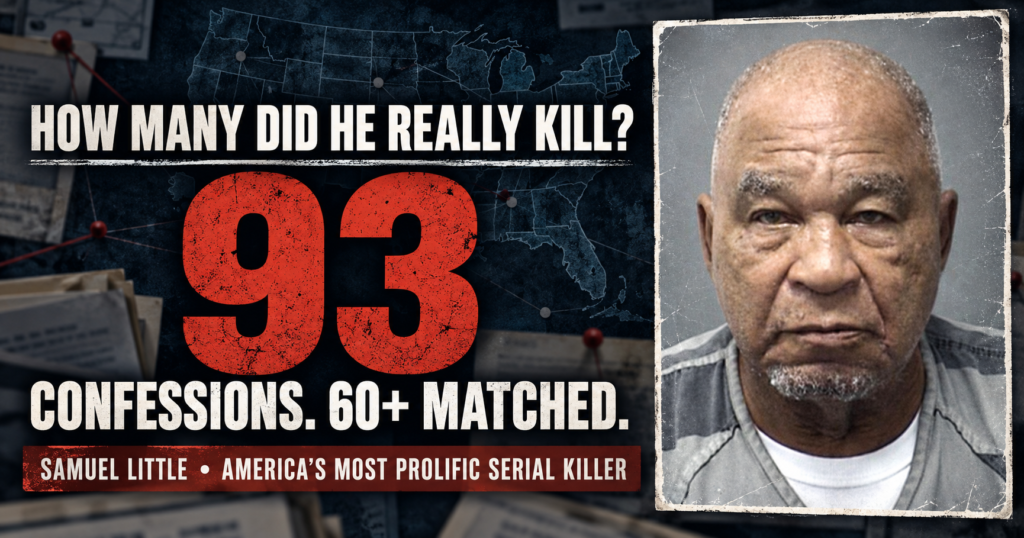
Samuel Little confessed to 93 killings. The FBI considered those confessions credible, and Texas authorities reported in December 2021 that more than 60 had been definitively matched to victims. That dated figure should not be mistaken for a final, current count of every resolved case. The distinction between a large victim total and a qualifying series is explained in how serial murder is defined.
The answer is more complicated than one number. The reasons are worth understanding.
What Does the Number 93 Actually Mean?
Ninety-three is Little’s confession total.
It is not the number of murder convictions he received, and it does not mean investigators publicly documented 93 identified victims.
In October 2019, the FBI reported that analysts believed all 93 confessions were credible. At that point, law enforcement had verified 50.
By December 2021, the Texas Department of Public Safety reported more than 60 definitive matches, supported by DNA evidence, extensively corroborated interviews, or both.
Those statements describe different stages of the investigation.
An older article giving 50 verified cases and a later release giving more than 60 are not necessarily contradicting each other. Investigators had made additional connections.
This is why our overview of serial killers with exceptionally high victim counts separates confessions from established findings. Otherwise, the biggest number can swallow the evidence behind it.
How Was Samuel Little Finally Convicted?
The investigation that secured his imprisonment began with evidence linking him to three deaths.
After Little’s arrest and extradition to California in 2012 on a narcotics charge, Los Angeles investigators obtained DNA connecting him to three unsolved homicides from 1987 and 1989.
He was convicted in 2014 and sentenced to three consecutive life terms without parole.
Those convictions were enough to keep him in prison. They were nowhere near a complete account of his crimes.
The Los Angeles Police Department had also contacted the FBI’s Violent Criminal Apprehension Program, known as ViCAP. Its background investigation identified a pattern suggesting many more killings.
The question expanded from whether he had committed those three murders to how far the pattern extended.
Why Had So Many Deaths Gone Unconnected?
Little traveled widely. According to the FBI, he moved between cities, frequently encountered police, and targeted vulnerable women, including women involved in sex work or living with addiction.
Some victims remained unidentified. Some deaths were not investigated as homicides.
The FBI also explained that his method did not always leave obvious evidence such as gunshot or stab wounds. Some deaths were attributed to overdoses, accidents, or natural causes. Many killings occurred before DNA profiling became a routine investigative tool.
That combination created several ways for a connection to disappear.
A death might never enter a homicide database. An unidentified body might not be linked to a missing-person report. Cases in different states might look unrelated when examined separately.
The women’s circumstances did not make their lives less valuable. They did make them vulnerable to a man who believed their deaths would not bring sustained attention.
The FBI reported that Little thought nobody was accounting for his victims.
His Memory Was Detailed, but It Wasn’t Reliable in Every Way
Little’s descriptions helped investigators. They also required careful checking.
Texas authorities reported that he could remember victims’ appearances and details about where he encountered them or left their bodies. But he was much less reliable about dates and distances.
In some instances, he was wrong by more than 10 years or 40 miles.
That is a major complication when searching old records.
A detailed account can still send investigators toward the wrong year or jurisdiction. Taking every remembered date literally could cause them to overlook a genuine match.
I keep coming back to that distinction: a vivid memory is not the same as an accurate timeline.
Investigators had to test what he said against records and evidence, rather than treating confidence as proof.
Patricia Parker’s Case Shows How a Match Was Made
In 1981, a woman’s body was found in Dade County, Georgia. She remained unidentified for decades.
In 2018, Little described taking a woman in Chattanooga, Tennessee, and killing her in the early 1980s. A cold-case investigator could not find a matching unsolved case in Chattanooga, so he contacted Georgia investigators across the state line. That search shows why investigators miss connections across jurisdictions even when a confession supplies a precise location.
The description matched the Dade County remains.
Further interviews strengthened the connection.
In 2019, authorities released a forensic reconstruction of the woman’s face. A family came forward, and DNA comparisons established her identity.
She was Patricia Parker, 30 years old when she died. Georgia authorities announced the identification in October 2020.
Her case puts a practical meaning behind “corroboration.”
It involved a confession, a search across jurisdictions, an existing case, additional questioning, public recognition, and DNA. The confession supplied a lead. Other work supplied the identification.
Why Did Investigators Publish His Drawings?
Little drew portraits of women he said he had killed. The FBI published drawings alongside accounts of unmatched crimes, hoping someone would recognize a person or remember a useful detail.
Those images were investigative leads based on his recollections. They were not photographs or proof of identity.
That difference matters if someone encounters a drawing online.
Recognition may help investigators decide what to examine. Establishing who the person was still requires corroboration.
The drawings make the case unusually unsettling: an offender could recall a face that authorities had not yet connected to a name.
But the important result was never the portrait itself. It was whether it helped locate a record, identify remains, or bring information to a family.
A Confirmed Killing Can Still Involve an Unidentified Victim
Yvonne Pless’s case illustrates this especially clearly.
Little’s confession was connected to the Macon cold case after investigators interviewed him in 2019. Authorities reported that the case was closed, but the woman’s family was still unknown.
Investigators later used genetic genealogy to identify her and locate relatives. The public announcement came in 2023.
That sequence explains why a victim list may contain both names and Jane Doe entries.
A case can be linked to an offender before the deceased person’s identity is established. Conversely, investigators may know a victim’s identity while the connection to Little remains under examination.
“Unidentified” and “unconfirmed” describe different uncertainties.
Why Didn’t Every Linked Case Become a Murder Conviction?
Little died on December 30, 2020. Some prosecutions never reached trial.
Texas authorities document one example involving Bobbie Ann Fields-Wilson, whose body was found in Lubbock in August 1993.
Her case initially stalled. Investigators later connected Little to it, and he was indicted in August 2019. He died before he could be tried for that killing.
An indictment is an accusation, not a conviction.
His death ended the possibility of that trial. It did not make the investigative work or the victim’s story disappear.
This is another reason his conviction count cannot serve as a complete measure of his crimes.
Why the Most Useful Victim Count Needs a Date
For Little, a number without a source and date can give a false impression of certainty.
The clearest official milestones cited here are 50 verified confessions in the FBI’s October 2019 account and more than 60 definitive matches in the December 2021 Texas release. His overall confession total was 93.
The later identification of an unnamed victim does not automatically mean the national confirmed count increased. That death may already have been counted as a linked Jane Doe case.
It would therefore be inaccurate to add every new identification announcement to the old total.
This differs from how the Shipman inquiry established a much larger victim total. Each investigation has its own evidence and counting process.
The numbers become useful only when we explain what they represent.
Frequently Asked Questions
Did Samuel Little kill 93 people?
He confessed to 93 killings, and the FBI considered his confessions credible. Investigators had definitively matched more than 60 to victims by December 2021. The full confession total should be distinguished from that dated corroborated count.
Why is Samuel Little called America’s most prolific serial killer?
The FBI identified him as the most prolific serial killer in U.S. history after investigators connected numerous cases to him and evaluated his confessions.
Were all of Samuel Little’s victims identified?
No. Official releases included cases involving unidentified victims and unmatched confessions. Yvonne Pless’s identification in 2023 shows how that work continued after Little’s death.
How long did Samuel Little’s confessed crimes span?
His confessions described killings between 1970 and 2005. Authorities cautioned that his recollections of individual dates were not always accurate.
Is Samuel Little still alive?
No. He died on December 30, 2020, while serving a life sentence in a California prison.
By Miles Rowan for Stories in the Static, examining criminal cases through overlooked evidence, unresolved questions, and the lives behind the headlines.
Pingback: Why Are Serial Killers So Hard to Catch? The Missed Connections – Stories In The Static