
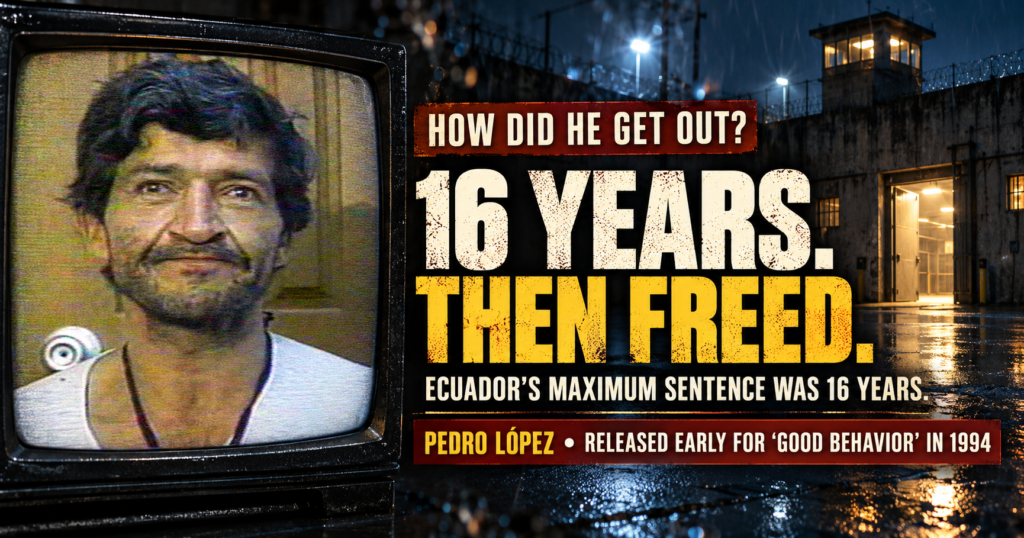
Colombian security agents took up a collection to pay for his hotel room.
The man they were watching was Pedro Alonso López, known as the “Monster of the Andes.” He had just returned from Ecuador after serving roughly 14 years for crimes against children.
But in September 1994, Colombian authorities initially had him under surveillance without formally holding him under arrest. According to a report published that week, he could no longer sleep in their cells because he was not officially deprived of his freedom.
So the agents arranged a room.
That small detail tells us more about his release than the familiar headline about a killer walking free for good behavior.
Authorities knew who he was. They were watching him. What they initially lacked was a settled legal basis for keeping him locked up in Colombia.
López’s release involved two separate events: the end of his reduced Ecuadorian prison sentence in 1994, followed by his reported release from psychiatric custody in Colombia in 1998. Different decisions opened those two doors.
Between them were missing evidence, another criminal proceeding, and a mother who returned to demand that her daughter’s death be investigated.
Why Ecuador Let Him Out of Prison
López received a 16-year sentence in Ecuador, the maximum sentence described in contemporary reporting on his case.
An AFP report published in March 1994 explained that ordinary sentences were not added together under the rules then being applied. It also reported that López had obtained a reduction of 599 days for good conduct.
An August report described his original 16-year term as reduced to approximately 14 years.
For an American reader, that can be difficult to grasp.
The scale of a murder case might suggest multiple sentences running one after another. That was not how his Ecuadorian punishment worked.
His sentence had an end. The reduction brought it closer.
Good conduct in custody also answers a much narrower question than whether someone can safely return to the community. Following prison rules does not, by itself, establish that a person will stop harming others outside prison.
Our comparison of serial killers’ victim counts and motives includes López, but the total attributed to him cannot explain his release on its own. The sentence structure is part of the answer.
Leaving Ecuador Did Not Mean the Case Was Over
López was deported to Colombia at the end of August 1994.
A September 1 report described him arriving at the Rumichaca international bridge with two changes of clothing in a sack. He had spent about 14 years and five months in Ecuadorian custody.
At first, Colombian officials were still determining what outstanding proceedings could justify holding him.
Then he was taken to El Espinal, in Colombia’s Tolima region, to answer allegations involving children killed years earlier.
That should have been an opportunity to examine the old evidence.
Much of it was gone.

The Court File Had Burned
A September 6, 1994, report from El Espinal described a major obstacle: a fire around 1991 had destroyed the substantial file concerning allegations that López had raped and killed 11 children.
Authorities were trying to rebuild the case while deciding whether they could continue to detain him.
This is the part I find hardest to shake.
The loss of a file sounds like an administrative problem until you consider what the file held: the material needed to pursue allegations concerning children who had never come home.
Their deaths had not disappeared. The evidence gathered about them had.
A killer’s reputation cannot replace the proof required in a particular case. Officials needed surviving evidence, renewed complaints, and witnesses they could locate.
The fire made that work harder at exactly the moment another opportunity to hold López had arrived.
A Mother Came Back With Her Daughter’s Name
Two days later, El Tiempo reported that Alba Sánchez had appeared at the courthouse.
She told authorities that her daughter, Floralba Sánchez Ospina, had been a victim of López years earlier. At that point, the newspaper reported, she was the only person who had returned to renew a complaint and provide evidence concerning the old cases.
López denied responsibility when questioned.
The report described roughly 2,000 people gathering around the courthouse as the proceedings attracted attention.
But the crowd could not reconstruct a case. Sánchez’s testimony could help.
Later reporting identified her daughter, whose name was also written as Flor Alba Sánchez, as a 12-year-old killed in December 1979. El Tiempo reported that this was the case for which López was ultimately convicted in Colombia.
Her name belongs in this story.
Accounts of López frequently move straight from an enormous victim total to his disappearance. Between those events was a mother returning to authorities after years had passed, insisting that one particular child still mattered.


Why He Was Placed in Psychiatric Custody
The Colombian proceedings took a different course from his Ecuadorian prison sentence.
According to later reporting, López was found inimputable, a legal finding concerning criminal responsibility, and placed in psychiatric custody.
El Tiempo quoted criminal lawyer Francisco Bernate explaining that this form of confinement concerned treatment and rehabilitation rather than an ordinary prison punishment.
That finding was not a declaration that the killings had never happened.
It changed the legal response to him.
The distinction is important to the timeline: he did not simply remain in Ecuador until 1998 and then walk out of the same prison. He had already left Ecuadorian custody in 1994 and become subject to proceedings in Colombia.
What Led to His Release in 1998?
El Tiempo’s retrospective reporting says López was released in 1998 after a psychiatric assessment declared him fit for release.
One account reported a payment of 80,000 Colombian pesos and a requirement that he report to judicial authorities monthly. Another described a medical assessment declaring him “cured” of the condition cited in his case.
Those descriptions come from reporting on the decision. They should not be turned into our own medical judgment about him.
They do explain why “good behavior” is an incomplete answer.
The 1994 release concerned his Ecuadorian sentence. The 1998 release concerned his psychiatric custody in Colombia.
Combining them into one event hides the decisions that actually need explaining.
Did He Escape, Receive a Pardon, or Finish His Sentence?
The release from Ecuador was reported as the completion of a sentence shortened through conduct-related reductions. It was not described as a pardon.
The later Colombian release was reported as a decision following psychiatric evaluation, with conditions attached.
That differs from breaking out of a prison.
It also differs from a government forgiving a crime.
López’s story is disturbing partly because lawful release decisions can still leave deeply troubling questions about evidence, supervision, and protection of the public.
The paperwork can authorize a door to open. That does not answer every question about the person walking through it.
Is Pedro López Still Alive?
His present whereabouts remain unverified in the reporting reviewed for this article.
A May 2025 report still described his location as unknown and treated an alleged 1999 sighting in Bogotá as lacking official confirmation.
That uncertainty supports a limited answer: we do not have reliable confirmation here of where he is or whether he remains alive.
It does not support a claim that he is definitely still killing.
Nor does it establish that someone killed him after his release.
An unresolved whereabouts story can attract increasingly confident theories. Confidence is not evidence.


How Certain Is the Famous Victim Total?
López confessed to killings across Ecuador, Colombia, and Peru. The frequently repeated total exceeding 300 comes from accounts of those confessions and attributed crimes.
It should not automatically be presented as the number of separate murder convictions.
Contemporary reports themselves differ in how they describe the killings covered by his Ecuadorian case. A March 1994 report discussed a confession involving more than 100 Ecuadorian girls; an August report described a conviction involving 16 minors.
Without the complete judgment, I would not turn those conflicting descriptions into a definitive conviction count.
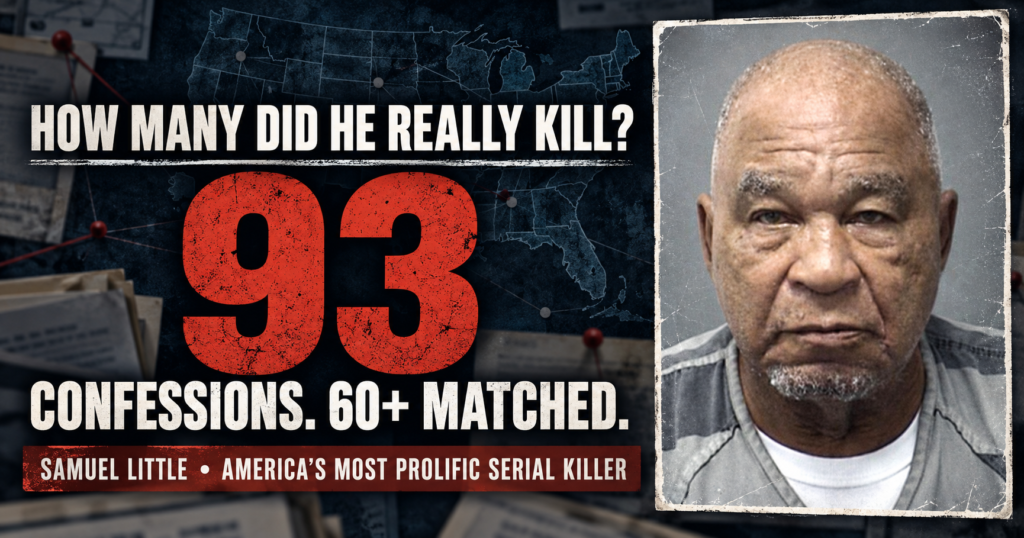
Our article examining Samuel Little’s confessed and verified murders explores the same underlying problem: a confession, an investigative finding, and a conviction are different kinds of evidence.
With López, the surviving reports of burned files and renewed testimony make that distinction especially concrete.
Frequently Asked Questions
Why was Pedro López released from prison?
His Ecuadorian sentence was 16 years, and contemporary reporting said it was shortened through reductions for good conduct. He left Ecuadorian custody in 1994 after serving roughly 14 years.
Why do some accounts say he was released in 1998?
That date refers to his later release from psychiatric custody in Colombia. It was a separate event from his departure from Ecuadorian prison in 1994.
Was Pedro López pardoned?
The reports reviewed describe a reduced prison sentence followed by a later release from psychiatric custody. They do not describe either event as a pardon.
What happened to the evidence against him in Colombia?
A contemporary report said a courthouse fire around 1991 destroyed the file concerning allegations involving 11 children. Authorities subsequently tried to reconstruct the proceedings.
Who was Floralba Sánchez Ospina?
She was a child whose mother, Alba Sánchez, returned to authorities in September 1994 to renew allegations against López. Later reporting identified her killing as the case that resulted in his Colombian conviction.
Do we know where Pedro López is now?
No verified current location was established in the sources reviewed. Recent reporting continues to describe his whereabouts as unknown.
By Miles Rowan for Stories in the Static, examining criminal cases through overlooked evidence, unresolved questions, and the lives behind the headlines.