

In 1986, an 18-year-old woman was raped and murdered in Irvine, California.
The attack became the last known crime associated with the man eventually identified as the Golden State Killer. His arrest came in 2018, more than three decades later.
For years, investigators had evidence from the crimes but no name to attach to it.
Joseph James DeAngelo was still alive.
That alone challenges one of the most familiar claims about serial killers: once they start, they cannot stop until someone catches them.
Yes, some serial killers stop committing murders before their arrest. The FBI explicitly identifies the belief that they cannot stop as a myth. But a long stretch without another known killing does not, by itself, explain why the killings ended or establish that an offender became harmless.
The difficult part is separating three possibilities: someone stopped, someone paused, or investigators have not found what happened next.

What Do We Actually Mean by “Stopped”?
Imagine a timeline with a murder in one year and an arrest 14 years later.
The empty space between those dates looks like an answer. It is really the beginning of a question.
Was the offender free throughout that period? Were there other crimes? Did investigators search for additional victims? Is the final date based on a conviction, a confession, or the last case police could connect?
Those details determine what the gap tells us.
I would rather read “no further murders have been established” than a confident explanation unsupported by the case. The first statement describes the evidence. The second can turn an unknown into a story.
This is also why our comparison of serial killers with large victim counts separates convictions, admissions, and estimates. A timeline built from proven cases can look different from one built from everything an offender claimed.
“Stopped killing” describes behavior. “Stopped wanting to kill” describes a mental state. One does not automatically prove the other.
BTK Had a 14-Year Gap Before His Arrest
Dennis Rader murdered ten people between 1974 and 1991. He was arrested in 2005.
The FBI used his case to illustrate that serial killers can stop before being caught. Its report states that Rader described sexual activities involving himself as a substitute for killing.
That account deserves careful handling. It comes from an offender explaining his own behavior.
There is stronger evidence for another part of the story: his public communications resumed.
In 2004, Rader sent police a photograph of a murder victim. Further correspondence eventually produced a computer disk containing a deleted file with the name “Dennis” and information about a Wichita church. Investigators developed additional evidence and arrested him.
The known killings had ended years earlier. His involvement with the crimes had not.
I find that distinction more unsettling than the idea of an offender simply disappearing. Rader could go years without another established murder and still return to the crimes through photographs and communications.
Investigators also found victim souvenirs in his home. Our examination of why killers preserve objects connected to their victims looks at how those collections can remain psychologically significant long after an attack.
A gap in killings was not the same as leaving the past behind.


The Golden State Killer’s Timeline Contains Two Different Gaps
DeAngelo’s case offers an especially useful warning about interpreting silence.
In its account of the investigation, the FBI reported no known associated incidents between July 1981 and the 1986 murder in Irvine.
That earlier gap lasted nearly five years. Then another victim died.
Looking backward, we know the earlier gap was not the end of the established series.
The later gap was much longer.
The Orange County District Attorney’s account states that DeAngelo was identified through investigative genetic genealogy in 2018, more than three decades after his final murder in 1986. He was sentenced in 2020 following guilty pleas to 13 murders and other offenses.
The contrast is stark: one quiet period was followed by another known killing. The other extended until his identification and arrest.
Neither set of dates, on its own, explains what changed inside his life.
This is where I think many accounts get ahead of their evidence. A marriage, a child’s birth, or a change of job may appear on the same timeline. That does not automatically establish why an offender stopped.
Chronology can identify a question worth investigating. It cannot answer every question about motive.
Jeffrey Gorton Is Another Example Beyond the Famous Cases
The FBI also cited Jeffrey Gorton in its discussion of offenders who stopped before capture.
Its report places his murders in 1986 and 1991, followed by his capture in 2002, with no further killing identified in that account.
The first victim was Margarette Eby, murdered at her home in Flint, Michigan.
A Michigan Supreme Court opinion records that her murder remained unsolved until DNA evidence identified Gorton in 2002. He later pleaded no contest and received a life sentence for the crime.
Eby’s case illustrates something easily overlooked: an offender does not need to commit a fresh murder for investigators to identify him.
Evidence from an earlier crime can become decisive years later.

That connection is central to how serial killers evade detection and what finally exposes them. The date of the arrest may tell us more about an investigative breakthrough than about a recent change in the offender’s behavior.

Why Might a Serial Killer Stop or Pause?
There is no single established explanation that fits every case.
The FBI’s discussion identifies circumstances such as increased family involvement, sexual substitution, and other diversions as possible factors inhibiting further killings.
A useful behavioral model discussed in the FBI Law Enforcement Bulletin separates an interest in offending from the things that prevent someone from acting.
Those restraints might include fear of detection or accountability to other people. The model also distinguishes these restraints from practical obstacles, such as being unable to reach a potential victim.
In ordinary language, wanting to do something, deciding to pursue it, and having the opportunity are different stages.
A change at any stage could affect the pattern.
The model helps frame questions about an offender’s circumstances. It is not a test that can prove why DeAngelo, Rader, or anyone else stopped.
It also avoids a misleading assumption: that a person who has killed repeatedly must be acting with the same intensity, opportunity, and constraints every day afterward.
Can Trophies or Fantasy Replace Further Killing?
Researchers have explored that possibility.
A 2021 study examined Dennis Rader and Lonnie Franklin Jr., looking at behavior during intervals between murders. Its analysis suggested that trophies, communications, and offense-related fantasy might sometimes lengthen those intervals by suppressing homicidal urges.
The important word is “might.”
This was an examination of two offenders, not evidence that keeping a trophy reliably prevents another murder. The researchers also considered how a desire for control could affect those proposed restraints over time.
Our article on the difference between a stolen object and a murder trophy explains why the object’s meaning needs to be established individually.
The question is not simply whether an offender owns something connected to a victim. It is how that person uses it and what evidence supports the explanation.
Sometimes the Apparent Gap Contains Undetected Murders
A timeline can be incomplete because investigators have not recognized every crime.
Samuel Little’s case makes that painfully clear.
The FBI reported that many deaths he confessed to had originally been classified as overdoses, accidents, or deaths with undetermined causes. Some victims’ bodies had never been found.
An analyst looking only at recognized homicides would be working with an incomplete record.
That does not mean every gap hides another victim. It means a gap needs investigation before it becomes evidence of stopping.
Little’s later admissions also presented difficulties: the FBI warned that his recollections of dates and clothing could be inaccurate. A possible connection should not be rejected solely because those details differed.
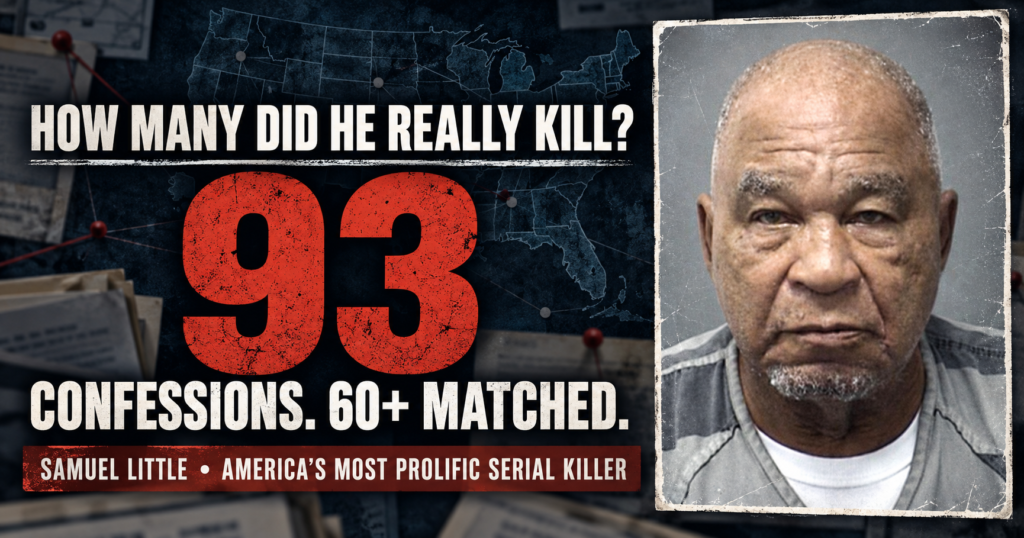
Our explanation of how investigators verify Samuel Little’s victim count follows that work. Establishing who was killed and when can change the apparent shape of an offender’s history.
An empty year on a chart may reflect missing information.
Stopping Does Not Erase the Earlier Crimes
DeAngelo’s prosecution shows how much remained to resolve after the known attacks ended.
The district attorney’s account describes more than 1.3 million pages of discovery. Prosecutors considered the ages of victims and witnesses, the deaths of other witnesses, and the prospect of a lengthy trial when evaluating the plea agreement.
The passage of time had created additional burdens for the people seeking justice.
For Little, investigators continued connecting crimes after he was already imprisoned for murder. His initial California convictions followed DNA links to three unsolved killings; later interviews and cooperation between agencies helped uncover a much broader history.
The cases behind the largest reported serial killer totals are reminders that arrest is sometimes the beginning of understanding the full harm.
Whether an offender stopped matters when reconstructing the case. It does not make the unanswered questions about earlier victims disappear.


Frequently Asked Questions
Can serial killers stop killing on their own?
Some stop before being caught. However, establishing a period without further murders does not prove that remorse, rehabilitation, or a deliberate decision caused it. The FBI rejects the blanket claim that serial killers cannot stop.
How long can a serial killer go without another known murder?
Documented gaps can last years or decades. Rader’s established timeline ended in 1991 before his 2005 arrest. DeAngelo’s final known murder occurred in 1986, and he was identified in 2018.
Does a cooling-off period mean the killer feels calm or remorseful?
The term should not be read as proof of either emotional state. Researchers examining intervals between murders have looked at continuing fantasy and other offense-related behavior during those periods.
Is someone still a serial killer if they stop?

Stopping does not undo the earlier pattern of murders. The FBI’s working definition concerns two or more unlawful killings by the same offender or offenders in separate events. Our guide to how many murders make someone a serial killer explains the definition and why some sources use different thresholds.
Can an old murder be solved without the offender killing again?
Yes. Gorton’s identification in the Eby case came through DNA evidence years after the murder. A new investigative connection can resolve an old crime without a fresh attack.
By Miles Rowan for Stories in the Static, examining criminal cases through overlooked evidence, unresolved questions, and the lives behind the headlines.
Pingback: Why Do Serial Killer Victim Counts Keep Changing? – Stories In The Static