
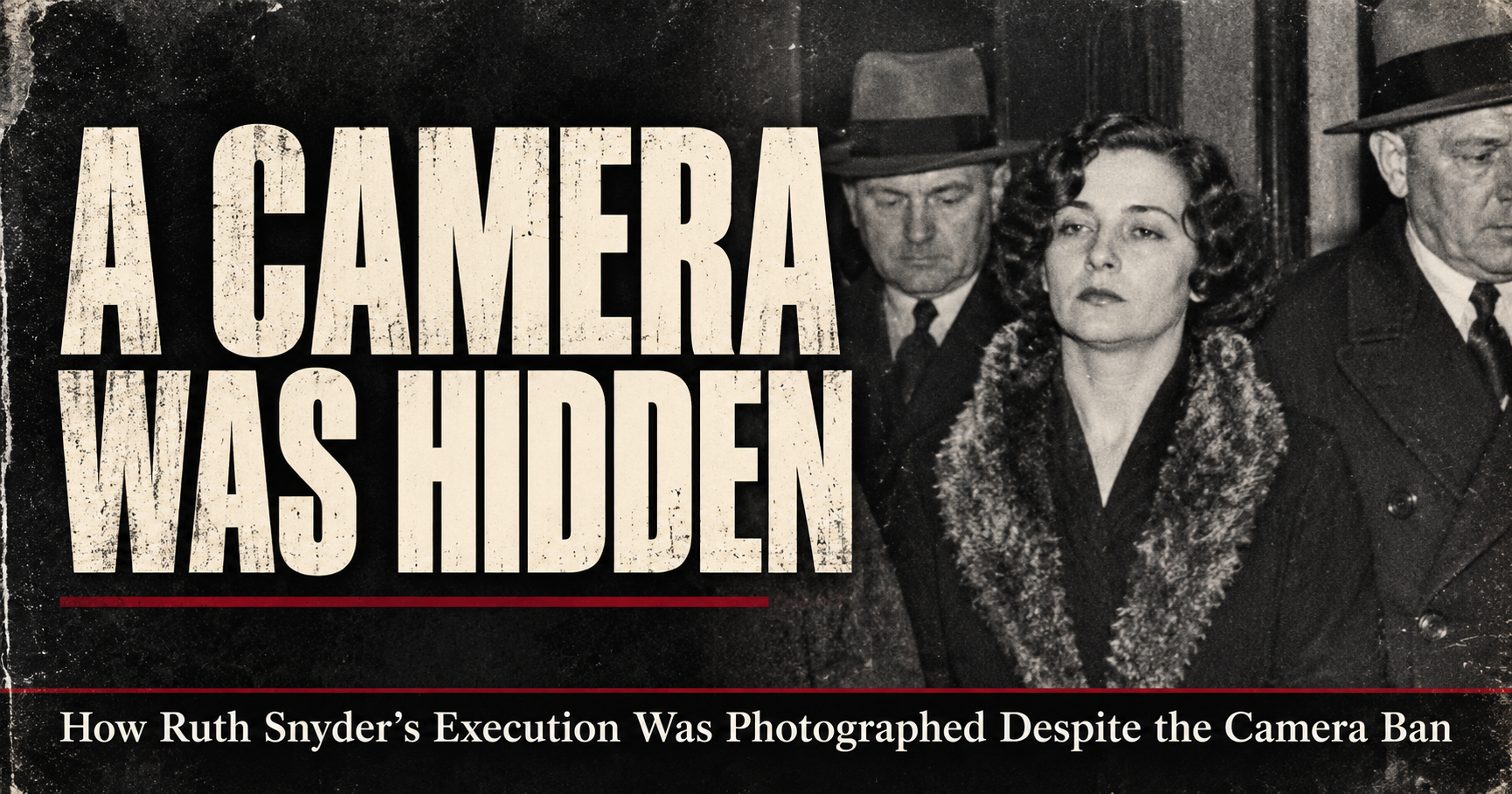
The camera was down by his ankle.
That is the detail I keep coming back to. While witnesses watched the electric chair, photographer Tom Howard had a miniature camera hidden beneath his trouser leg. The chair’s operation also depended on practical bodily preparations, including those described in physical preparations for an electric-chair execution.
He had entered Sing Sing to witness Ruth Snyder’s execution. He was also there to bring back something the prison expressly prohibited: a photograph from inside the death chamber.
On January 12, 1928, he succeeded. The Metropolitan Museum of Art identifies the resulting image as Howard’s photograph of Snyder’s electrocution at Sing Sing in Ossining, New York. The Metropolitan Museum of Art
By the next morning, that private moment was on a newspaper’s front page beneath one enormous word:
“DEAD!”
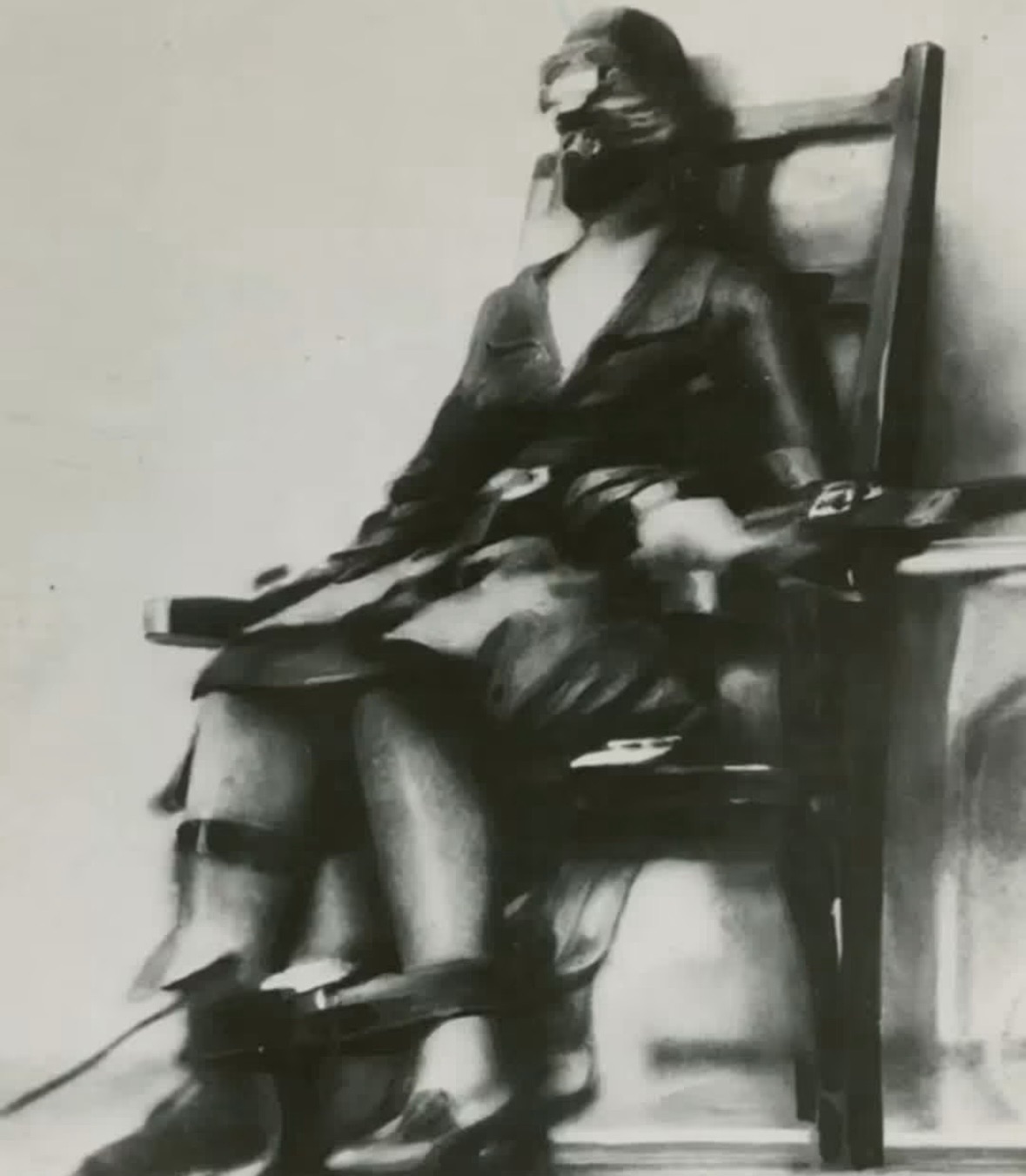
The January 13 extra edition of the New York Daily News survives as a record of what readers were shown. Getty Images
But before Snyder became the woman in that photograph, someone else had died in this story.
His name was Albert Snyder.
The Murder Behind Ruth Snyder’s Execution
On March 20, 1927, Albert Snyder was killed in bed at his home in Queens Village.
His wife, Ruth, and their young daughter were in the house.
Ruth initially claimed that robbers had tied her up and killed her husband. The disturbed rooms appeared to support a burglary story, but investigators questioned it.
According to New York’s Court of Appeals, Ruth eventually admitted that Henry Judd Gray had killed Albert and then tied her hands and feet with her agreement to divert suspicion.
Gray was apprehended in Syracuse. He first claimed he had been in a hotel there when the murder happened. He later confessed, describing an advance arrangement with Ruth to kill her husband and an effort to manufacture an alibi.
The supposedly stolen jewelry supplied another problem for the robbery account: investigators found it beneath Ruth’s mattress.
Albert had been attacked with a window sash weight, chloroform, and wire. The sash weight was a heavy component used in older window mechanisms, rather than the window itself. HISTORY
The staged burglary depended on investigators accepting the scene as they found it.
They did not.
An Affair, Insurance, and a Plan That Fell Apart
Ruth and Gray were having an affair. Gray was a married corset salesman, and life insurance on Albert became part of the prosecution’s explanation for the murder.
The insurance history was more complicated than a wife simply buying a policy.
A later insurance lawsuit described Albert signing a completed application for a small policy and another application left blank. An agent subsequently filled the blank application out for substantially larger coverage after discussions with Ruth. The court record said there was no evidence Albert knew that larger application had been made.
That detail makes the financial part of the story more concrete without pretending we can reconstruct every private conversation.
The murder prosecution and the insurance dispute were different proceedings. The insurance court was examining whether valid contracts had been formed, not retrying the criminal case.
Ruth and Gray’s relationship did not produce a united defense.
Each tried to leave the other holding more of the blame.



The Lovers Turned on Each Other in Court
Ruth and Gray were tried together and convicted of first-degree murder.
Ruth claimed she had tried to discourage Gray and stop the killing. Gray portrayed himself as a man whose will had been weakened by alcohol and who had fallen under a stronger personality’s control.
The Court of Appeals rejected their challenges and affirmed both convictions in November 1927. It also rejected the argument that the joint trial had deprived them of a fair trial.
Their competing accounts are revealing for a reason that has little to do with romance.
The original cover story required cooperation. Once that failed, their defenses required separation: each wanted the jury to distinguish their responsibility from the other’s.
Meanwhile, the newspapers had found a story they could keep selling.
Ruth Snyder Became a Character the Tabloids Could Sell
The case unfolded during fierce competition among New York tabloids.
Coverage emphasized Ruth’s appearance, sexuality, and supposed personality. The papers gave her lurid nicknames and turned the murder trial into a spectacle. Historical accounts describe vendors even selling souvenir pins shaped like the sash weight used in the killing.
A murder weapon had become merchandise.
That is a disturbing detail before we ever reach the execution photograph.
Readers were being offered more than information about a criminal case. They were being offered a villain, a scandal, and something to take home.
Albert’s death supplied the reason for the trial. Ruth’s image supplied a product.
The distinction matters because it explains why the newspaper’s interest did not end with the verdict.
There was still one picture it did not have.


Why Tom Howard Was Brought in From Chicago
The Daily News wanted a photograph of the execution, but cameras were forbidden in the chamber.
There was another obstacle: prison staff knew the local newspaper photographers.
The paper brought in Tom Howard from the Chicago Tribune, someone less likely to be recognized. He prepared a concealed camera that could be operated without holding it in his hands. smithsonianmag.com
It was an assignment built around deception.
Howard needed to be admitted as a witness while concealing the equipment that made his presence valuable to the newspaper.
The difference between a reporter and a photographer normally would have been obvious. A reporter could leave with notes. A photographer needed a camera.
Howard’s arrangement hid that difference beneath his clothes.
How the Ankle Camera Worked
Howard strapped the miniature camera to his ankle and ran its operating connection up inside his trouser leg to a control in his pocket.
A 1935 TIME account described him making a six-second exposure from approximately 12 feet away.
Six seconds is a long time compared with the quick click we associate with taking a picture.
A photograph made that way records light over an interval. Movement during the exposure can blur the result.
That matters when looking at Snyder’s photograph. It is not a perfectly frozen fraction of a second, and it cannot tell us the precise instant at which she died.
It is an image made during an execution.
The blur does not make it less real. It makes the equipment and circumstances more visible.
January 12, 1928, Inside Sing Sing
Ruth Snyder and Judd Gray were both executed that night.
During Snyder’s electrocution, Howard exposed his concealed camera and captured the image. Afterward, the photograph was taken back to Manhattan for publication.
The picture shows Snyder restrained in the chair, her face covered.
There is no expression for the viewer to read. The visible restraints and equipment carry the scene.
For me, that is part of what makes the photograph unsettling. It does not offer the familiar storytelling cues of a portrait. There is no face inviting sympathy or defiance.
There is a person inside an apparatus designed to kill her.
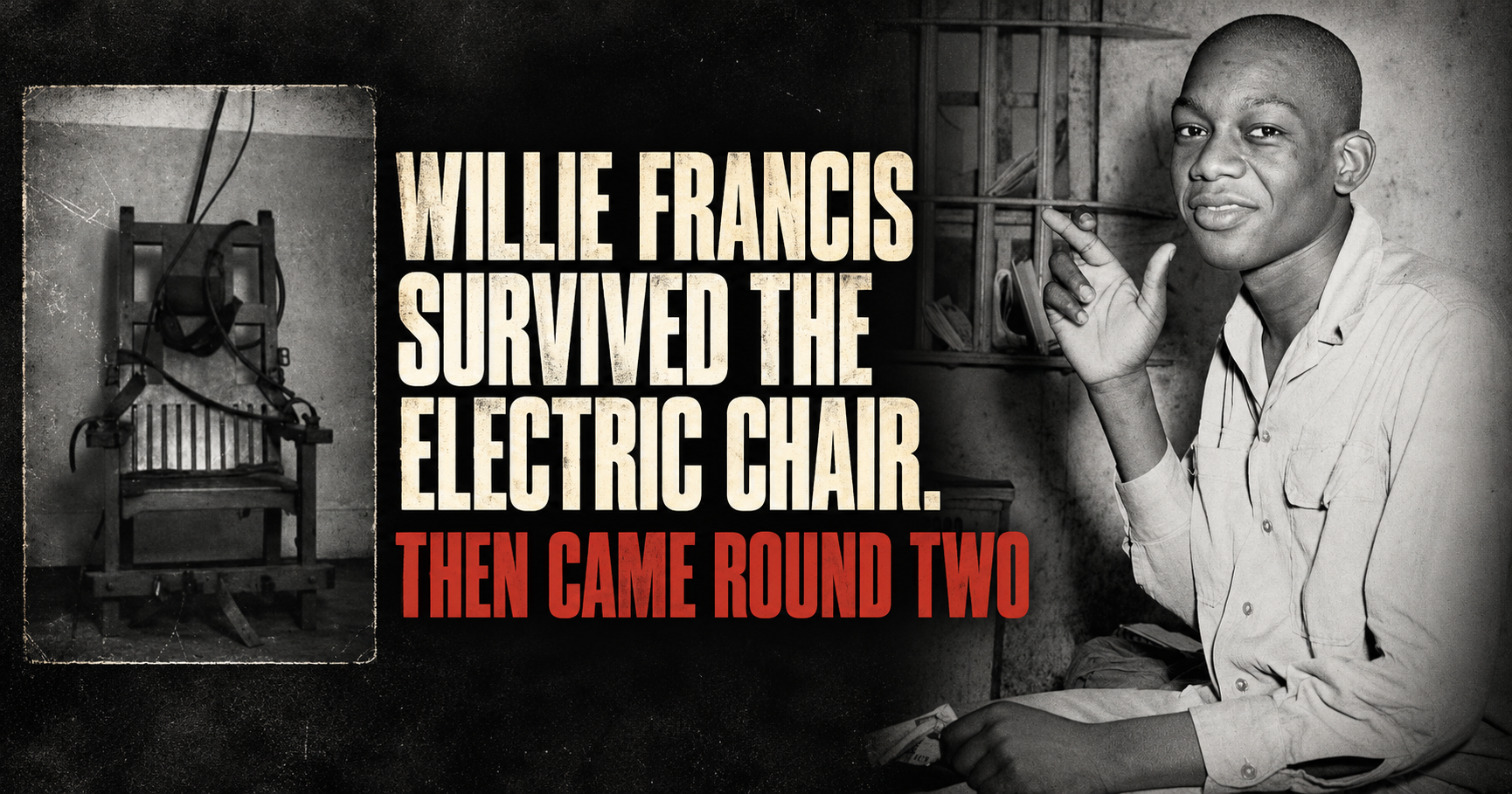
The chair also connects this case with Willie Francis, who survived his first encounter with the electric chair. The cases had very different outcomes, but both force the machinery itself into a story that can otherwise become only a sentence on a court record.
The Newspaper Turned the Execution Into a Front Page
The Daily News published Howard’s photograph under its stark headline. The Met notes that the image appeared on the paper’s front page two days in a row. The Metropolitan Museum of Art
Prison officials were furious. New York’s corrections commissioner sought action against Howard and the newspaper, although the effort did not result in the prosecution he wanted. smithsonianmag.com
The photograph created two arguments that are still difficult to separate.
One is that people should understand what a government does in their name. A photograph can make an execution harder to discuss as an abstract policy.
The other is that a newspaper can profit by turning someone’s death into an attraction.
Both can be true.
An image may reveal something important while being presented in a way designed to sell copies. Calling it journalism does not settle every question about how it was obtained or displayed.


Was Ruth Snyder’s Execution Public?
Snyder was executed inside a prison before selected witnesses. The newspaper photograph did not make the chamber an event anyone could attend.
But it gave an outside audience access afterward.
That distinction helps explain why the date of America’s last public execution has a complicated answer. Watching in person, receiving a photograph, and viewing a broadcast are different ways of witnessing an execution.
Howard’s camera crossed a boundary between them.
The prison controlled entry into the room. Once the newspaper printed the image, it no longer controlled who could see what had happened there.

The same question sits behind the debate over broadcasting the Fort Hood shooter’s execution: what does the audience gain by seeing a death, and what might the act of watching turn it into?
The Camera Survived, Too
Howard’s ankle camera entered the Smithsonian’s collection after the Daily News donated it in 1963. The museum identifies it as the camera used to photograph Snyder’s execution. americanhistory.si.edu
That gives the story an unusually tangible surviving object.
The photograph records the execution. The camera records the effort made to get the photograph.
Together, they raise a question the headline could not answer: were readers being shown something they needed to understand, or something they had been taught to want?
Questions About Ruth Snyder’s Execution Photograph
Was Ruth Snyder’s execution photograph real?
Yes. The Metropolitan Museum of Art holds a print attributed to Tom Howard, and the Smithsonian identifies the surviving ankle camera used to make it. The Metropolitan Museum of Art
Who photographed Ruth Snyder in the electric chair?
Tom Howard, a photographer brought in from Chicago for the New York Daily News, took the photograph with concealed equipment.
When was Ruth Snyder executed?
She was executed at Sing Sing on January 12, 1928. Judd Gray was executed that same night.
Was it the first photograph of an electric-chair execution?
Historical accounts identify Howard’s image as the first photograph of an execution by electric chair. That is a narrower claim than saying no other such photograph has ever existed. time.com
Did the photograph show the exact instant she died?
It was made during her electrocution. Because the exposure lasted several seconds, it should not be described as pinpointing a medically identifiable instant of death.
Why were Ruth Snyder and Judd Gray executed?
They were convicted of first-degree murder for killing Ruth’s husband, Albert Snyder, in March 1927.
By Miles Rowan for Stories in the Static.