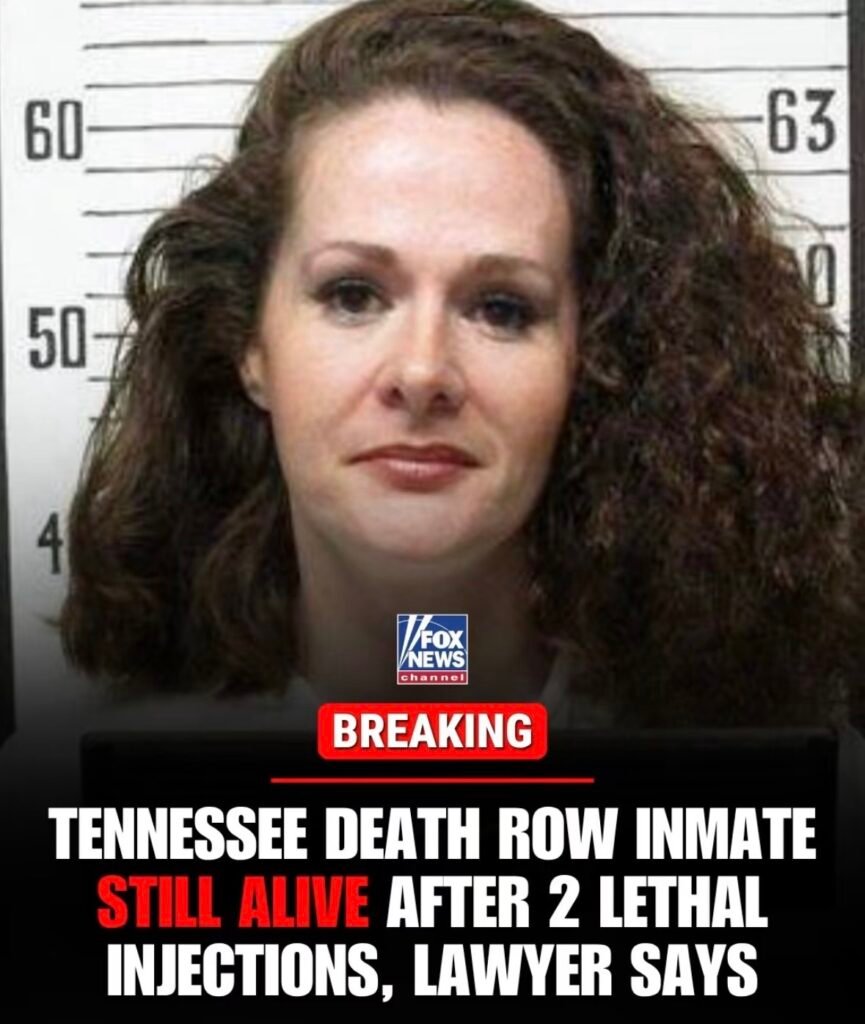
The headline seemed almost impossible: a Tennessee death row prisoner had received two lethal injections, but her lawyers said she was still alive.
On September 30, 2026, Christa Pike’s scheduled execution became an unfolding emergency. Instead of a straightforward announcement that her sentence had been carried out, reports described breathing sounds, closed curtains, emergency legal filings, and unanswered questions.
The central fact needs careful wording: Pike’s attorneys reported that she remained alive after the injections. That report did not establish her eventual medical outcome.
What happened that night deserves more than a shocking headline. It also deserves a clear distinction between what people witnessed, what lawyers alleged, and what officials had explained.
Reporting cutoff: September 30, 2026, at approximately 10:35 p.m. Central. This account reflects information available during a developing story.
Did Christa Pike Survive the Lethal Injections?
According to her defense team, Pike remained alive after receiving two syringes of the lethal injection drug.
WVLT reported that assistant federal defender Luke Ihnen confirmed the injections and said her attorneys had filed an emergency motion seeking to stop the execution. At this reporting cutoff, her longer-term condition remained unresolved in the reporting reviewed for this article.
There is a meaningful difference between saying someone was reported alive during an execution attempt and saying that person survived it with a known medical outcome.
The first describes an observation at a particular moment. The second requires information about what happened afterward.
If you arrived here from a screenshot saying “still alive after two lethal injections,” that distinction is the first thing to understand.
What Witnesses Could See, and What They Couldn’t
Perhaps the most unsettling part of the early accounts was the interrupted view.
WVLT published a witness timeline describing curtains opening and closing during the procedure. Witnesses were escorted out of the viewing room at 8:53 p.m. Central. Reporter Will Puckett described sounds resembling heavy snoring, while other accounts described Pike complaining about pain in her arm.
Those accounts matter. But a witness watching through a window cannot provide a complete medical explanation of what is happening inside an execution chamber.
An observation about a sound is not a diagnosis. A closed curtain leaves a gap in the public account.
That is the detail that stands out most to me. Readers can easily picture an execution as one continuous, witnessed procedure. The accounts emerging that night described something harder to reconstruct.
When the view disappeared, so did the witnesses’ ability to explain what happened next.
What Her Lawyers Said in the Emergency Motion
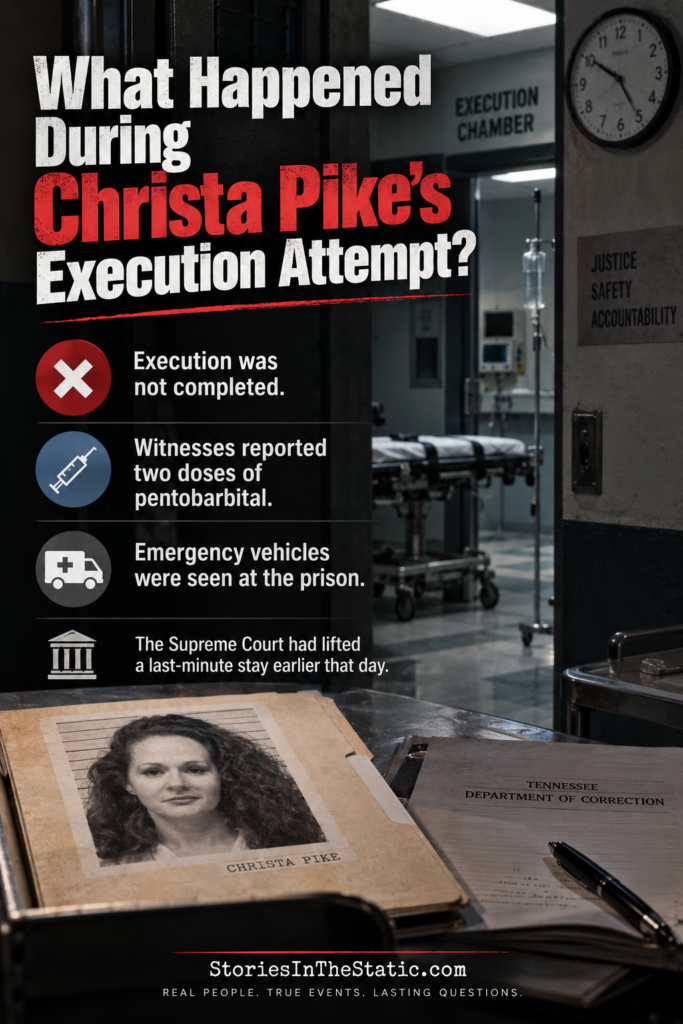
WSMV reported that Pike’s attorneys filed an emergency motion alleging that both syringes of pentobarbital had been administered, but that she still had a heartbeat and had not lost consciousness.
The filing described her as “still alive and snoring” and asked for the execution to stop and lifesaving measures to begin. Those were statements from her legal team, rather than independent medical findings published by the state.
The request changed the immediate question.
Earlier, the dispute had been whether the execution should proceed. Now, her attorneys were asking a court to intervene in a procedure already underway.
A motion asking for emergency relief is not itself a court order granting that relief. Keeping those two steps separate is essential when following a rapidly changing case.
Were Ambulances Called to the Prison?
WSMV reported observing ambulances arrive at the prison and leave afterward with police vehicles following. That observation alone did not establish who was transported or their condition.
Tennessee Lookout separately reported that a spokesperson for the U.S. Campaign to End the Death Penalty said Pike had been taken to a hospital. The group did not know her medical status. That hospital-transfer account was attributed to an advocacy organization, not presented as a medical update from the Tennessee Department of Correction.
This is where breaking stories can become misleading without anyone inventing an entire event.
An ambulance is observed. A transfer is reported. Someone online fills in the outcome.
Those are separate pieces of information. They should stay separate until evidence connects them.
Why Was Christa Pike on Death Row?
Behind the execution headlines was the killing of Colleen Slemmer, a 19-year-old student at a job-training facility in Knoxville.
Pike was 18 when Slemmer was killed in 1995. Pike and her boyfriend were convicted in the case, and Pike received a death sentence. By the scheduled execution in September 2026, she was 50.
Slemmer’s mother, May Martinez, told the Associated Press that she wanted the sentence carried out after decades of waiting.
I think a responsible account has to hold two things in view: the person whose life was taken and the questions surrounding the state’s attempt to carry out a sentence.
Examining the execution does not require minimizing the murder. Remembering Colleen does not require guessing what happened inside the chamber.
Why Did the Execution Proceed After a Court Had Stopped It?
Earlier on September 30, a federal appeals court temporarily stayed Pike’s execution.
The Sixth Circuit sought more time to consider issues involving her childhood abuse history and its treatment during sentencing. Tennessee appealed, and the U.S. Supreme Court lifted the stay that evening. Justices Sonia Sotomayor, Elena Kagan, and Ketanji Brown Jackson dissented.
That sequence explains why early headlines appeared to contradict one another.
A headline saying the execution was halted could accurately describe the morning’s court action. A later headline saying it could proceed could accurately describe the Supreme Court’s decision.
Neither headline, by itself, explained what happened during the subsequent execution attempt.
The court dispute before the injections and the emergency filings afterward were different stages of the same night.
Why Didn’t the Injections Produce the Expected Outcome?
At this reporting cutoff, the available accounts did not establish a verified medical explanation.
The Associated Press reported that authorities appeared to administer two doses of pentobarbital and that a corrections spokesperson could not immediately explain what had happened.
That leaves a question, not permission to choose the most dramatic answer.
I would not treat reports of snoring, arm pain, or an extended procedure as proof of a particular cause. Explaining the outcome would require medical records, a documented account of the administration, and qualified review.
The honest answer to “How could this happen?” was still incomplete.
The Questions an Official Account Needs to Answer
The most useful next update would be a documented sequence of events.
That means explaining when the drugs were administered, what staff observed afterward, what happened while the curtains were closed, when the procedure was stopped, and what medical treatment followed.
Pike’s condition is another essential part of that account.
To me, these are the questions that make the story worth following. The headline captures attention, but the timeline determines what readers can actually understand.
Until those details are established, the uncertainty should remain visible.
What Happens If Someone Survives an Execution Attempt?
Surviving an execution attempt does not automatically cancel a death sentence or mean the prisoner goes free. It can lead to emergency medical treatment, additional court proceedings, a delay, and potentially another attempt.
What happens next depends on the prisoner’s condition, the execution authorization, court orders, and any action by the governor.
The Immediate Question Is Medical Care
When an execution is interrupted and the prisoner remains alive, their medical condition becomes an urgent concern.
In Pike’s case, her attorneys asked the courts to stop the procedure and require lifesaving measures. That was a request for emergency intervention, not proof that a judge had already granted it. WSMV also reported seeing ambulances arrive and depart.
Stopping the execution and treating the prisoner are separate decisions from what happens to the death sentence afterward.
Can the State Try to Execute the Person Again?
A second attempt can be legally possible. There is no automatic “you survived, so you’re free” rule.
In the 1947 case Louisiana ex rel. Francis v. Resweber, the U.S. Supreme Court allowed Louisiana to attempt another execution after an electric-chair malfunction failed to kill Willie Francis. The Court treated the first attempt as an accidental failure and rejected the constitutional objections to another attempt under those circumstances.
That decision does not establish that every second attempt is lawful regardless of what happened. The circumstances, alleged suffering, execution method, and applicable court orders still matter.
For Pike, the possibility of another attempt should not be confused with an announced decision to make one.
Would They Try Again Immediately or Set Another Date?
There is no single timetable that applies to every failed execution.
Tennessee’s Supreme Court rules provide a process for the state attorney general to request an execution date when no date is in effect. A future attempt would have to comply with the applicable authorization and any intervening court orders or reprieve. An unfinished execution does not create open-ended permission to continue whenever officials choose.
A delay can also come from the governor. After Tennessee’s unsuccessful attempt to execute Tony Von Carruthers in May 2026, Governor Bill Lee announced a one-year temporary reprieve. That was a specific decision in Carruthers’ case, not a guaranteed waiting period for every prisoner who survives an attempt.
Could the Death Sentence Be Changed to Life in Prison?
That is a possible outcome through a separate legal ruling or executive clemency decision. It does not happen automatically because an execution failed.
A reprieve postpones an execution. A commutation reduces or changes the sentence. A court-ordered stay temporarily blocks the execution while legal issues are addressed.
Those terms can sound interchangeable in breaking headlines, but they describe different outcomes.
What Does That Mean for Christa Pike?
At this article’s reporting cutoff, the accounts reviewed did not establish Pike’s final medical outcome or an announced schedule for another execution attempt.
The next developments to watch are her condition, official confirmation of whether the procedure was terminated, rulings on the emergency filings, and any new execution order or action by the governor.
My biggest takeaway is that surviving the procedure and having the sentence lifted are two very different things.The first would leave urgent medical and legal questions. The second would require a separate decision.
Questions About Christa Pike’s Execution Attempt
Was Christa Pike still alive after two lethal injections?
Her defense team reported that she was. That statement described her condition during the attempted execution and did not establish her eventual outcome.
What drug was reportedly used?
Her attorneys’ emergency filing identified pentobarbital and alleged that both syringes had been administered.
Did surviving the attempt mean she was released?
The reporting reviewed for this article did not announce her release or the cancellation of her conviction. An interrupted execution and a change to a criminal judgment are separate matters.
Was she taken to a hospital?
Tennessee Lookout attributed a hospital transfer to a spokesperson for an anti-death-penalty organization. The spokesperson did not know her medical status, so that report should not be read as confirmation of recovery.
Is this a true story?
Yes. This article covers a real criminal case and reported events surrounding the September 30, 2026, execution attempt. The developing medical outcome and the explanation for what happened remained unresolved at the stated reporting cutoff.
About this story: This is a real, documented case, not original fiction. Written by the Stories in the Static editorial team using attributed news reports, with first-person commentary clearly separated from reported facts.
Comments
One response to “What Happened During Christa Pike’s Execution Attempt?”
[…] same question came up during the reporting surrounding Christa Pike’s interrupted execution attempt. Understanding what happened during a particular procedure requires a separate account from […]