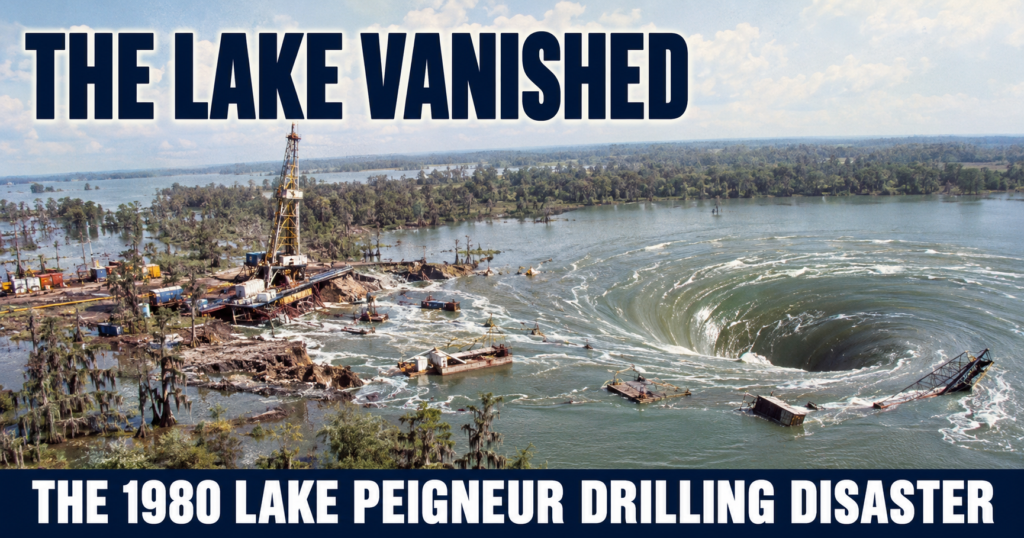
A drilling rig started leaning on a Louisiana lake. The crew tried to free a stuck drill, realized something was badly wrong, and abandoned the platform.
Then the rig disappeared beneath water that was supposed to be shallow.
On November 20, 1980, Lake Peigneur began draining into the salt mine underneath it. The opening expanded, a giant whirlpool formed, and the disaster swallowed equipment, boats, and pieces of the surrounding shoreline.
This was a real lake draining into a real underground mine.
The detail I keep coming back to is the difference in scale. A drilling opening seems small. A lake seems enormous. How does one become big enough to swallow the other?
The answer starts with something ordinary: freshwater dissolves salt.
How Did Lake Peigneur Drain Into a Salt Mine?
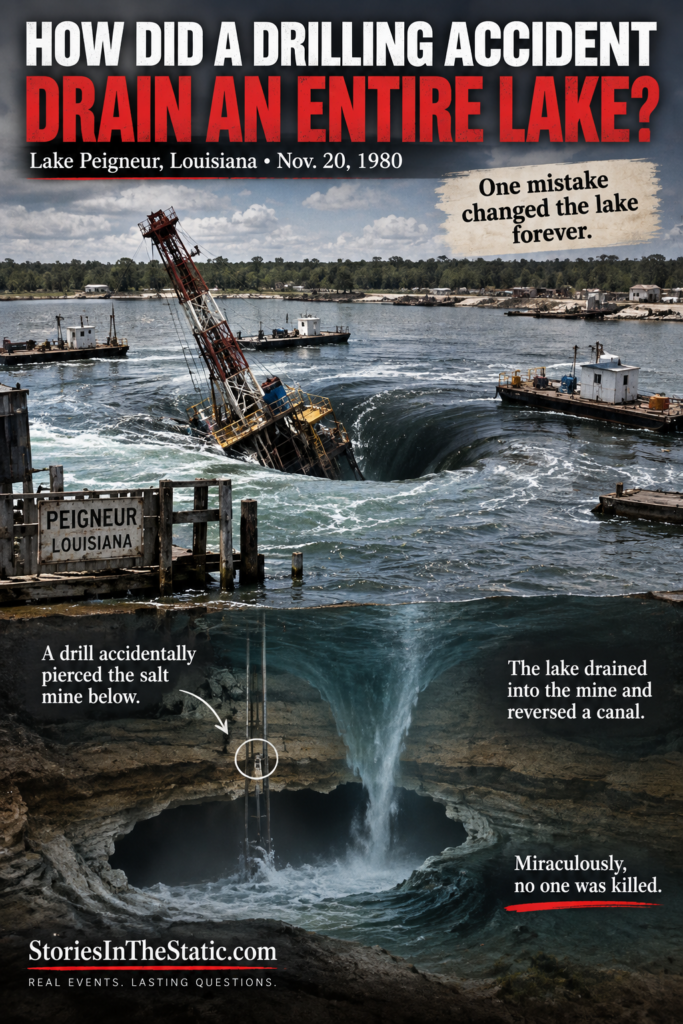
An oil exploration well penetrated a chamber of the Jefferson Island salt mine beneath Lake Peigneur. That created a path for lake water to enter the underground workings.
A technical paper presented to the Solution Mining Research Institute describes the drilling penetration, the loss of drilling-fluid circulation, and the rapidly enlarging opening. The water did not keep flowing through a neat, drill-sized hole. Erosion and salt dissolution made the passage much larger.
That is the essential part of the story.
Imagine pulling the plug from a bathtub, except the rushing water can eat away at the material surrounding the drain.
The opening grows. More water gets through. That water enlarges the opening further.
At Lake Peigneur, the lake supplied the water, the mine supplied the underground space, and the salt made the connection increasingly destructive.
Why Was There a Mine Under the Lake?
The Jefferson Island mine had operated since 1920. Workers excavated underground salt, leaving supporting pillars between the large spaces they created.
Geologist Dale H. Easley described mine passages with roofs approximately 80 feet high and widths comparable to a four-lane highway.
That changes how I picture the accident.
“Salt mine” can sound like a narrow tunnel. Here, the lake was above an extensive underground operation.
The drilling did not have to excavate an entirely new cavern capable of accepting the water. There was already substantial empty space below.
The technical study estimates that the mine’s volume was greater than the volume of water in the lake before the accident.
The Rig Was the First Warning Above the Water
The University of Louisiana at Lafayette’s account describes a drill that seized, noises from the structure, and a platform that began tilting.
The crew escaped to shore before the roughly 150-foot derrick was swallowed. A whirlpool developed where the rig had stood.
A rig leaning on soft lake-bottom mud might initially seem like an equipment problem. Watching it disappear would have changed that understanding completely.
What makes this sequence unsettling is how quickly the problem outgrew the machinery involved.
The crew’s worksite was no longer simply unstable. The lake beneath it was becoming a drain.
How Did the Miners Get Out?
The miners underground escaped.
The technical account reports that approximately 50 miners evacuated safely as the mine flooded. The university’s historical summary describes noises from fuel drums being swept away as an early warning of the incoming water.
For me, this is the part that deserves at least as much attention as the whirlpool.
Aboveground, the disaster was visible. Underground, the people in its path had to recognize the danger and get out.
The available accounts establish the successful evacuation. They do not give us permission to invent conversations, thoughts, or a minute-by-minute escape scene.
The documented result is remarkable enough: the people working below the lake survived.
The Canal Started Flowing Backward
Lake Peigneur was connected to the Gulf through the Delcambre Canal.
As the lake drained, the canal reversed its normal flow and supplied water toward the developing crater. Easley’s account describes a temporary waterfall where that incoming water dropped into the lowered basin.
The disaster did not stop at the lake’s original supply of water. Its connection to the coast helped refill it.
That detail makes the event feel almost impossible, but the direction of flow followed the changed water levels.
The water was moving toward the space being emptied.
I find that more interesting than describing the whirlpool as some mysterious force. The event was extraordinary, but the water was responding to a physical opening and a changing landscape.
What Did the Whirlpool Swallow?
The university’s account lists drilling equipment, a tugboat, 11 barges, trees, and substantial surrounding land among the losses.
It also reports one of the strangest developments afterward: nine of those barges resurfaced as the lake refilled.
That does not mean every vessel traveled intact through the mine or that the disaster somehow reversed itself.
It means that objects drawn into the collapsing basin could later become visible again as conditions changed.
The shoreline damage, flooded mine, and altered lake remained.
Was a Mapping Mistake Definitely to Blame?
This is where I would slow down a familiar version of the story.
Many retellings explain the disaster with a simple statement: someone got the drilling coordinates wrong.
The university’s retrospective attributes the accident to a mapping error. But contemporary UPI reporting recorded Texaco disputing the claim that its rig had been placed incorrectly. The companies also made competing allegations about responsibility.
The physical mechanism and the assignment of blame are separate questions.
The technical account describes the well opening a path into the mine. Establishing exactly why the drilling and mining operations came into conflict requires more than repeating the most memorable explanation.
Easley’s later account describes an unclear breakdown in communication and lawsuits between the companies.
My reading is that we can explain how the lake drained with much greater confidence than we can reduce every decision behind the accident to one person making one mistake.
Did Lake Peigneur Come Back?
The basin refilled, but the original lake did not simply return.
The University of Louisiana at Lafayette describes a formerly shallow freshwater lake transformed into a much deeper saltwater lake, with a different ecosystem.
Water returning was not the same as the landscape recovering.
That distinction is easy to miss when the story ends with barges popping back to the surface.
A lake could be visible again while the underground mine was lost and the conditions that supported the old lake had changed.
There Is Archived Footage of the Disaster
This story has evidence beyond modern animations and repeated internet summaries.
The University of Louisiana at Lafayette’s Center for Louisiana Studies catalogs a film by Bruce Conque that includes disaster footage and interviews, along with background on Jefferson Island’s mining and oil operations. Its catalog identifies disaster footage beginning around 2:20 and another segment around 16:33.
The university’s record of the Lake Peigneur film provides a useful starting point for tracing that material. Access to a catalog entry does not automatically mean the complete film is available to stream.
That is the kind of source I want attached to an extraordinary story: something identifiable, preserved, and connected to the event.
Questions About the Lake Peigneur Disaster
When did Lake Peigneur drain?
The disaster began on November 20, 1980, near New Iberia, Louisiana.
Did the drilling hole stay the same size?
No. The technical account describes rapid enlargement through erosion and dissolution of the surrounding salt. That growth explains why the consequences became much larger than the initial drilling opening.
Did anyone die in the disaster?
The university’s historical account reports no human deaths or injuries. That refers to people, rather than a claim that nothing living was harmed.
Why didn’t the lake stay empty?
Water entered through the canal connecting the lake to the Gulf. The basin refilled, although the disaster had changed its depth and water conditions.
Was the whole lake suddenly hundreds of feet deep?
Descriptions of the disaster’s deep crater should not be read as meaning every part of the lake had the same depth. The important change was from a shallow lake to a basin containing a much deeper collapse area.

About this story: The Lake Peigneur disaster is a real, documented event, not original fiction. Written by the Stories in the Static editorial team using technical research, historical reporting, and university archival records, with first-person interpretation separated from documented facts.