
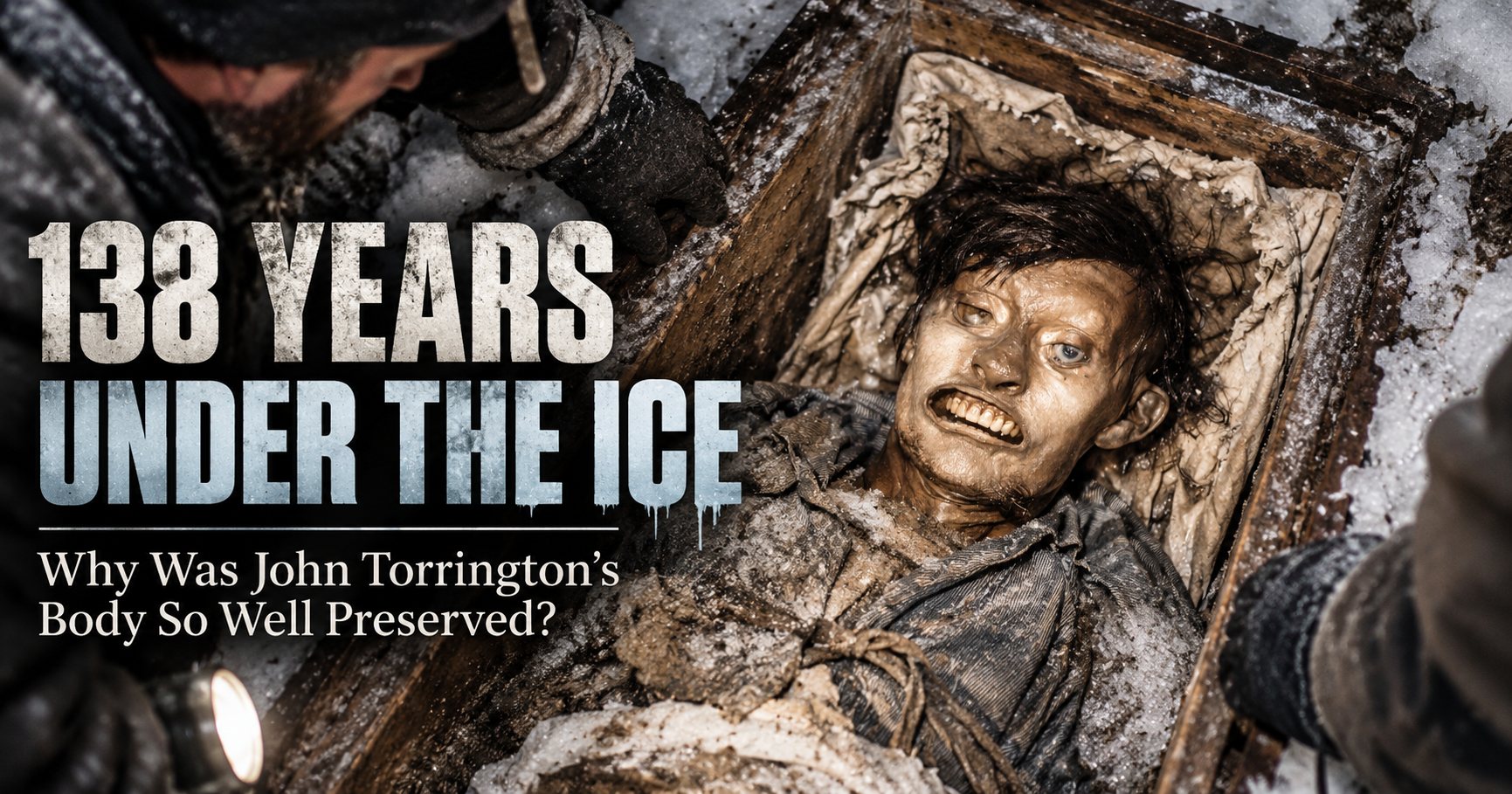
In August 1984, researchers opened the grave of a sailor who had been dead for 138 years.
His name was John Torrington. He was 20 when he died.
Beneath the frozen ground of Beechey Island, his face had survived with an intimacy that a skeleton never could. Eyelashes. Skin. Partly open eyes.
That is what makes the photograph so difficult to look away from. You know you are looking at someone who died in 1846. Your brain keeps trying to place him somewhere much closer.
Anthropologist Owen Beattie had expected the Arctic ground might preserve tissue. What he encountered became one of the defining images of the lost Franklin expedition: a young man whose appearance had outlasted everyone who knew him.
But the photograph was only the beginning.
Inside Torrington’s body were clues to a disaster that killed an entire expedition. Reading those clues would prove considerably harder than finding them.
Why was John Torrington’s body so well preserved?
John Torrington’s body remained remarkably preserved because his grave lay in Arctic permafrost. The prolonged cold greatly slowed decomposition, allowing skin and other soft tissues to survive.
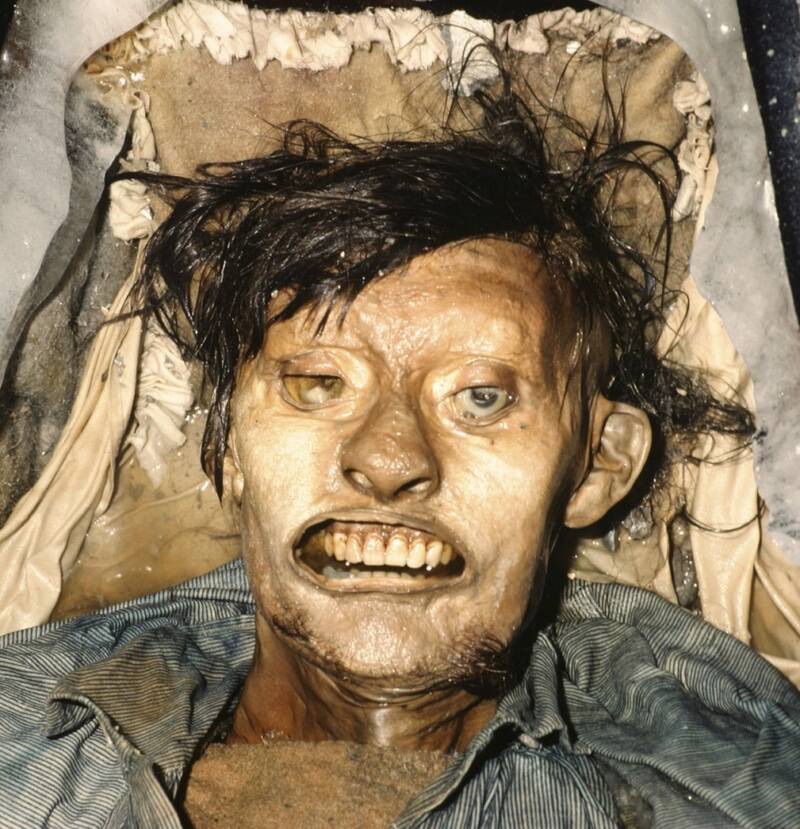
He had not undergone an elaborate embalming procedure. Researchers found a body encased in ice inside a wooden coffin.
The conditions were so cold during the examination that the team used warm water to thaw the ice and portions of his body. The published postmortem report describes hours of preparation before they could temporarily remove him from the grave.
“Perfectly preserved” is a tempting description when you see that face. It is also misleading.
Recognizable features do not mean every organ remained intact, or that researchers could examine him as though he had died the previous week. His body had undergone changes, and the available tissue could answer only certain questions.
That distinction matters throughout this story. The cold preserved an extraordinary amount. It did not preserve everything.
The young man aboard a ship called Terror
Torrington served as a leading stoker aboard HMS Terror, one of two ships commanded by Sir John Franklin’s expedition.
The other was HMS Erebus.
Their names sound almost painfully appropriate now. At the time, these were vessels prepared for a demanding voyage, equipped with technology and provisions intended to help them survive the Arctic.
Franklin’s expedition departed England on May 19, 1845. After several men returned from Greenland, 129 continued into the Arctic.
They were searching for a Northwest Passage, a sea route through the northern reaches of North America.
The official account of Franklin’s voyage records that the ships carried three years of supplies. Franklin believed careful management might stretch those provisions even further.
I find that preparation more unsettling than the idea of men simply wandering into danger.
They had planned. They had supplies. They had ships strengthened for difficult conditions.
The disaster still happened.


Torrington died before the expedition’s final ordeal
John Torrington died on January 1, 1846, during the expedition’s first Arctic winter.
The date is important.
His photograph often appears beside accounts of abandoned ships, starvation, and desperate journeys across the ice. It is easy to absorb all of that as one terrible episode.
But Torrington’s death came earlier.
The ships spent the winter of 1845–1846 near Beechey Island. They became trapped farther south in September 1846, months after his burial. The surviving crews abandoned them in April 1848.
Torrington never reached that final stage.
He is generally identified as the expedition’s first known fatality. John Hartnell and William Braine were also buried on Beechey Island during that first winter and spring.
Their graves marked the loss of three individuals. For later investigators, they also raised a question: what had begun going wrong so early?
Opening the coffin in 1984
Beattie’s team approached Torrington’s grave as a scientific investigation.
They wanted evidence that ordinary skeletal remains could not provide. Preserved hair and soft tissue offered possibilities for studying illness and exposure to toxic substances.
The coffin lay about five feet below the surface.
Inside, Torrington wore a shirt and trousers and rested on wood shavings. The postmortem examination took place beside the grave. Afterward, his body was reburied and the grave reconstructed.
The researchers’ account of the examination describes roughly seven hours preparing his body for removal, followed by another four hours for the autopsy and collection of coffin and clothing samples.
The practical details make the scene feel real to me.
There was no bright hospital room. There was frozen ground, wind, a coffin, and a limited opportunity to examine a man who had died more than a century earlier.
Every sample had to come from somewhere. Every disturbance had to serve a purpose.
What did the examination reveal?
The findings pointed toward serious illness.
Torrington’s lungs showed disease, including changes interpreted as evidence of probable tuberculosis. Researchers also identified coal dust in his lungs, a finding consistent with his occupation.
A young age had not protected him from substantial physical deterioration.
The evidence summarized in the Franklin medical debate describes severe lung disease alongside elevated lead levels in his remains. Those findings became central to competing explanations for his death and the expedition’s wider collapse.
Was John Torrington murdered?
The examination did not support that explanation.
In contemporary reporting from October 1984, pathologist Dr. Roger Amy identified pneumonia as the most likely direct cause of death based on the limited tissue evidence. He also reported finding no tissue evidence supporting death through violence.
That is a more careful finding than saying every possible question about his death was settled.
It does, however, give us a reason to resist turning an unsettling photograph into a murder mystery.
A person can look profoundly disturbing after death without having died in the way that appearance suggests.
Did poisoned canned food kill him?
For years, lead poisoning offered one of the most memorable explanations for the Franklin disaster.
Researchers found elevated lead in expedition remains. The ships carried canned provisions sealed using lead solder. It seemed possible that the food intended to sustain the men had contributed to their deterioration.
That explanation had enormous power.
A well-equipped expedition travels into the Arctic carrying the source of its own destruction. It sounds like the cruel final reveal in a horror story.
But the evidence became more complicated.
Finding lead does not establish when exposure happened
An elevated lead measurement raises several questions.
How much accumulated before the voyage? How much entered the body during it? What effects did that exposure actually have?
A reanalysis of the expedition’s lead evidence questioned whether the available results justified making lead the central explanation. It considered exposure before departure, differences between individuals, and other possible sources.
Later research examining the distribution of lead within skeletal tissues also failed to support the idea that unusually high lead exposure during the expedition was a primary cause of its loss.
That does not make lead harmless. It means the familiar claim that bad cans explain the deaths is too confident.
Torrington could have suffered from more than one problem. So could the men who lived longer.
The missing records that a preserved body could not replace
Here is the frustration at the center of the case.
Researchers could examine tissue from a sailor who died in 1846. Yet the medical records that might explain his symptoms and treatment remained missing.
The expedition’s surgeons kept journals often called sick books. Without those records, investigators lacked the kind of day-by-day account that could connect a physical finding to a particular illness.
Researchers at the University of Glasgow examined medical records from ships sent to search for Franklin to explore what comparable crews experienced. Their work considered ordinary infections, injuries, exposure, and other conditions rather than assuming a single unusual cause.
That is one of the most unnerving possibilities.
Perhaps there was no single hidden thing to defeat.
Perhaps illness, isolation, weather, and dwindling options became deadly in combination.
We can consider that possibility without pretending it reconstructs Torrington’s final hours.
His face cannot tell us what he felt
The partly open eyes are the detail many people remember.
They can make a still photograph feel like an encounter.
But a preserved expression is not a reliable record of someone’s final emotion. It cannot establish that Torrington died frightened, in agony, or looking at a particular person.
I think that is where a story like this needs restraint.
We know his age. We know the date of his death. We have evidence of disease. We do not have permission from those facts to invent his last thoughts.

The same care matters in the story behind Diogo Alves’s head in a jar. Preserved remains can draw us toward a person’s history, but their appearance cannot answer every question we bring to them.
Torrington’s face is powerful enough without making it speak.


Where is John Torrington’s body now?
After the examination, Torrington was returned to his grave on Beechey Island.
His remains did not become a permanent museum exhibit.
Hartnell and Braine were also reburied after researchers examined them. The site remains associated with those three Franklin expedition graves, alongside the later grave of Thomas Morgan from HMS Investigator.
Royal Museums Greenwich’s photographic record of the Beechey Island grave markers identifies the four burials and explains that replacement markers were installed, with the originals taken into museum care.
There is something grounding about knowing where Torrington went after the photograph.
His face traveled around the world.
His body was returned to the place where his shipmates had buried him.

That is a different fate from Elmer McCurdy’s decades of travel after death, when a human body passed through entertainment venues until its identity was finally recovered.
The ships were found long after his grave was opened
The larger investigation continued.
HMS Erebus was located in 2014. HMS Terror followed in 2016.
Their discovery did not come from Torrington’s examination alone. Inuit knowledge provided essential evidence about the expedition’s fate and helped guide the search for the wrecks.
That contribution belongs at the center of the history, especially given how often earlier outsiders dismissed Inuit accounts.
Parks Canada’s history of the wreck discoveries explains that no survivors from either ship were found. Archaeology and recorded testimony have had to recover the story piece by piece.
Torrington provides one of those pieces.
He shows us a man who died during the first winter, before the ships were abandoned. He cannot tell us everything that happened to the people who buried him and continued onward.
Questions about John Torrington’s frozen body
How old was John Torrington when he died?
He was 20 years old. He died on January 1, 1846, while serving aboard HMS Terror.
How long was his body buried before researchers examined it?
His grave was opened in August 1984, approximately 138 years after his death.
Was John Torrington buried alive?

There is no credible evidence establishing that he was buried alive. His preserved appearance and partly open eyes do not demonstrate consciousness at burial. Octavia Hatcher’s burial legend offers another case where a dramatic claim about death must be separated from the available evidence: Octavia Hatcher’s burial legend
Did John Torrington die from lead poisoning?
Elevated lead was found in his remains, but its precise contribution remains debated. Evidence of serious lung disease is also important, and pneumonia was identified as the most likely direct cause in contemporary reporting about the examination.
Was his body found inside the wreck of HMS Terror?
No. His shipmates buried him on Beechey Island. Researchers examined his grave decades before the wreck of Terrorwas located.
Why does his photograph feel so different from other historical remains?
To me, it is the recognizable face. A name and date can remain abstract. Skin, eyelashes, and eyes make it harder to keep that distance.
You can read “aged 20” on a grave marker and understand it.
Seeing his face asks you to sit with it.
Written by the Stories in the Static team, exploring unsettling history, strange true stories, and the questions the surviving evidence can answer.