
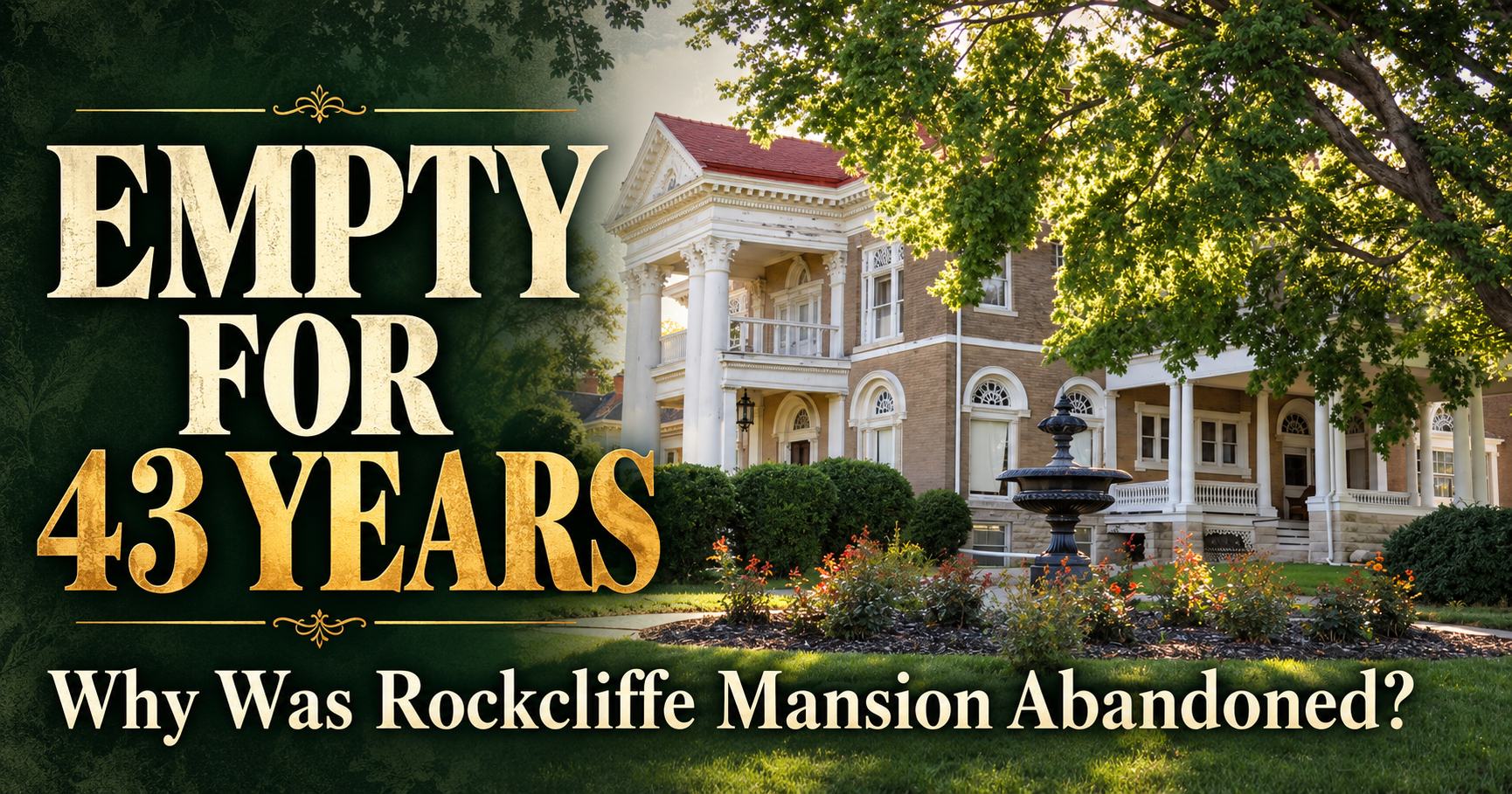
Before John J. Cruikshank Jr. could build his dream home, another mansion was in the way.
It occupied the best view on a hill above Hannibal, Missouri. Cruikshank wanted that view.
So he had the existing house moved about 80 feet west.
That is the scale of ambition behind Rockcliffe Mansion. A wealthy lumberman looked over a Mississippi River town and built a home meant to impress almost anyone who entered it.
Then, after his death in 1924, the family left.
His widow moved into a smaller house nearby. Rockcliffe entered a 43-year stretch without the family life it had been built to hold. By 1967, demolition was approaching.
The house had survived its owner, the passing of its fashionable era and decades of neglect. What nearly finished it was a decision to tear it down.
Why was Rockcliffe Mansion abandoned?

Rockcliffe closed after Cruikshank died in 1924. His widow moved into a smaller house on the estate with one of their daughters, and the mansion remained largely unused until its rescue in 1967. The history of Lynnewood Hall’s long decline follows a different timeline, with family life continuing after its defining loss.
That explains when its decline began. It does not fully explain why the family allowed so many years to pass without returning the house to regular use.
The distinction matters.
There is a temptation to give an abandoned mansion a single dramatic explanation. Financial ruin. A bitter family fight. A tragedy that made the rooms unbearable.
The established history does not justify presenting any of those as the definitive reason.
What makes Rockcliffe unusual is already there in the account of the family’s move into a neighboring home: the family did not have to leave the estate to leave the mansion behind.
I find that more unsettling than the usual image of a forgotten house deep in the woods. Rockcliffe remained above the town, close to the people whose lives had once filled it.
What kind of house did Cruikshank leave behind?
Construction began in 1898, and the family moved in by 1900.
The residence measured approximately 13,500 square feet, with more than 30 rooms and ten ornate fireplaces. Its Georgian Revival exterior framed an interior decorated in the Late Victorian and Art Nouveau styles.
Mahogany and quarter-sawn oak were prominent throughout the house.
For a lumber baron, the woodwork was personal. This was the material behind his fortune, displayed in the place where he lived and entertained.
The surviving rooms and original furnishings at Rockcliffe give the house a connection to its first occupants that a shell of brick and empty rooms could never provide.
It is easy to read “30 rooms” and think only about size.
But every additional room represented another space to heat, clean, furnish and maintain. The same features that made the house impressive also made it an enormous responsibility once its original household was gone.


The staircase where Mark Twain spoke
Rockcliffe was built for company, and it received plenty.
During his final visit to Hannibal in 1902, Mark Twain addressed approximately 300 guests from the mansion’s grand staircase.
The setting matters. Twain’s connection to Hannibal usually sends people toward the places associated with his childhood. Here, the connection is to his return as a celebrated writer, speaking inside one of the town’s grandest homes.
Today, the staircase associated with Twain’s 1902 reception remains a feature of the house tour.
That gives the abandonment a particular weight.
A place that had gathered hundreds of people eventually went decades without functioning as the family home it was meant to be. The staircase remained. The household around it did not.
Was Rockcliffe really untouched for 43 years?
“Abandoned for 43 years” describes the long gap between the family’s departure and the 1967 rescue. It should not be mistaken for proof that nobody entered the building during that entire period.
The mansion’s history and tourism accounts consistently describe those decades as a period of vacancy and decline. Some historical retellings also mention caretakers.
The safest description is that Rockcliffe ceased operating as the Cruikshanks’ grand family residence and went without the sustained care necessary to protect it.
Nor was it a perfectly sealed time capsule.
Neglect leaves damage. Weather does not recognize expensive craftsmanship, and a building does not have to collapse before restoration becomes difficult.
That is an important part of this story because Rockcliffe’s survival can make the years of deterioration seem less serious than they were.


Why was Rockcliffe Mansion going to be demolished?
By 1967, the neglected mansion faced demolition at the prompting of municipal authorities.
The house’s architectural value had not disappeared. Its future as a maintained, useful building had become uncertain.
This is the dangerous point for an old property: the building can still contain remarkable things while its overall condition makes people see it as a problem to remove.
Rockcliffe’s own history places the rescue two weeks before the planned demolition.
According to the mansion’s account of its last-minute rescue, three local families intervened and began restoring it.
They found substantial interiors beneath accumulated soot and grime, including Tiffany-designed stained glass, elaborate woodwork, marble and tile fireplaces, and combination gas-and-electric lighting fixtures.
Those details changed what could happen next. There was enough left to restore.
Saving the house did not mean saving every piece
The rescue was successful, but it was not complete in the sense of preserving every original feature.
The historic nomination records that a connecting section of porch could not be restored. Roof balustrades were also removed during the 1967 work.
Those are useful details because they show what the familiar phrase “saved from demolition” can leave out.
Restoration involves decisions. Some materials survive. Others have deteriorated beyond practical recovery. The finished building can look whole even though parts of the original structure are gone.
The historic nomination documenting Rockcliffe’s architecture and restoration also describes original wallpaper surviving in most main rooms and original fittings remaining in service areas and bathrooms.
That combination is what makes the house interesting: real losses alongside an extraordinary amount that endured.
How did the original furnishings survive?
The Cruikshank family helped with the restoration, and original furnishings became part of the revived house.
By the time the historic nomination was prepared, approximately half the furniture was described as original, with additional pieces promised by descendants.
An open house on June 14, 1968, marked Rockcliffe’s renewed public life.
That was a different kind of survival from keeping the walls standing.
A historic house can be repaired and filled with antiques from the right period. Original belongings preserve something more specific. They connect particular rooms to the people who occupied them.
A chair chosen for the house, a surviving fixture or an original wall covering carries evidence that a later replacement cannot.
For me, that is the strongest reason to care about Rockcliffe’s rescue. The people who intervened preserved more than an impressive outline on Hannibal’s skyline.
Is Rockcliffe Mansion still standing?
Yes. Rockcliffe remains at 1000 Bird Street in Hannibal and operates as a historic house museum and boutique bed and breakfast.
It entered the National Register of Historic Places on September 18, 1980. The National Register record for Rockcliffe Mansion recognizes its architectural and historical significance.
The building’s continued existence should not make its rescue seem inevitable.
Someone had to purchase it. Someone had to undertake the work. Its history describes restoration as an ongoing project rather than a task finished permanently in the 1960s.
The demolition never happened, but maintenance did not stop being necessary.
Can you go inside Rockcliffe Mansion?
Yes. Guided tours allow visitors to see the house rather than simply photograph it from outside.
As of October 2026, the mansion advertises its tour season as April 15 through November 15, with tours beginning at 10 a.m. and the last tour starting at 4 p.m.
Check the mansion’s current tour times and admission details before making the trip, especially near the beginning or end of the season.
Overnight accommodations are also offered in selected historic rooms.
That is a remarkable change in the building’s fortunes. A house once approaching demolition now welcomes people who deliberately choose to spend the night there.
Questions about Rockcliffe Mansion’s history
Who built Rockcliffe Mansion?
Lumber baron John J. Cruikshank Jr. commissioned the mansion. The St. Louis architectural firm Barnett, Haynes & Barnett designed it, and construction took place from 1898 to 1900.
How long was Rockcliffe Mansion abandoned?
Its commonly reported period of abandonment lasted 43 years, from the family’s departure after Cruikshank’s death in 1924 until the 1967 rescue.
Who saved Rockcliffe Mansion?
Three local families purchased the property in 1967 and undertook its restoration, with help from Cruikshank descendants.
Did Mark Twain live at Rockcliffe Mansion?
No. His documented connection is as a guest who addressed a reception there during his final Hannibal visit in 1902.
Is the story about Rockcliffe nearly being demolished real?
Yes. The threatened demolition and subsequent rescue are part of the mansion’s documented history. The building visitors tour today is the house that survived that threat.
By Miles Rowan for Stories in the Static.