

The face in the jar has hair, eyebrows, and features distinct enough to make you stop scrolling.
Usually, the photograph arrives with a name: Diogo Alves. Then comes the explanation. He murdered people in nineteenth-century Lisbon, was hanged, and had his head preserved so doctors could discover what made him kill.
It is an unforgettable story.
But the preserved head widely identified as Diogo Alves may not be his. Researcher Rafaela Ferraz has challenged that identification, explaining that historical inventories describe Alves’s remains as a bony skull, not the intact head familiar from photographs.
That leaves an uncomfortable question behind the glass.
Whose face have we been looking at?
The Story Everyone Recognizes
The popular account places Alves high above Lisbon, waiting for people crossing the Águas Livres Aqueduct.
Travelers carried the money they had earned selling goods in the city. Alves supposedly robbed them, then pushed them over the edge. Their deaths were mistaken for suicides, allowing him to continue.

The number usually attached to this account is around seventy.
Later, the story goes, he joined other criminals in robbing homes. A deadly attack on a physician’s household brought his criminal career to an end. He was executed in 1841.
Then the head became the main attraction.
The problem is that these details do not all stand on equally firm ground. The aqueduct legend, the criminal case, and the preserved specimen have been joined into one smooth narrative.
Separating them makes the story harder to tell confidently. It also makes it much more interesting.
The Aqueduct Was Real, and the Drop Was Enormous
Lisbon’s Águas Livres Aqueduct needs no invented scenery.
Its stone arches cross the Alcântara valley. EPAL, the water company responsible for the associated Water Museum, describes a crossing stretching approximately 941 meters, with thirty-five arches. The tallest reaches 65.29 meters, about 214 feet.
The museum’s description of the aqueduct above the valley places those dimensions within a much larger water-supply system.
This was substantial public infrastructure, built to bring water into the city. In the story attached to Alves, a place serving ordinary life became a place where someone could disappear over an edge.
You can understand why that image endured.
A person returning home. Money earned during the day. A narrow crossing above a long fall.
Those elements make a powerful crime story. They do not establish how many people Alves killed there.



Was Diogo Alves Really Responsible for Seventy Murders?
The widely repeated total should not be presented as seventy individually proven murders.
In her later discussions of the case, Ferraz distinguishes the aqueduct legend from the robbery and associated killings that led to Alves’s condemnation.
Her November 2025 account describes a criminal gang, a deadly robbery at a physician’s home on Rua das Flores, and five deaths connected with the case.
That is a different claim from proving a series of seventy aqueduct murders.
The distinction matters even when someone was unquestionably involved in serious crime. A conviction for one set of killings cannot automatically validate every additional death later attached to the person’s name.
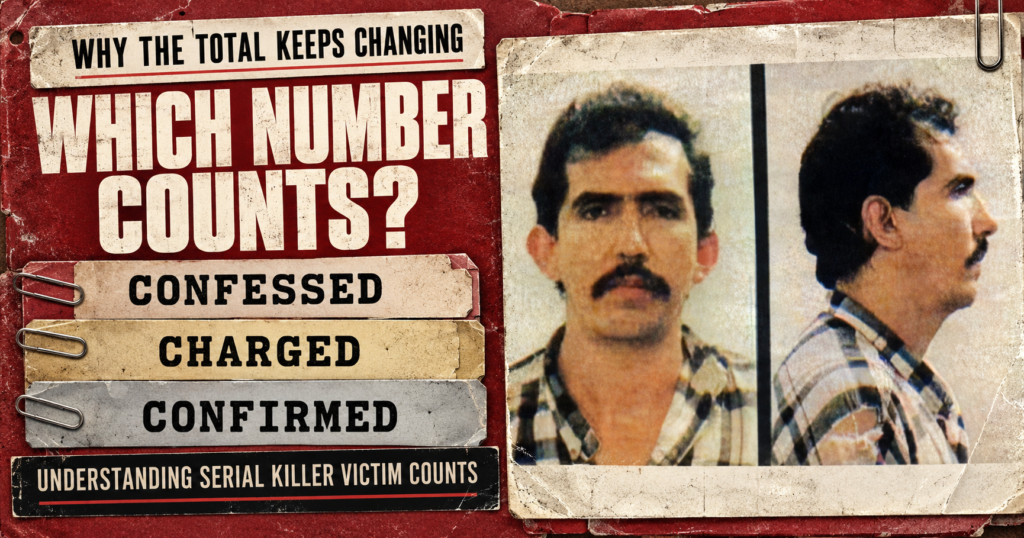
It is the same problem explored in how a killer’s reported victim total becomes confused with a proven count. Once a large number becomes part of someone’s identity, it can travel much farther than the evidence supporting it.
Alves’s reputation deserves particular care because the spectacular account and the documented prosecution have become so tightly intertwined.
His Execution Belongs to the Historical Record
Alves was not simply invented to explain a frightening specimen.
Portugal’s Public Prosecutor’s historical archive contains a record dated February 20, 1841, reporting that the capital sentences imposed on Diogo Alves and António Martins had been carried out.
The archived communication reporting the executions provides an administrative trace of the event.
Historical accounts describe Alves’s execution as hanging.
That point can get muddled when the preserved head becomes the headline. A head separated from a body afterward does not mean the prisoner was executed by beheading.
His death was real. What happened to his remains requires its own examination.



Why Would Doctors Want a Criminal’s Head?
The usual explanation involves phrenology.
Its followers believed that the shape of a person’s skull could reveal qualities of character and mind. Examining bumps and contours supposedly offered access to traits hidden beneath the surface.
It was an appealing promise for people who wanted criminal behavior to leave a readable physical mark.
A notorious offender’s remains could therefore become material for comparison and classification. The reasoning was that studying the body might reveal why its former owner had behaved so violently.
That belief was wrong.
The history of phrenology described by McGill University explains how claims about skull shape developed into a supposed method of assessing personality and intelligence. Phrenology is now recognized as pseudoscience.
Its appeal is still easy to recognize. People wanted an answer they could see or touch.
A measurement. A contour. Something that would distinguish a murderer from the person standing beside them.
The preserved-head story offers exactly that disturbing image. But the scientific fashion of the period cannot, by itself, prove the identity of a particular specimen.
The Old Skull Record Complicates Everything
A doctoral thesis completed in 2015 contains a detail that is difficult to reconcile with the familiar photograph.
Graça Maria Miranda Lérias Pacheco’s research on popularized criminals discusses a historical description of a bony head identified as Diogo Alves. It records catalog number 3050, referring to an anatomical museum inventory organized in 1886.
That is a skull with a historical identification.
The famous photograph shows an intact preserved head.
The doctoral research discussing the cataloged skull does not provide a complete modern identification of the photographed specimen. It does, however, supply something more concrete than a caption repeated across the internet.
A name in an inventory and a name beneath a photograph are not interchangeable evidence.
Someone has to establish that they refer to the same remains.
The Writer Who Helped Spread the Story Later Challenged It
This is where the modern history takes an unexpected turn.
In May 2017, Rafaela Ferraz wrote an Atlas Obscura article describing the preserved head as Alves’s. It helped bring the specimen to a much wider audience.
Years later, she revisited the account.
In a September 2025 Observador interview, Ferraz said she had repeated material she originally considered factual but later understood as myth. She discussed the criminal case, the skull identification, and the difficulty of establishing whose preserved head was actually in the jar.
Her later explanation of what changed in the Diogo Alves story is particularly significant because she had helped introduce the earlier version to English-speaking readers.
I find that more compelling than another confident retelling of the aqueduct murders.
A researcher returned to a story associated with her own work and questioned it. The unsettling photograph remained, but its familiar explanation no longer looked secure.
So Whose Head Is in the Jar?
Ferraz did not supply a replacement identity.
In her November 2025 interview with Notícias ao Minuto, she described the preserved specimen’s ownership as unresolved in her research. She considered a bony skull the more likely form of Alves’s preserved remains.
Her discussion of the unidentified head and the museum inventories leaves room for further investigation.
That should not be inflated into a claim that a particular alternative identity has been established. Nor does it justify calling the specimen a prop or an artificial head.
The uncertainty concerns the name attached to the remains.

There is something especially uncomfortable about that possibility. The face has become famous because of a murderer’s alleged history. If the identification is wrong, another person’s remains have been carrying that history instead. McCurdy’s case presents a different but related history of human remains being turned into an attraction: another disturbing history of human remains.
We should not invent that person’s biography to fill the gap.



Was Alves Portugal’s First Serial Killer?
The label is often repeated, but it is not a reliable way to introduce him.
Even the earlier Atlas Obscura account challenged the “first” claim, pointing to Luísa de Jesus, who was executed in the eighteenth century, decades before Alves.
There is also a more basic question: which killings can actually be attributed to him, and what pattern did they form?

Our explanation of what distinguishes serial murder from several deaths in one incident shows why a dramatic victim total does not settle the classification.
Alves does not need a disputed national title to make this a remarkable story. His criminal case, the history of collecting human remains, and the specimen’s uncertain identification provide more than enough to investigate.
Questions About Diogo Alves’s Preserved Head
Is Diogo Alves’s head really in a jar?
A preserved head in Lisbon has long been identified as his. Ferraz’s later research challenges that identification, pointing instead to historical records of a bony skull under his name. The photographed specimen should not be presented as conclusively identified here.
Why was Diogo Alves’s head supposedly preserved?

The familiar explanation connects its preservation with nineteenth-century interest in phrenology and studying criminals’ remains. That historical context does not establish that the intact head in photographs belongs to him. A better-documented example of preserved human remains is discussed in the Arctic preservation of John Torrington’s body.
Was Diogo Alves beheaded?
Accounts describe him as executed by hanging in February 1841. Claims about separating or preserving his head concern what happened after death.
Did he definitely murder seventy people?
Seventy is a widely repeated figure associated with the aqueduct legend. It should not be treated as a verified total of individual murders established in his prosecution.
Who questioned the preserved head’s identity?
Researcher Rafaela Ferraz discussed the problem in 2025 interviews. A 2015 doctoral thesis also describes historical documentation of a bony skull cataloged as Alves’s.
Can you visit the head in Lisbon?
Historical reports place the specimen at the University of Lisbon’s Faculty of Medicine, but that does not establish current public access. Anyone planning a visit should obtain permission and current arrangements directly from the institution.
By Miles Rowan for Stories in the Static, exploring the history and unanswered questions behind unsettling true stories.