
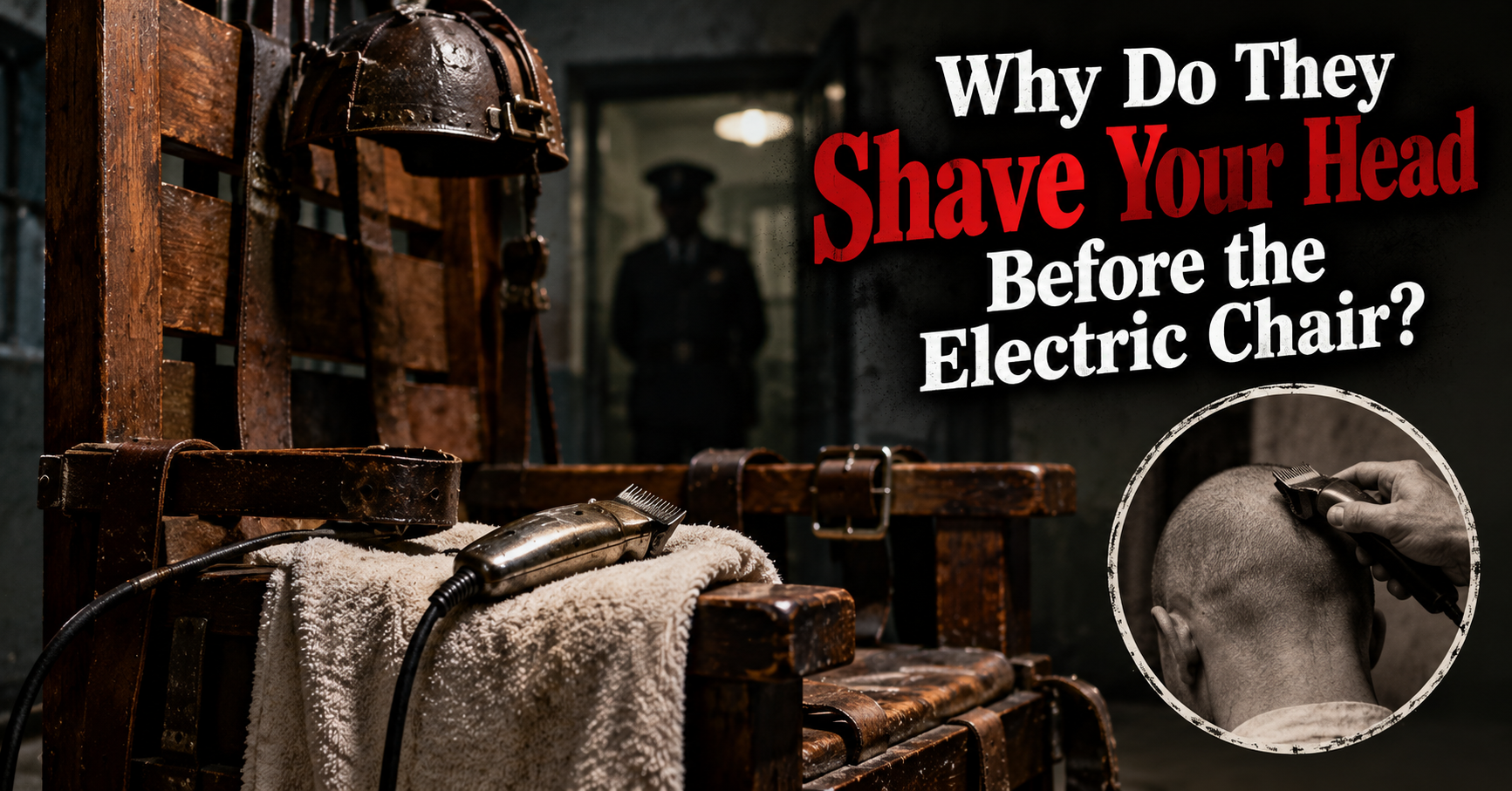
Before Edmund Zagorski was executed in Tennessee’s electric chair in 2018, his head and face had been shaved.
Reporter Jason Lamb noticed the difference immediately. The man restrained in front of him looked different from his mug shots. Soon, members of the execution team would place a wet sponge against his bare scalp.
A prisoner’s head is shaved before electrocution to help establish electrical contact between the scalp and the electrode placed over it. An area of one leg is also commonly shaved for another electrode. The preparation is associated with the electric chair, not a universal requirement for every method of execution.
The shaved head, the sponge, and the metal headpiece belong to the same process.
Something as ordinary as removing someone’s hair becomes part of preparing their body for the current.
Why Hair Is Removed Before the Electric Chair
The electric chair relies on electrodes making contact with the prisoner’s body. Hair can interfere with close contact at the scalp, so officials remove it where the head electrode will sit.
That is the practical explanation behind the familiar image.
It is easy to assume the shaving is primarily a punishment, an effort to erase someone’s identity, or a symbolic preparation for death. Those interpretations may affect how a person views the practice. They do not replace its documented electrical purpose.
The headpiece is not simply a cap placed over someone’s hair. It is part of an electrical system that depends on contact with the body.
Accounts of the preparations described in the Nebraska Supreme Court’s electrocution decision identify shaved areas on the head and left leg where electrodes were positioned.
The court examined those details because the way the equipment interacted with a human body was central to the dispute over the punishment.
A haircut can seem incidental beside an electric chair. In this setting, it is part of how the chair is intended to work.
Why Do They Shave a Prisoner’s Leg, Too?
The head is only one contact point.
Electrocution procedures have also used an electrode attached to a shaved area of the leg. Removing hair there serves the same broad purpose: preparing the place where the equipment meets the skin.
Kentucky’s published rule for preparation before electrocution expressly includes shaving the condemned person’s head and one leg on execution day.
That small detail helps explain the larger picture. This is not merely a tradition involving a bald head. Different parts of the body are prepared for their role in the execution method.
The exact location, timing, and equipment have varied. A description of one state’s procedure should not become a claim that every American prison has always done it the same way.
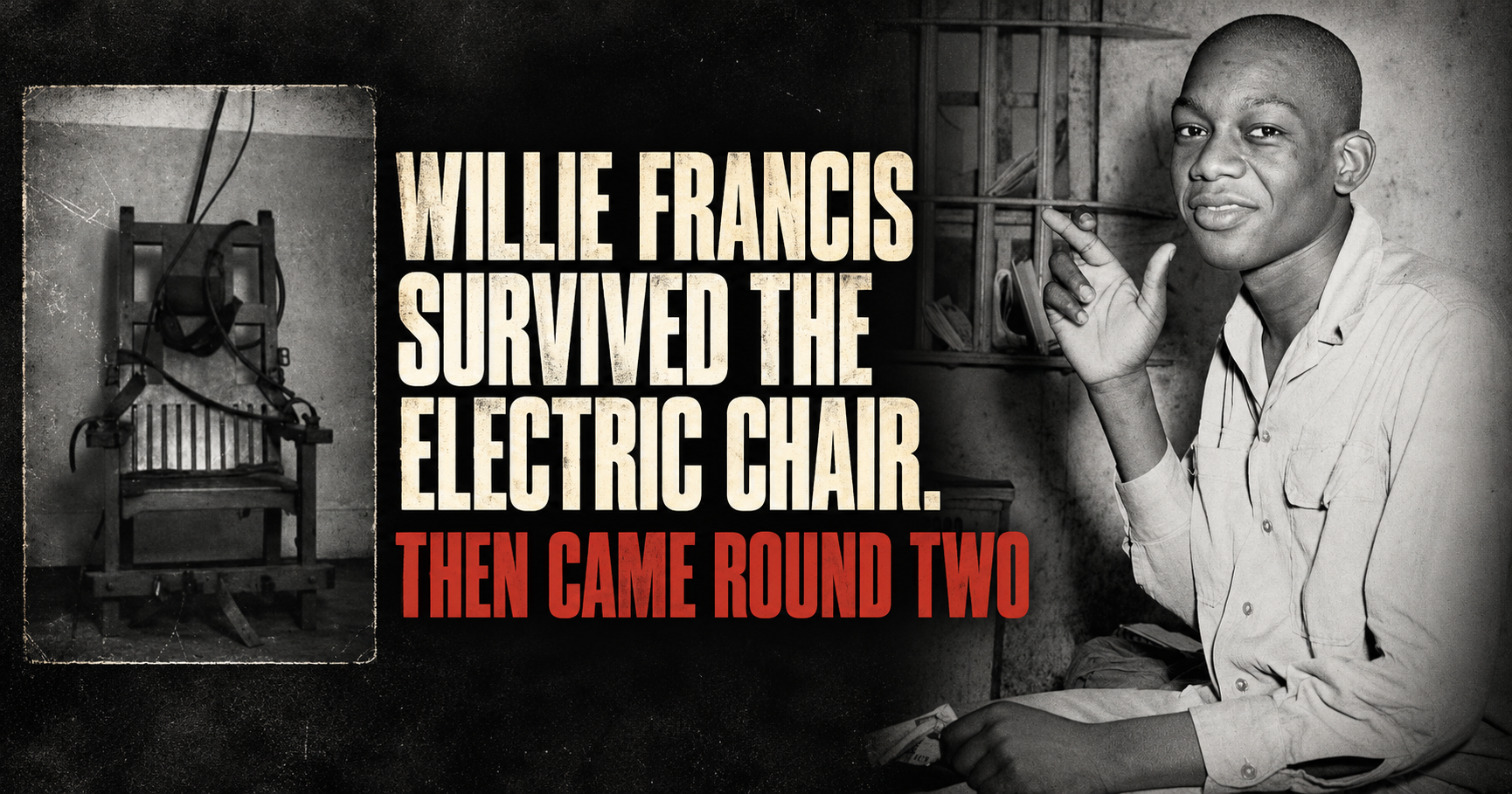
For readers familiar with Willie Francis’s survival in Louisiana’s electric chair, those differences matter. His historical case involved a particular chair, a particular attempt, and disputed circumstances surrounding its failure.
The equipment and the people operating it were part of the story.



Why Is a Wet Sponge Put on the Prisoner’s Head?
The sponge helps provide electrical contact between the electrode and the skin.
It is moistened with a saline solution, which conducts electricity. In the preparation described in court records and execution accounts, the sponge sits beneath the head electrode.
It is not there to cool the prisoner or cushion the headpiece for comfort.
That was the detail I found hardest to put aside while reading about this practice. A sponge is such a familiar household object that it seems out of place in an execution chamber. Here, its purpose is to help the electrical system make contact with a person.
The account involving former Florida warden Ronald McAndrew describes a saline-wetted natural sponge beneath the electrode over the shaved scalp.
Calling it a sponge can make it sound like an accessory.
Its condition and material have been significant enough to become subjects of investigations and litigation.
The Sponge Does Not Make Electrocution Painless
Preparing the contact points is intended to help the equipment function. That does not establish that an execution will be instantaneous or free of suffering.
The Nebraska Supreme Court examined evidence about burns, physical reactions, and uncertainty about the effects of current on prisoners. In 2008, it held electrocution unconstitutional under Nebraska’s constitution.
That was a ruling in one state, not a nationwide decision outlawing the electric chair.
It also exposes a problem with neat explanations of the method. Describing what the equipment is supposed to accomplish does not settle what a prisoner experienced.
A shaved scalp and a correctly placed electrode cannot, by themselves, prove the absence of pain.
When a Sponge Became Part of an Execution Investigation
On May 4, 1990, Florida executed Jesse Tafero.
Smoke and flames appeared around the headpiece. Officials interrupted the electricity, then applied further jolts. He was found dead roughly six or seven minutes after the execution began.
Florida’s governor ordered an investigation.
The state’s account, summarized in the court decision examining Tafero’s execution, said a synthetic sponge had been substituted for a natural one. The Department of Corrections attributed the visible smoke and flames to the sponge burning.
The litigation also included a challenge to the electrode itself. The state’s explanation and the objections raised against it should not be collapsed into one uncontested account.
What is clear is that an object small enough to fit inside the headpiece became part of a dispute reaching Florida’s highest court.
The frightening part is how ordinary the component sounds.
A sponge, selected and handled by people, was part of equipment being used to end someone’s life.



What a Witness Saw in Tennessee
Zagorski’s execution took place on November 1, 2018.
He had been convicted of killing John Dale Dotson and Jimmy Porter. Decades later, he chose electrocution rather than Tennessee’s lethal injection procedure.
Lamb, a NewsChannel 5 reporter serving as a media witness, described seeing his freshly shaved head and face when the viewing blinds opened.
The team placed a large natural sponge soaked in salt water against his head, followed by the headpiece. Lamb observed liquid running down Zagorski’s face. Staff wiped it away before covering his face.
His firsthand account from inside the witness room makes the preparation unusually tangible.
The shaving had already happened. The remaining arrangements unfolded while witnesses watched.

An execution photograph shows only a fraction of that process. The story of the camera hidden at Ruth Snyder’s execution concerns one famous image. A witness account can reveal the minutes and preparations that a single photograph leaves out.
Is Everyone’s Head Shaved Before Execution?
No. The execution method matters.
The reason for shaving the scalp before electrocution is connected to the electrode placed there. Lethal injection, for example, uses intravenous access rather than an electrode over the head.
That does not mean hair could never be removed for another procedure or practical reason. It means we should not describe electric-chair preparation as a standard requirement for every execution.
The same caution applies to facial hair.
Lamb reported that Zagorski’s face was freshly shaved. Kentucky’s cited provision specifically refers to the head and one leg. Those descriptions should retain their own details.
Nor does everyone sentenced to death undergo this preparation. A death sentence, an execution date, and the final physical preparations are different stages.

Our explanation of what changes when a prisoner enters death watch covers the period in which supervision and daily arrangements become tied to a scheduled execution.
The shave belongs to the narrower preparations associated with a particular method.
Does Being Prepared Mean the Execution Cannot Be Stopped?
No.
Preparation does not remove the authority of a court to stop an execution. Kentucky’s electrocution rule includes a final inquiry about whether stays, orders, pardons, or commutations have been received.
That places two activities alongside each other: staff may be preparing the prisoner while officials must still establish whether the execution may proceed.
It is one reason accounts of the final hours can be difficult to read. Physical preparations can be advanced while the outcome remains unresolved.

And an attempt that begins but does not result in death raises a further set of questions. As the cases involving unsuccessful execution attempts demonstrate, preparation and an intended outcome are not the same thing.
Questions About Shaving Before Execution
Why do they shave your head before execution?
In electric-chair procedures, shaving helps establish contact between the scalp and the head electrode. It is not a universal requirement for every execution method.
Why is one leg shaved before electrocution?
A leg electrode provides another contact point with the body. Hair is removed from the area where that electrode will be attached.
What is the wet sponge on the prisoner’s head for?
The saline-moistened sponge helps conduct electricity between the electrode and the skin. It is part of the electrical contact arrangement.
Is the shaving mainly done to humiliate the prisoner?
The documented practical purpose in electrocution is preparation for electrode contact. The act may be experienced as humiliating, but that is different from establishing humiliation as its operational purpose.
Does a wet sponge prevent burns?
It does not guarantee that burns will be prevented. Court records concerning electrocution describe serious burns and disputes about the method’s effects despite preparations intended to make the equipment function.
Can someone be shaved and prepared but still receive a stay?
Yes. Physical preparation does not override an order preventing the execution. Officials must follow the applicable orders and legal requirements.
By Miles Rowan for Stories in the Static, covering the documented details behind unsettling history and true crime.