
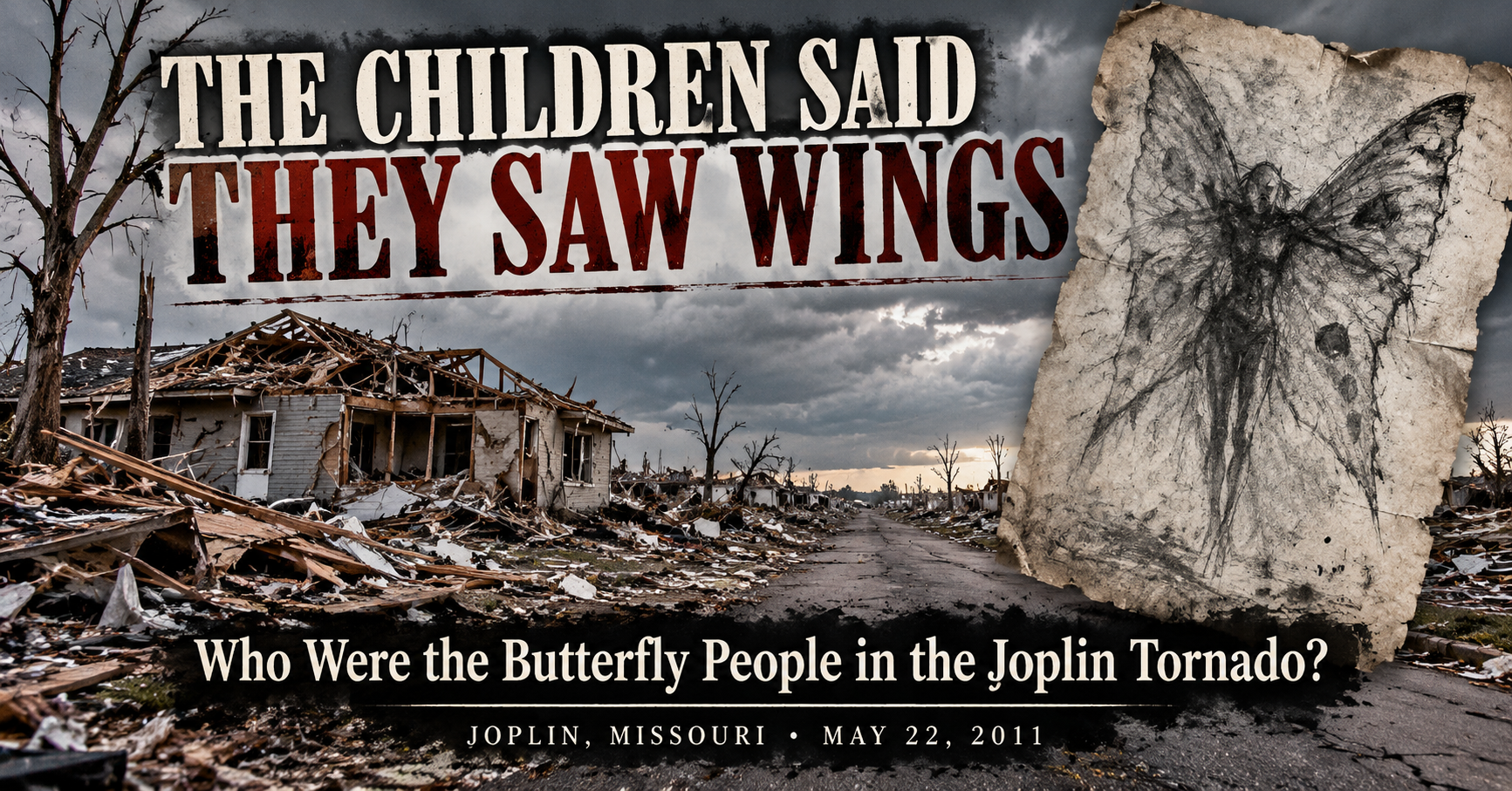
A father lies over his daughter in the grass while the tornado passes. He tries to hold them both against the ground. The wind takes his shoes.
Afterward, according to a story preserved on a marker in Joplin, the girl explains why they survived.
“Daddy, it was OK, a butterfly was holding us down.”
The account is one of several associated with Joplin’s butterfly people, winged figures some children reportedly described after the tornado of May 22, 2011. In the stories, these figures offered protection or comfort while the world around the children was being torn apart.
For some families, they were angels. For others, they became a mystery inseparable from the disaster.
The unsettling part is that the figures were remembered as something beautiful.
The Storm Behind the Butterfly People Stories
At approximately 5:41 p.m., an EF5 tornado tore through Joplin, Missouri.
Winds exceeded 200 mph. Homes and businesses were destroyed or damaged across a catastrophic path through the city. Missouri’s Storm Aware program describes nearly 8,000 homes and buildings affected.
Numbers can establish the scale. They struggle to communicate what it means for familiar streets to become unrecognizable.
The state’s account of the Joplin tornado records the destruction and the emergency response that began immediately afterward. People searched for survivors while others tried to establish whether their own families were alive.
This was the setting in which stories about protective, butterfly-like figures began circulating.
They emerged from a community dealing with actual deaths, actual injuries, and survival that could be difficult to comprehend.
Why Some Accounts Say 158 Deaths and Others Say 161
The National Weather Service’s 2011 assessment recorded 158 direct fatalities and more than 1,000 injuries.
Missouri’s disaster information and Joplin’s memorials use 161 lives lost.
The Weather Service assessment of the disaster specifically uses the direct-fatality classification. The number commemorated locally is 161.
Those figures appear in different contexts. Neither should become an excuse to lose sight of the people they represent.
What Did the Children Say They Saw?
The accounts describe butterflies, butterfly people, or angel-like beings helping children during the storm.
The details vary.
Some stories concern children who felt held against the ground. Others describe wings surrounding them or figures offering a sense of safety. The name does not refer to ordinary butterflies spotted in the weather.
A marker in Cunningham Park preserves three representative accounts. Alongside the father and daughter in the yard, it describes a girl reportedly brought back to the ground by a winged protector and a child in a debris-filled car who described protective wings.
The stories recorded on Joplin’s Butterfly People marker show how firmly these accounts entered the community’s memory.
The marker is a record of the stories people chose to preserve. It is not a set of independently verified incident reports identifying every child and establishing precisely what happened.
That distinction matters, particularly once a short retelling begins circulating as though every detail has been confirmed.


These Stories Were Being Reported in 2011
The butterfly people were not invented years later for a paranormal podcast.
Todd C. Frankel’s reporting for the St. Louis Post-Dispatch in December 2011 examined how the accounts were moving through Joplin. It described stories passing through churches, relief efforts, and conversations between residents.
It also identified an important difference between the accounts.
Counselor Shelley Wilson said the versions she heard were secondhand. Meanwhile, Dawnielle Robinson, clinical director of the Joplin Child Trauma Treatment Center, said two therapists had heard butterfly-related accounts directly from children.
The early reporting preserved in this contemporary republication contains both strands.
There were children reportedly describing experiences to therapists. There were also adults sharing stories they had received from someone else.
A hundred repetitions of one account do not establish a hundred separate encounters. But secondhand circulation does not erase the reports that reached therapists directly.
Were the Butterfly People Angels?
For people who understand the stories through Christian faith, angels are a natural interpretation.
The figures reportedly protected children. They were associated with wings, reassurance, and survival during an event beyond a child’s control. Some believers recognized those descriptions as accounts of divine protection.
That interpretation deserves to be represented fairly.
It also deserves to remain an interpretation. A survivor’s account can be sincere and deeply meaningful without providing a way for someone else to establish its supernatural cause.
I don’t think we have to choose between treating families with respect and being careful about what we claim.
What we should avoid is turning an extraordinary story into a declaration that we know exactly why one person survived.

The story of Frank Wright surviving two devastating combat wounds raises a similar human question. Establishing that someone survived something terrible does not settle every question about what that survival means.
For the person who lived through it, the explanation may remain intensely personal.
The Question That Must Leave Room for the Dead
Any account of miraculous survival runs beside a painful question: what about the people who did not survive?
An article about Joplin cannot treat the dead as background scenery for a mystery.
Nor should anyone imply that children who died were less loved, less deserving of protection, or somehow deficient in faith. Nothing in the reported butterfly people accounts establishes that.
A family may understand an experience as a miracle. Another family may be grieving someone taken by the same storm.
Both families belong in the story.



Could Fear or Trauma Explain What Children Described?
Some readers interpret the accounts through the circumstances in which they occurred: extreme danger, frightening sensory experiences, and the effort afterward to understand what happened.
Those are reasonable subjects for discussion. They are not grounds for diagnosing an individual child from a newspaper article.

The available accounts do not give us enough information to determine the cause of each reported experience. We should be equally cautious about declaring that every child saw an angel or that every account was a hallucination. The the Anneliese Michel case shows how uncertainty about unusual experiences can become more serious when one explanation directs a person’s care.
Children’s descriptions, adults’ interpretations, and later retellings are different parts of the record.
That leaves uncertainty.
It may feel less satisfying than announcing a solution, but it allows us to listen without pretending we possess an explanation the evidence cannot supply.
Joplin Gave the Stories a Place to Stay
The butterfly people did not remain confined to conversations.
At Cunningham Park, the stories became part of a physical landscape of remembrance. The volunteer tribute includes a mosaic connected with the butterfly accounts, alongside symbols honoring the people who helped after the disaster.
Nearby are memorials to those who died.
Joplin’s description of the volunteer tribute and surrounding memorials brings these elements together: survival stories, rescue work, loss, and rebuilding.
That setting changes the mood of the mystery.
A butterfly on a memorial is doing something different from a frightening illustration beside a headline. It belongs to people who still have to live in the place where the disaster happened.
The Outlines of Homes That Are No Longer There
The Butterfly Garden and Overlook incorporates the outlines of homes destroyed by the tornado.
Its designers used entrances, paths, places to sit, and planted spaces to address grief and remembrance. Nature Sacred’s account describes the garden as a place for people working through the loss of someone or something.
The design behind the garden’s missing houses makes absence visible without rebuilding what was lost.
That detail stays with me.
A house outline tells you where ordinary life used to happen. It leaves room to imagine dinners, laundry, children coming through a door. Then it makes you notice what is missing.
You do not have to believe in butterfly people to understand why someone might need a place like that.
Butterflies Also Represent the People Who Died
The butterfly’s meaning in Joplin extends beyond protection.
In 2020, artist Eric Haun created a mural called “161.” It contains 161 butterflies, each representing a life lost in the tornado.
The memorial meaning behind those 161 butterflies adds something essential to the better-known survival stories.
In one context, wings represent a child’s account of being protected. In another, they represent someone who never came home.
The same image can hold hope and grief.
That is what gives Joplin’s butterflies a depth that gets lost when they are presented only as mysterious creatures seen during a storm.
Why the Story Keeps Returning
The accounts have continued into documentaries, podcasts, and anniversary coverage.
Filmmaker Gregory Fish explored the subject in “The Butterfly People.” In a 2024 interview, he described including both firsthand and third-person accounts, along with religious interpretations.
The local reporting on Fish’s documentary shows how the subject continued attracting attention long after the immediate recovery.
Every new version creates another opportunity to listen. It also creates an opportunity for uncertain details to harden into apparent facts.
That is why attribution matters. A story recorded on a marker, a recollection shared years later, and something a therapist heard from a child are not identical kinds of evidence.
They can all tell us something. They cannot all answer the same questions.


Questions About Joplin’s Butterfly People
What were the butterfly people?
They were protective, winged figures described in accounts associated with children who survived the May 22, 2011, Joplin tornado. Some people interpret them as angels.
Did children actually report seeing them?
Reporting from 2011 included a clinical director’s statement that two therapists heard butterfly-related accounts directly from children. Other widely circulated versions were secondhand stories.
Is there proof that angels appeared during the tornado?
The reporting establishes that accounts were told. It does not independently establish a supernatural explanation for them.
Were the butterfly people supposed to be frightening?
The accounts generally describe them as comforting or protective. Much of the story’s unsettling quality comes from the violent circumstances surrounding those descriptions.
Is there a butterfly people memorial in Joplin?
Cunningham Park’s Butterfly Garden and Overlook includes a marker preserving representative stories. Butterfly imagery also appears in other memorial and recovery projects around the city.
What does Joplin’s “161” mural mean?
Its 161 butterflies represent the lives lost in the tornado. It is a remembrance of the dead, rather than a count of reported sightings.
By Miles Rowan for Stories in the Static, exploring the documented history and human experiences behind unsettling stories.