

“I’m here with you. Talk to me.”
The air traffic controller was still trying to reach the crew.
Above Palm Beach County, a Learjet was descending at a terrifying rate. A pilot had already warned that the aircraft was going to hit the ground. The controller’s response, preserved in published accounts of the radio exchange, was painfully human.
There are numbers in the recording. Altitudes. Descent rates. The aircraft’s identification.
Then there are those words.
I keep coming back to the distance between the people in that exchange. One person was on the ground, trying to help through a radio. Others were inside an aircraft they were struggling to control.
On November 1, 2026, the Bahamas-bound Learjet crashed in a residential area of Palm Beach County, Florida. All nine people aboard died.
The recording and the footage spread quickly. So did claims that the aircraft was a missile, a drone, or the victim of newly deployed air defenses near Mar-a-Lago.
The confirmed story is already devastating. Understanding it means keeping the voices, the flight data, and the speculation separate.
What happened in the Palm Beach Learjet crash?
The aircraft was a Learjet 60 traveling from Austin-Bergstrom International Airport in Texas to North Eleuthera Airport in the Bahamas.
It came down around 12:50 p.m. Eastern time on Sunday, November 1, near Military Trail in the Greenacres area of Palm Beach County.
Transportation officials confirmed that all nine occupants were killed. The National Transportation Safety Board launched an investigation, with assistance from the Federal Aviation Administration. No cause had been established in the initial reporting.
The aircraft was identified as N722BD.
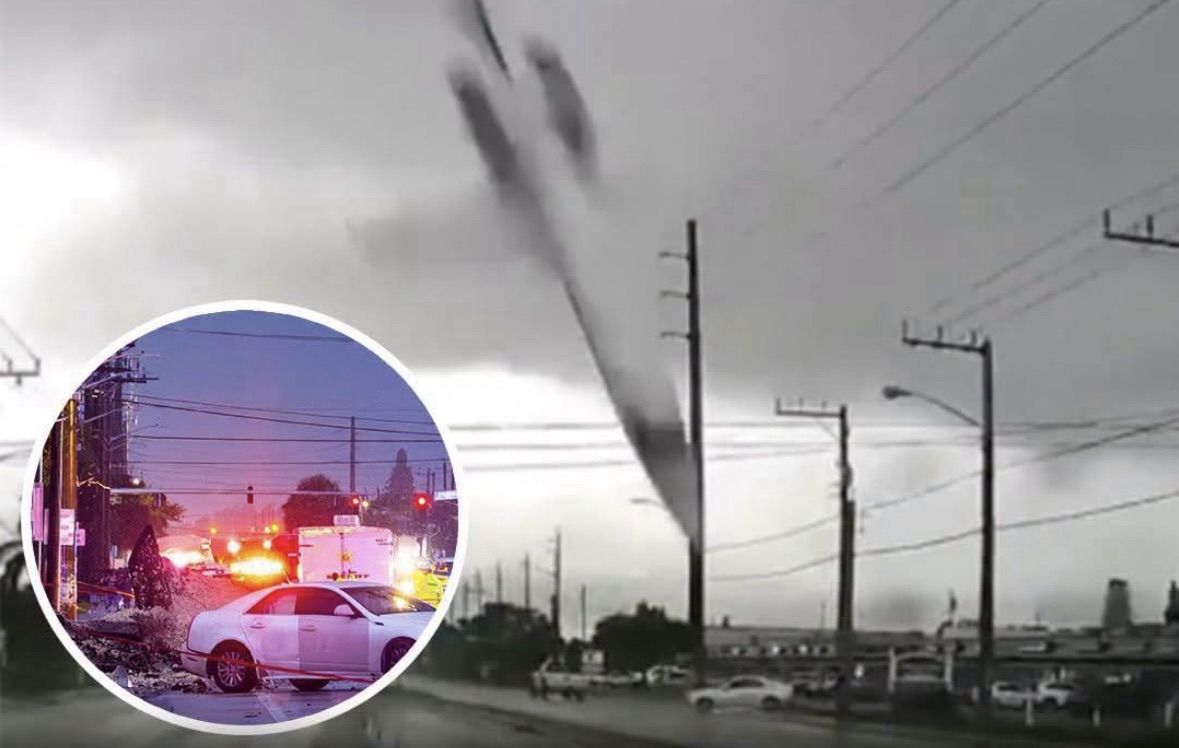
That registration connects the accident to a tracked flight and an identifiable business jet. It provides considerably more evidence about what fell from the sky than a blurred frame taken from a video.
Before the emergency, the crew wanted smoother air
The final flight did not begin with a mayday call.
In radio communications reviewed by Flightradar24, the crew reported icing, moderate turbulence, and precipitation. They asked about a better ride and requested a climb to 37,000 feet.
Those requests are an important part of the sequence.
Before the desperate warnings, the crew was communicating about conditions and seeking a change in altitude.
Flightradar24’s reconstruction of N722BD’s tracked movements records a brief climb at approximately 12:48 p.m. Eastern, followed by a steep descending right turn. Its last received altitude was 8,750 feet at 12:49:22 p.m.
That last data point was not the impact.
It was the last altitude that service reported receiving.
There is a difference, particularly when people are trying to turn scattered timestamps into an exact account of the final seconds.



What the Palm Beach Learjet crash audio reveals
Published accounts describe the radio exchange changing abruptly.
The crew reported a rapid descent and declared an emergency. Subsequent transmissions described an overspeed condition and an increasing descent rate.
Aviation International News reported that the calls progressed from a descent of 10,000 feet per minute to 20,000 feet per minute.
Then came the warning that the aircraft was going to crash.
The aviation report tracing the emergency transmissions also records the words “we’re out of time” near the end of the exchange.
I would be careful about calling any isolated sentence the crew’s definitive “last words.”
A public radio recording captures transmitted sound. It does not necessarily preserve everything said inside the aircraft, identify every voice, or establish the last thing anyone aboard said.
What it does preserve is enough to explain why people find the recording so difficult.
The people describing the emergency were still inside it.
These are radio transmissions, not a released black-box recording
The widely reported audio comes from communications with air traffic control, captured through LiveATC.
That is different from a cockpit voice recorder.
A radio transmission can carry voices or other sounds from the cockpit while the microphone is transmitting. It is not a continuous recording of everything happening there.
The public audio should not be presented as an officially released cockpit voice recorder recording.
That distinction helps explain both the power and the limits of what listeners are hearing.
What about the Lord’s Prayer in the audio?
Listeners have described hearing the Lord’s Prayer being recited in the background of the circulating recording.
That detail has become part of the public reaction to the crash. However, this article has not independently authenticated the alleged prayer segment or established who was speaking. It would be premature to identify the voice as the male pilot or publish a supposedly exact transcript of it.
For anyone who hears familiar words of prayer in those moments, the emotional force is understandable.
Words often spoken beside a bed, in a church, or with family take on a different weight when someone believes they are hearing them during an emergency.
But the person behind a background voice still deserves accuracy.
We do not need to invent a name, a role, or a complete final moment to recognize the human loss.


The controller kept answering
Among the most affecting parts of the published exchange is the controller continuing to communicate.
The crew described a worsening situation. The controller offered assistance and asked them to keep talking.
FOX 13’s account of the crew’s warnings and the controller’s replies preserves that attempt to maintain contact as the emergency unfolded.
We cannot know from those words alone what the controller felt.
What we can recognize is the effort to remain present.
That is one reason emergency recordings can stay with us. We hear someone calling for help and someone answering, while knowing that an answer cannot always change the outcome.

The circumstances were different in the unanswered questions surrounding Michael Wamsley and Janelle Hornickel’s 911 calls, but both stories expose that painful gap between making contact and being able to bring someone home.
Why does the crash video look so strange?
The reported footage captures an aircraft descending at a very steep angle before impact.
That is far removed from the level flight or gradual approach most people associate with an airplane.
A distant object moving rapidly through a narrow camera view can also be difficult to interpret from a single frame. The screenshot alone cannot establish the aircraft’s full shape, movements, or condition.
Here, there is evidence beyond the appearance of the video.
Authorities identified a Learjet. Flight-tracking information documented its route and descent. Radio communications recorded an emergency involving that aircraft.
NBC’s coverage of the crash and ground footage describes the jet plunging near a roadway and homes before erupting in fire.
The unusual appearance is a reason to investigate carefully. It is not evidence, by itself, that the aircraft was something else.
Describing it as missile-like does not identify a missile
Governor Ron DeSantis compared the aircraft’s plunge to a missile coming down.
That was a description of its appearance.
It was not an announcement that investigators had identified a missile or found evidence of a missile strike.
A comparison can lose that distinction when it is shortened into a caption and repeated beside a dramatic image.
Were air defenses recently deployed near Mar-a-Lago?
Yes. That part of the surrounding discussion has a factual basis.
Before the crash, local reporting documented ground-based air-defense assets around Mar-a-Lago.
WFLX reported seeing equipment aboard a barge in the Intracoastal Waterway on October 26. NORAD and U.S. Northern Command confirmed that assets had been deployed at the Secret Service’s request.
The report on the Mar-a-Lago security deployment also noted that officials had not disclosed whether a specific threat prompted the deployment.
The War Zone separately documented Avenger air-defense systems and counter-drone capabilities in the area. Its reporting included photographs predating the crash by more than a few days.
The equipment was real.
Its presence does not establish involvement in this accident.
Is there evidence the Learjet was shot down?
No verified evidence reviewed for this article links the crash to a missile launch, a military interception, or the air-defense deployment.
The publicly reported evidence establishes an aircraft in distress. It does not yet establish what initiated that distress.
The timing of security news, the proximity to Mar-a-Lago, and wider international tensions help explain why people are asking questions. None of those facts supplies the missing evidence of a shootdown.
The same restraint applies to theories involving Iran. A tense international situation is context, not proof that a particular government or weapon caused a civilian crash.
There is an important middle ground between accepting a conspiracy theory and pretending the investigation is finished.
We can say what is unsupported while acknowledging what remains unknown.



Did icing or turbulence cause the crash?
The crew reported both.
Investigators had not established either as the cause in the reporting reviewed for this article.
That difference matters.
A radio call tells us what a crew was experiencing or observing. It does not, by itself, reconstruct the complete sequence that led to a loss of control.
AeroTime’s account of the weather reports and investigation distinguishes the crew’s observations from a finding about what caused the accident.
The descent figures need similar care.
Flightradar24 reported a vertical rate exceeding 32,000 feet per minute during the plunge. That is tracking information, not a final NTSB reconstruction or a measurement of forward airspeed.
The numbers describe a catastrophic emergency. They do not explain its origin.
The neighborhood beneath the flight
For residents along Military Trail, the aftermath involved far more than a video on a phone.
County officials said approximately 600 people from a nearby mobile home community were expected to be relocated. Shelters and transportation were being arranged. Some residents could not immediately return for clothing and other belongings.
The local reporting on displaced residents described road closures, power outages, and uncertainty about when people could go home. Officials initially reported no known deaths or injuries on the ground.
Those are the details that disappear when a disaster becomes a theory.
A closed road. A family waiting outside its neighborhood. Someone who needs clothes from a home they cannot enter.
And beyond the neighborhood were the families of nine people who would not arrive in the Bahamas.
Questions about the November 1 Learjet crash
Where did the Learjet crash?
It crashed in Palm Beach County, Florida, near Military Trail in the Greenacres and Cresthaven area, around 12:50 p.m. Eastern on November 1, 2026.
How many people died?
Officials confirmed that all nine people aboard died. “Nine people aboard” should not be changed to “nine passengers,” because that total includes the aircraft’s occupants, including crew.
Where was the plane going?
It departed Austin-Bergstrom International Airport in Texas and was headed to North Eleuthera Airport in the Bahamas.
Is the circulating audio from the cockpit voice recorder?
The widely reported recording consists of air traffic control radio communications captured through LiveATC. It should not be labeled a released cockpit voice recorder recording.
Was the Lord’s Prayer being recited?
Listeners have reported hearing it in the background. I also could hear the male pilot reciting the Lord’s Prayer in the background of the released audio.
Was the object in the video a drone or missile?
Authorities identified the accident aircraft as a Learjet 60. Its registration, tracked flight, and radio communications support that identification.
Has the cause been determined?
No cause had been established in the information reviewed for this November 2 article. The NTSB investigation was underway.
The words from the controller remain the part I would carry away from the recording.
Someone was still answering.
Behind the aircraft’s registration were nine people, each with a life beyond those final transmissions. Whatever the investigation eventually establishes, their story deserves more than becoming a blurred shape in someone else’s theory.
Written by the Stories in the Static team. This developing account distinguishes reported radio communications, flight-tracking observations, and confirmed official information from unresolved claims.