Two passengers got off a plane in Abu Dhabi.
Something they had brought aboard stayed behind.
According to the investigation and the surviving bomber’s account, it was a timed explosive concealed in ordinary travel items, including a transistor radio. Korean Air Flight 858 continued toward Bangkok. On November 29, 1987, it was destroyed over the Andaman Sea, killing all 115 people aboard.
One of the two agents, Kim Hyon-hui, survived capture and eventually confessed. She received a death sentence.
Then South Korea pardoned her.
The government’s stated reasons were her value as a living witness against North Korea, her confession, and its judgment that the regime had turned her into an instrument through indoctrination.
That answers the question. Understanding how she reached that point is considerably harder.
Because before there was a pardon, there was a plane full of people whose journey ended while the people responsible were already somewhere else.
The Bombers Left. The Passengers Continued.
The part I keep returning to is the stopover.
Kim and her older partner traveled under false Japanese identities. Their cover presented them as a father and daughter. After boarding in Baghdad and leaving the device aboard, they disembarked in Abu Dhabi.
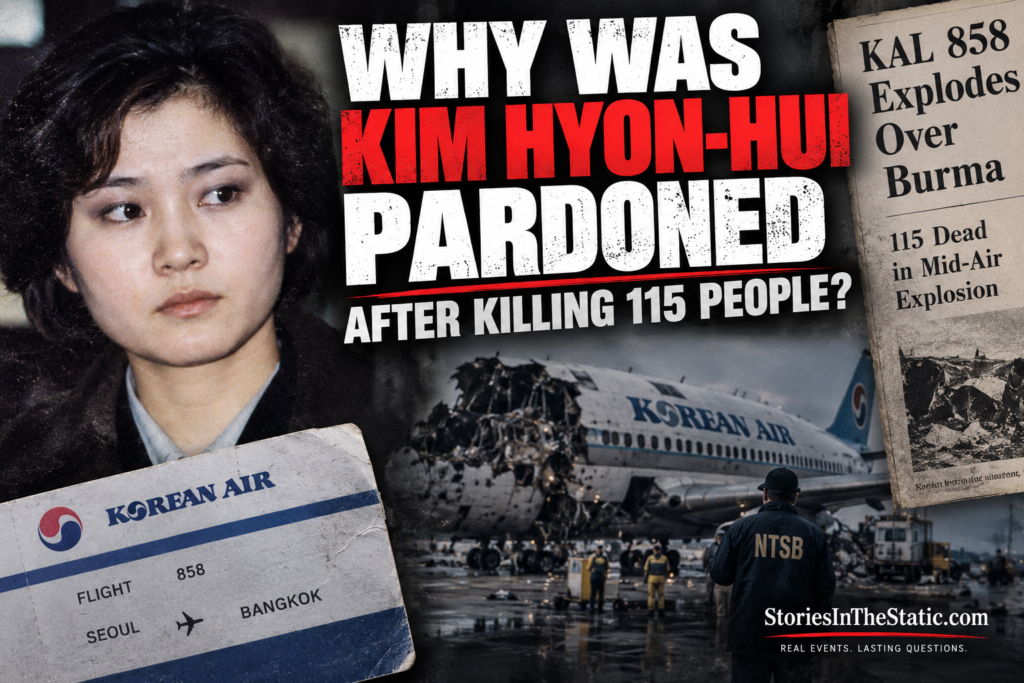
They were no longer on the aircraft when it was destroyed.
Many passengers were South Korean construction workers returning from jobs in the Middle East. The death toll included 104 passengers and 11 crew members.
I cannot tell you what those passengers said, what they noticed, or what they were thinking. The record does not give us those scenes.
It gives us something awful enough without inventing them: people were traveling home, and two fellow passengers had arranged for them never to arrive.
The familiar term “air disaster” does not capture that decision.
This was a bombing.
An Airport Check Broke the Escape
The agents reached Bahrain, where authorities discovered problems with their false passports.
In her later interview with Australia’s ABC, Kim described being unable to leave immediately and becoming increasingly anxious. When authorities confronted the pair, both attempted suicide using cyanide concealed in cigarettes. Her partner died. She survived.
That survival changed what investigators could learn.
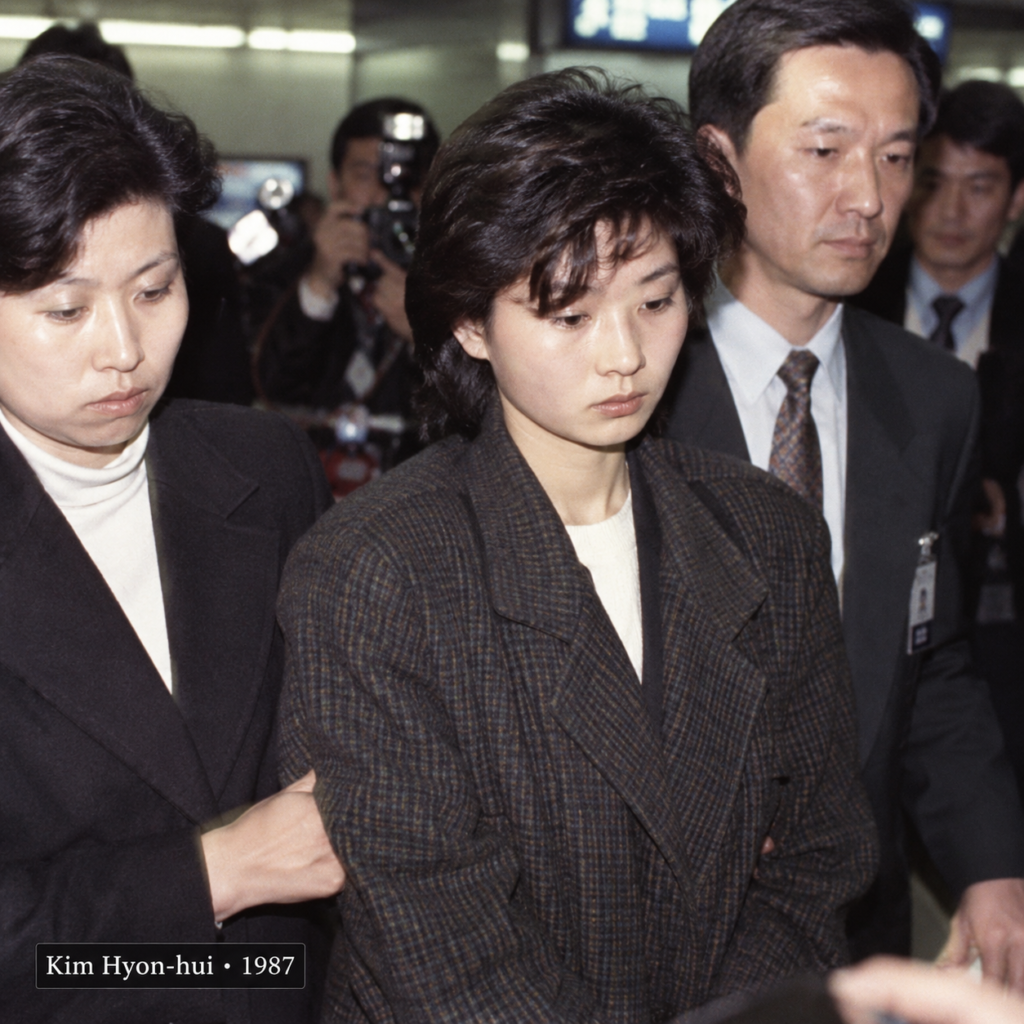
The operation had produced a living suspect who could describe the journey, identify the people involved, and explain the assignment.
A person intended to disappear from the story was now available for questioning.
I find that reversal more unsettling than any imagined chase through an airport. The escape came apart during the kind of document check travelers usually regard as routine.
Why Would Anyone Destroy This Flight?
Kim said the mission was meant to damage confidence in South Korea before the 1988 Seoul Olympics.
In her account, the order came from Kim Jong-il, then the son and intended successor of North Korean leader Kim Il-sung. The objective was to frighten countries away from participating.
That is her account of the command behind the attack. North Korea denied responsibility. Contemporary reporting on her pardon recorded that denial alongside South Korea’s attribution of the bombing.
The alleged goal was much larger than the aircraft.
But the people killed were passengers and crew, not an abstract international audience.
That is where I think political explanations need to slow down. Explaining the intended effect does not make the victims interchangeable with an Olympic strategy.
A worker returning home was not a message.
Someone made him one.
Her Japanese Identity Led to Another Victim
There is another disturbing connection behind Kim’s cover.
Japan’s Ministry of Foreign Affairs records her testimony that an abducted Japanese woman, Yaeko Taguchi, taught her Japanese. The ministry describes the use of abductees to train North Korean agents to pass as Japanese citizens.
Taguchi disappeared in or around June 1978, at age 22. Japan’s official account lists her whereabouts as unconfirmed. North Korea claimed she died in a traffic accident.
The connection matters because a convincing identity requires more than a passport.
An agent needs language, habits, and the ability to move through ordinary situations without attracting attention. According to Kim’s testimony, some of that preparation came from a woman taken from her own country.
I struggle to read that as a clever spy detail.
It is another person’s missing life.
The Japanese government’s explanation of abductees being used to train agents provides the official background to this part of the case.
What Made Kim Hyon-hui Confess?
Kim later said that encountering South Korea contradicted what she had been taught in the North.
In a 2017 interview with Voice of America, she described initially trying to maintain false accounts using Japanese and Chinese. She said she came to recognize that the attack had taken innocent lives and decided to confess, despite fearing consequences for her family in North Korea.
That is her explanation of her change of mind.
It is not something we can independently see inside her head.
What interests me is the contrast between the elaborate preparation for the mission and the ordinary life she said challenged her beliefs afterward.
There was no secret document that magically settled every question for her. In her telling, the country she encountered did not resemble the country she had been trained to hate.
Whether a reader finds that explanation persuasive, insufficient, or self-serving, it needs to remain attributed to her.
The confession and the later account of her motives are related evidence. They are not identical things.
Why Did South Korea Spare Her?
On April 12, 1990, President Roh Tae-woo granted Kim a special pardon. It followed a Supreme Court ruling upholding her death sentence.
Reporting that day quoted Information Minister Choe Byung-yul explaining that the crime deserved harsh punishment, but the government wanted her alive as a witness to North Korean atrocities.
Officials also cited her confession and the belief that intensive indoctrination had made her a tool of the regime.
She was spared because the government chose clemency, not because the bombing had been disproved.
I think that distinction deserves to be stated plainly.
A pardon can reflect a government’s judgment about punishment, political value, and responsibility. It does not turn the dead into survivors or make the underlying act disappear.
The contemporary report announcing Kim Hyon-hui’s pardon is particularly useful here. It records the reasons officials gave at the time, rather than relying entirely on explanations offered years later.
The Radio Connection Needs a Careful Distinction
Kim’s espionage history also appears in research on numbers stations.
Priyom’s archive connects her memoir to the North Korean Morse station designated M40, through which she described receiving communications during her work as an agent.
That does not mean a mysterious radio broadcast remotely triggered the aircraft bomb.
The transistor radio concealed aboard the flight and the radio communications used in espionage were different parts of the story.
Our article about how numbers stations delivered instructions to spies explains that communication method.
After exploring the machinery behind Swedish Rhapsody’s unsettling voice, I think this case is a necessary reminder of the people behind the subject.
Secret communications can sound fascinating in an archived recording. The operations surrounding them can have devastating consequences.
Her Explanation Did Not End With the Pardon
Years afterward, Kim continued describing herself as a witness whose responsibility was to explain the bombing.
In the Voice of America interview, she acknowledged that nothing could close the wound suffered by the victims’ families. She framed her remaining life as an obligation to tell what happened.
A reader does not have to accept that as adequate repayment.
I do not think there is a neat sentence that balances a surviving perpetrator’s remorse against 115 deaths.
Her testimony may have value. Her account of indoctrination may help explain how she became an agent. Neither requires us to move the passengers and crew into the background.
The pardon preserved her voice.
The people aboard Flight 858 lost theirs.
Questions About Kim Hyon-hui and Flight 858
Did anyone aboard Korean Air Flight 858 survive?
No. All 115 passengers and crew members aboard the aircraft died. Kim survived because she had left the plane at an earlier stop, before the bombing.
Was Kim Hyon-hui found innocent?
No. She received a death sentence that was upheld before President Roh granted a pardon. Clemency was the government’s decision about her punishment.
Why are there different spellings of her name?
English-language accounts render Korean names differently. Kim Hyon-hui and Kim Hyun-hee appear in coverage of the same woman, including ABC’s interview.
Does her survival mean someone survived the plane bombing?
No. Her survival refers to the poisoning attempt after authorities confronted her. Confusing those events changes the story: the bomber survived capture, while no one aboard the destroyed aircraft survived.
Written by Dax Weaver for Stories in the Static, examining strange history and true crime through documented events, original reporting, and the human consequences behind the headlines.